
A patent application published on Thursday, August 2, describes a two-screen pocket-sized device that is likely tied to Microsoft’s Andromeda project. Labeled “Navigational Aid for a Hinged Device via Semantic Abstraction,” it describes how the hinge can be used to locate specific sections of content displayed on the two screens. Thus, rather than visually scanning page by page, these sections can be grouped together on both displays.
According to the patent, sections are pulled from the content using a variety of different information stemming from said content, the device owner, other users, and the content’s author(s). The hinge is not only responsible for shifting through these sections, but it also controls the speed of the shifting.
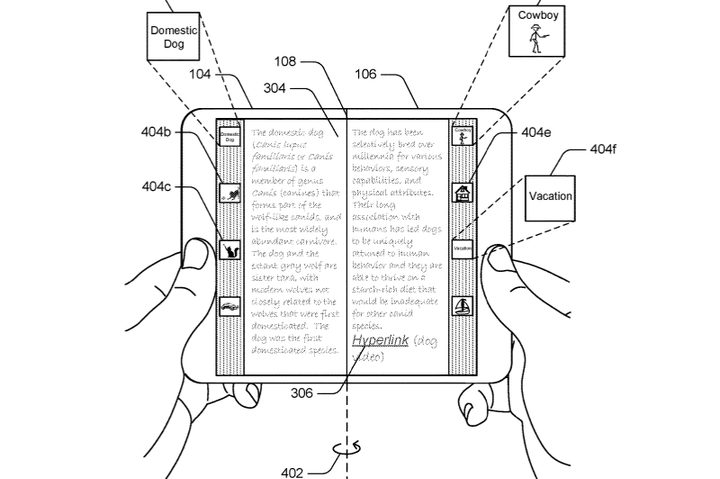
In one diagram, Microsoft illustrates the two-screen device in a held open-book position. The pulled sections are drawn as icons in strips along the outer edges of the screens. For instance, the left screen renders four thumbnails on the left side pertaining to the content, such as a domestic dog, a squirrel, a car, and so on. Links will generate icons, too.
“The abstracted views are generated based on the subject matter of the particular section of content that they represent,” the patent states. “The abstracted views can provide the user with a sense of relative location within a document or within the content. Rather than simply relying on a page number, the abstracted views can give the user a sense of which subject matter is proximate to the right and left of currently displayed content.”
That said, you tap on a specific abstracted icon, the device will automatically navigate to the source within the content. This method serves as a makeshift table of contents even though the content doesn’t actually provide a built-in table of contents. This method doesn’t organize the content into specific sections either.
As for using the hinge, Microsoft is attempting to emulate flipping through physical pages. With a hardback or paperback, you bend the spine and quickly flip through pages using your thumb. In the case of this device, you would touch a location on the right screen and slightly turn the hinge to initiate the virtual flipping forward through the content. Touch the left screen and move the hinge to flip backward.
“Rotational movement (bending) of the hinge is detected by the sensors and used as at least a portion of the input signal to initiate or control the rifling operation,” the patent adds. “In response, the notes are semantically abstracted to present abstracted views of the notes to the user in a rifling state and enable the user to quickly understand the subject matter of a particular section of the notes.”
This patent is just one of many that describe a two-screen pocket-sized device code-named Andromeda. The device is expected to arrive in late 2019 possibly packing Intel’s upcoming 10nm “Cannon Lake” processor. The device was presumed dead in the water based on previous reports, but Microsoft merely went back to the drawing board to overhaul the project.


