
Fitbit sits at the top of the fitness wearables market which means there are a lot of people wearing the company’s devices and syncing their health data to the company’s servers. The fitness leader recently combed through 149 billion hours of heart rate data from more than 10 million Fitbit users to see if it could discover some unexpected trends about this vital health parameter. The results bucked conventional medical wisdom — and re-confirmed the importance of exercise to a person’s heart health.
What’s Your Resting Heart Rate?

Fitbit focused its data analysis on resting heart rate (RHR), a measurement of how efficient your heart is at pumping blood that your body needs while sedentary. The average person has a resting heart rate between 60 and 100; athletes or very physically active people can have an RHR as low as 40, because of the beneficial effect exercise has on the heart.
You can check your resting heart rate easily at home. The best time to measure your RHR is in the morning before getting out of bed. Use your index and middle finger to find your pulse on your wrist below your thumb. Count the number of times your heart beats in 30 seconds while you continue to rest and relax. Multiple that number by 2 to get your resting heart rate. If you wear a Fitbit or similar fitness tracker, this metric is measured and calculated automatically for you every day.
Resting Heart Rate and Cardiac Health

Research has shown that the resting heart rate can be used to gauge the overall health of a person’s heart and predict their chance of cardiac-related health issues. A lower RHR has been associated with a lower risk of cardiac events, while a higher RHR increases the risk of cardiovascular disease and even early death. And this mortality risk can be substantial. A 16-year-long study of 2,800 healthy, middle-aged men published in Heart found that an elevated RHR (81-90BPM) can double a person’s risk of death, while a high RHR over 90 nearly triples that risk.
Age and Resting Heart Rate
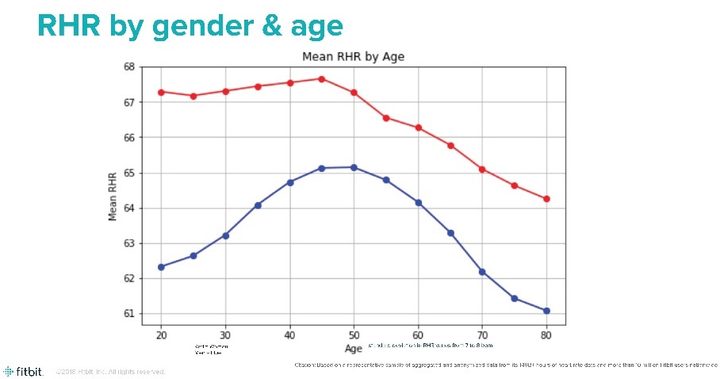
As a person ages, their resting heart rate should not change significantly, but this relatively steady state was not shown in the data collected by Fitbit. Instead of staying constant, Fitbit’s data indicates that RHR increases with age, reaching its maximum between ages 45 and 50. It then surprisingly starts to decline. This unexpected midlife climb could be the result of stress from kids, difficulties at work, unhealthy eating and an increasingly sedentary lifestyle suggests Fitbit. As health and fitness reach a low point, people begin taking blood-pressure and heart-related medications to manage their cardiac health, Fitbit hypothesized. These medicines may produce an observable drop in RHR as a bonus side effect.
BMI and Resting Heart Rate
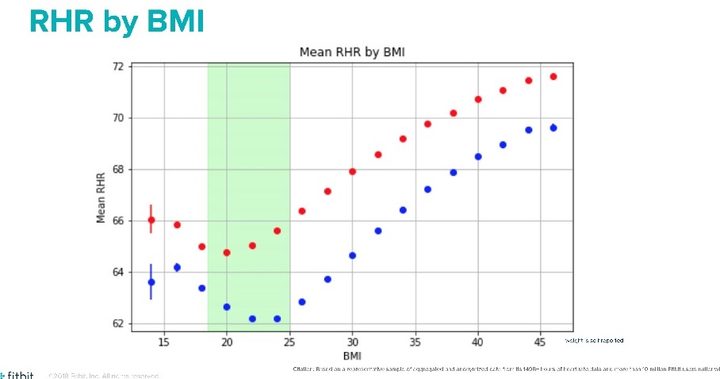
BMI, or body mass index, is an estimation of body fat based on a person’s height and weight. The data presented by Fitbit shows that BMI has an effect on a person’s heart rate with RHR increasing as BMI increases. This result isn’t too surprising. Folks with a high BMI tend to be bigger and heavier, so their heart has to work harder to pump blood to that extra body mass. Folks with a healthy BMI, between 19 and 25, have the lowest resting heart rates because their heart doesn’t have to work as hard. Interestingly enough, this linear relationship falls apart when a person’s BMI dips too low according to Fitbit. At a below-normal BMI, Fitbit suggests the body may be forced to work extra hard to support the person’s basic functions and may have to raise the heart rate in response.
Physical Activity and Resting Heart Rate
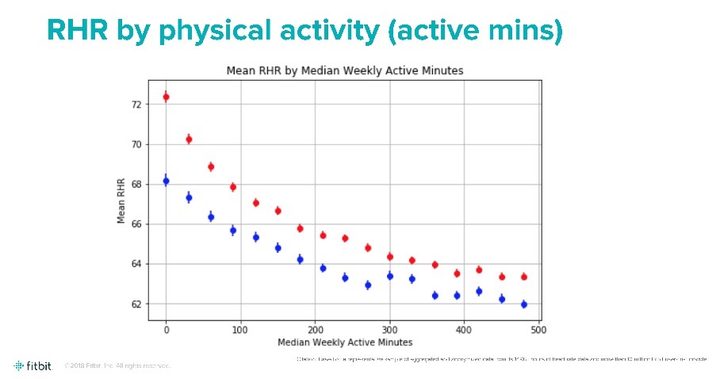
It’s not surprising that physical activity has a profound effect on RHR. Scientists have known for years that the best way to lower RHR is to increase a person’s fitness level with exercise. According to Fitbit, this advice is accurate until a person reaches about 250 minutes of exercise each week. At this 250-minute mark, the improvement to RHR begins to taper off. The take-home message? Exercise enough to help your heart, but don’t go crazy and overdo it.
Sleep and Resting Heart Rate
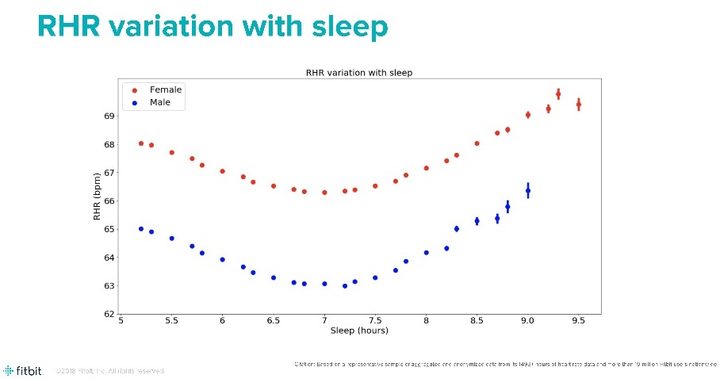
Many people overlook the importance of sleep, burning both ends of the candle when it comes to getting some shut-eye. Not only does sleep deprivation affect a person’s ability to think clearly and quickly, but it also affects their RHR. According to the analysis by Fitbit, the optimal sleep time for a healthy RHR is 7.25 hours. Any more or any less shut-eye and a person’s RHR will increase.
Geography and Resting Heart Rate
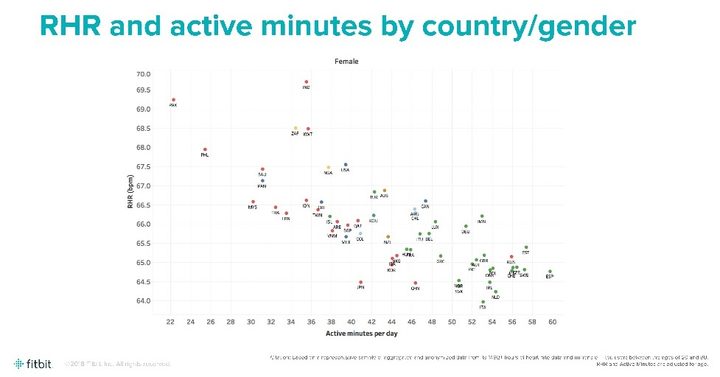
Not all changes in RHR can be attributed to physical activity, Fitbit dug deep into its data to see if any other factors, like genetics or geography, have an effect on RHR. The analysis found that where a person lives can have an impact on their heart rate. Fibit grouped women according to their physical activity and discovered that Indian women have a higher RHR, while Japanese and Italian women have a lower RHR even though all the women exercise the same amount.

Not surprisingly, the countries with the highest physical activity also have the lowest RHR except Qatar. Qatar for some unexplained reason has a reasonably low RHR of 62 BPM even though 70 percent of the population has a high BMI because they are overweight or obese, notes Fitbit.
An overview
Resting heart rate is a highly studied health parameter that has been tied to cardiovascular health which is why this heart rate analysis by Fitbit is so interesting. Fitbit’s dataset developed as a result of the recent boom in fitness trackers and is a relatively untapped source of health and lifestyle information. If we can discover some of the factors that influence RHR, then maybe we can help people improve their heart health and lower their risk of heart-related illnesses.
According to the Fitbit study, people may be able to lower their RHR with some simple lifestyle changes. They should consider exercising the recommended 150 minutes per week, manage their sleep so they average 7.25 hours each night and maintain a healthy BMI to keep their RHR as low as possible. Some people, though, tend to have high RHR because of their genetics or geography so they may need different interventions to keep their heart in tip-top shape.


