Most information today travels through underground cables and from satellites beaming radio signals. In the coming decade, satellite information may instead be sent via lasers, which, among other advantages, are more secure and can carry more data. But lasers have a big weak spot those other technologies don’t have — lasers can’t pass through clouds.
Now, researchers at the University of Geneva in Switzerland have proposed a new technique for clearing cloud layers to aid in communication via laser technology. That solution? Add more lasers.
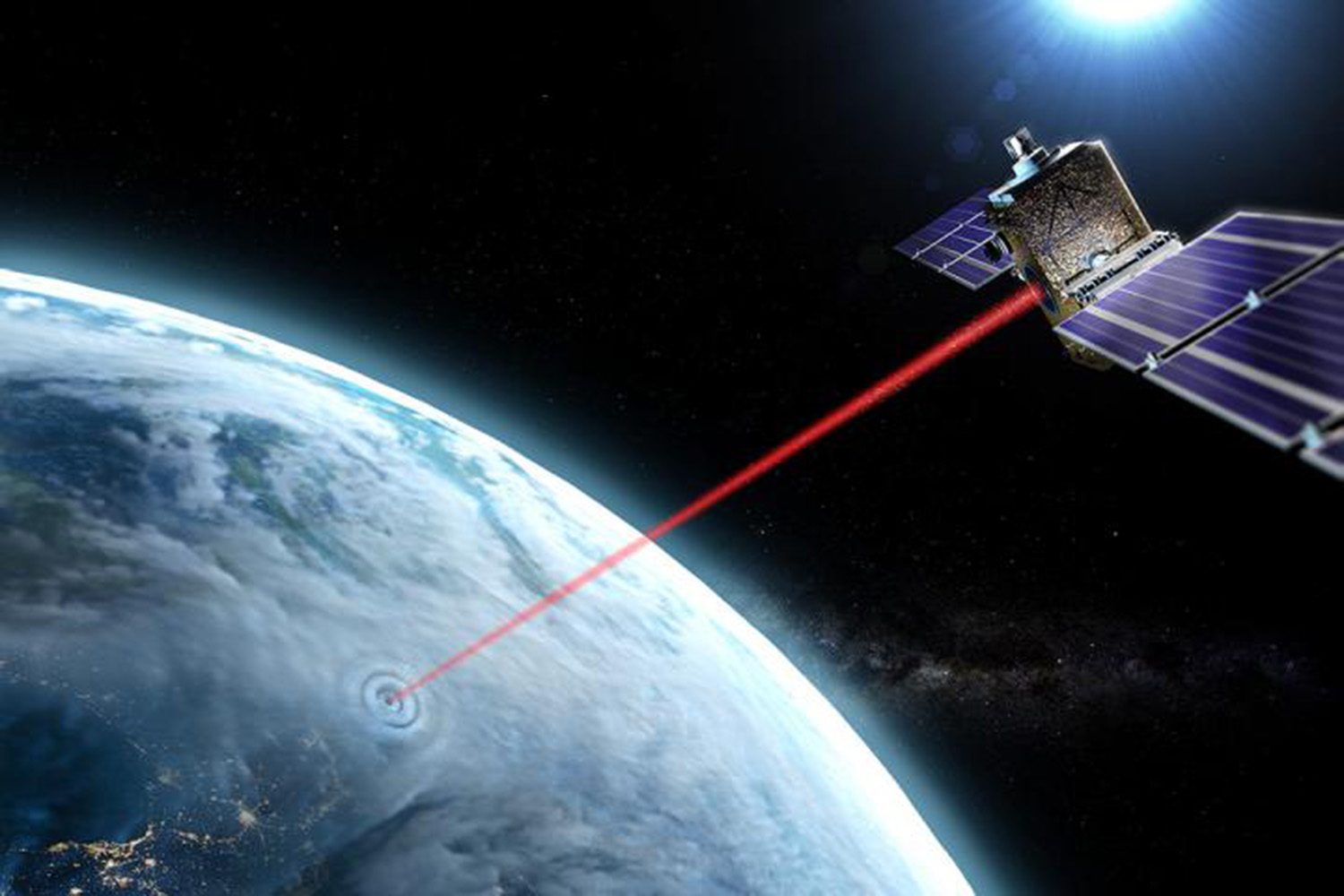
Using ultra-hot and ultra-short laser beams, the researchers say they can temporarily bore a hole through clouds so that the information-carrying lasers can pass through uninterrupted.
With all the information sent around the planet, radio frequency bands are crowded and long wavelengths limit the amount of information that can be carried. It can’t keep up with our modern-day demands, so researchers have begun experimenting with other technologies to fulfill our needs.
Lasers may offer one solution. Their short wavelengths can transmit thousands of times more information than radio frequency, according to the researchers, and offer more security. However, “as soon as there are clouds or fog, the usual light is scattered in every direction and not transmitted anymore,” Jean-Pierre Wolf, a physicist at the university who worked on the project, told Digital Trends. “There are nowadays no active solution to this problem, and what we propose may provide a solution.”
“We have demonstrated that a certain type of laser — ultra-short lasers, producing pulses as short as 1/10th of one millionth of one millionth of a second — create a shock wave in the air, that blows out the water droplets on its way,” Jérôme Kasparian, a physicist at the university who worked on the project, said. “By doing so, it can clear the way through a fog or a cloud, and open a clear channel for optical communication through the cloud.”
The satellite laser configuration proposed by Wolf and Kasparian includes one ultra-short laser that produces a shock wave to clear the clouds and a second to carry the information to Earth. Kasparian pointed out that the lasers they’ve used rely on chirped pulse amplification, a technology that earned Gérard Mourou and Donna Strickland a Nobel Prize in physics this year.
There’s still plenty of work to be done, particularly in distributing the laser energy evenly over long distances, but Wolf said they have close contacts in aerospace interested in licensing the technology. They’re testing the lasers on synthetic clouds in the lab but hope to test on real clouds soon, with potential implementation by 2025.
A paper detailing the study was published this week in the journal Optica.