Whether it’s timing runners in a race, cooking dinner, or trying to get to the airport on time, the standard minutes, seconds, and milliseconds found on most digital clocks are more than enough to keep folks on schedule. But it’s possible for clocks to get a whole lot more accurate — and a clock built by researchers from National Institute of Standards and Technology in Boulder, Colorado, proves it. Their latest atomic clock, the most accurate ever created, can tell the time with an astonishing 18 digits of precision.
“For a few years now, there’s been work on developing a new breed of atomic clock called an optical clock,” Andrew Ludlow, the NIST physicist who led the project, told Digital Trends. “These are different to most atomic clocks that are used, with the main difference being that they operate in the optical domain. The internal ‘ticking’ of these clocks happens at a much, much higher frequency than most atomic clocks. A traditional system might have a ticking rate that’s more like a billion times a second. These new optical clocks, meanwhile, oscillate at a rate of a quadrillion times per second. This divides time up into finer intervals, giving us enhanced measurement for the resolution of [timekeeping].”
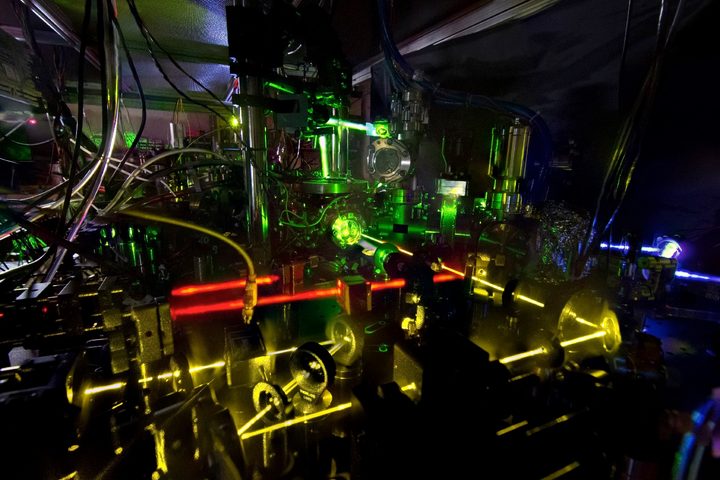
The optical lattice clock developed by Ludlow and his colleagues measures the oscillations of a ytterbium atom. Its atomic pendulum swings at a speed of 500 trillion times per second.
Given that we’d measure the timekeeping of a regular clock by testing it against one we know to be accurate, Ludlow said that testing a whole new benchmark of accuracy proves difficult. To check consistency, the team built two separate models of the atomic clock and then tested them both in separate locations, where gravity would normally cause slight alterations in their timekeeping.
“Any measurement that we make is, in fact, limited by the performance of the existing benchmark,” he said. “Really, the only thing you can do is to build two distinct systems and try and show relative comparisons between them to show that they are consistent with one another.”
The results showed that the clock is so stable in its timekeeping that it won’t gain or lose more than a single second in 14 billion years. As Ludlow said, noticing the difference compared with existing atomic clocks is “beyond the scope of human perception.” However, there are applications in which this will prove useful. In the lab, it could be used for detecting the mysterious substance known as dark matter. A more earthbound application will involve improving navigation systems to allow them to more accurately triangulate objects’ location.
A paper describing the project was recently published in Nature.