1. Home
  2. Space
  3. Emerging Tech
  4. News

China to launch the first mission to the far side of the moon

Add as a preferred source on Google

China plans to launch a spacecraft to the far side of the moon this month. The Chang’e-4 spacecraft is scheduled to take off from Xichang Satellite Launch Center in Sichuan on December 8 carrying a lander and rover, which will touch down on the lunar surface. No spacecraft has ever touched down on the surface of the moon’s far side.

The mission is to explore and study the crater-marked far side of the moon, conducting the first radio astronomy experiments from that region, reports Scientific American.

Recommended Videos

Chang’e-4 is the China National Space Administration’s (CNSA) latest move in its lunar aspirations. In 2013, Chang’e-3 performed a “soft” landing on the surface. In the years that followed, CNAS announced its plan to build a moon base, launching a satellite to relay communications from the lander on the lunar surface to Earth, circumventing the moon’s mass.

If the touchdown is successful for the Chang’e-4 rover, it will be tasked with mapping the area around its landing site. Equipped with a ground-penetrating radar, the rover will measure the subsurface layers. A near and infrared spectrometer will allow it to measure the mineral makeup of the lunar soil. These measurements may help geologists better understand the geological dynamics of the moon’s evolution.

The CNSA has not made Chang’e-4’s landing site public, though Zongcheng Ling, a planetary scientist at Shandong University and member of the mission team, told Scientific American that the most probable location is Von Kármán, a more than 115-mile wide crater.

Part of Chang’e-4 mission is in preparation for future crewed missions and the CNAS’s desired moon base. Among its experiments will be one to study whether certain seeds sprout and photosynthesize in a controlled environment on the moon’s low-gravity surface.

“When we take the step towards long-term human habitation on the Moon or Mars, we will need greenhouse facilities to support us, and will need to live in something like a biosphere,” Anna-Lisa Paul, a horticultural scientist at the University of Florida, told Scientific American.

This specific experiment will aim to verify studies conducted no the International Space Station, which determined that potato and thale-cress grow normally in controlled low-gravity environments but not in environments with gravity as low as the moon’s.

The CNAS has another mission, Chang’e-5, slated to launch in 2019. Chang’e-5’s mission will be to bring back samples collected by the rover.

Dyllan Furness
Former Contributor
Dyllan Furness is a freelance writer from Florida. He covers strange science and emerging tech for Digital Trends, focusing…
Space is becoming Bezos and Musk’s next data center site, and we have every reason to worry
The AI boom is coming for the night sky
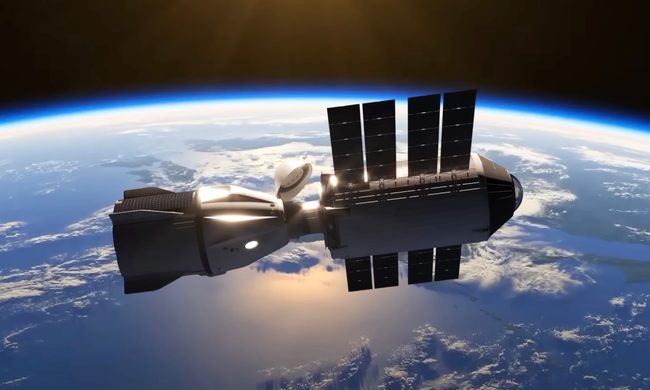
How Vast's space station will look in orbit.

AI data centers already consume vast amounts of electricity and water on Earth, so Silicon Valley has begun looking somewhere considerably more spacious... literally.

Elon Musk's SpaceX and Jeff Bezos' Blue Origin, along with several other companies, have proposed enormous constellations of satellites designed to operate as orbital data centers. However, environmental groups and former space officials are now warning that putting them into orbit at the proposed scale could have severe consequences for Earth's atmosphere and the night sky.

Read more
The first possible exomoon is here, and it makes our Moon look hilariously tiny
Scientists may have found the first exomoon, except this one is the size of Jupiter
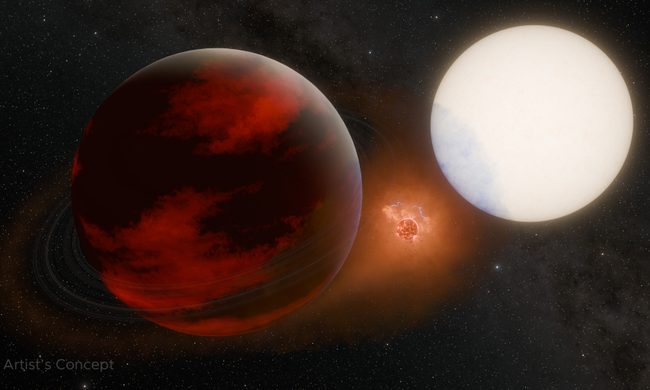
This artist’s concept depicts a potential volcanic moon between the exoplanet WASP-49 b, left, and its parent star. New evidence indicating that a massive sodium cloud observed near WASP-49 b is produced by neither the planet nor the star has prompted researchers to ask if its origin could be an exomoon.

We have already discovered more than 6,000 planets outside of our immediate neighborhood. Yet, finding a moon orbiting one of those distant worlds has proved considerably harder. Astronomers may finally have something close to the real deal, but this particular object stretches the word “moon” almost beyond recognition.

Using the European Southern Observatory’s Very Large Telescope in Chile, researchers detected strong evidence for a moon-like object in the CD-35 2722 system. Further observations are still necessary to confirm the discovery, but it could become the first confidently detected natural satellite outside our solar system. There is still one tiny complication though. This moon is apparently massive.

Read more
China’s answer to SpaceX’s reusable rockets literally catches boosters in a net
SpaceX catches boosters on legs. China just used a net.
Ammunition, Missile, Weapon

SpaceX's playbook for recovering a rocket booster generally involves legs, a precisely controlled vertical landing, and either a concrete pad or a drone ship. 

China just managed to pull off something similar, but in a slightly different way, and on July 10, it tested the method as well.

Read more