  1. Home
  2. Emerging Tech
  3. News

This exotic new material somehow gets thicker when stretched

Add as a preferred source on Google
Devesh Mistry

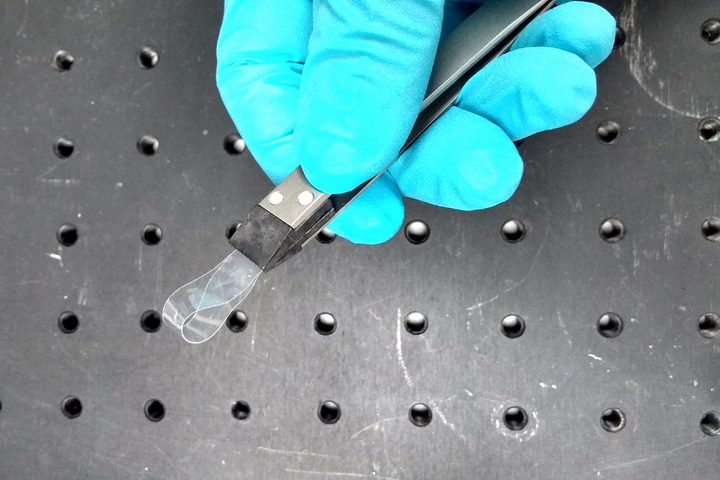
Stretch just about any material and what happens to it? It gets thinner, of course. It turns out that this isn’t a universal rule, however. Scientists at the U.K.’s University of Leeds have discovered a new synthetic material which actually gets thicker the more it’s stretched. Referred to as a liquid crystal elastomer, it’s composed of the same liquid crystal material most commonly seen in flat screen monitors and television displays.

“This behavior of increasing in thickness as a material is stretched is known as ‘auxetic’ behavior,” Dr. Devesh Mistry from Leeds’ School of Physics and Astronomy — though soon to join the University of Colorado, Denver — told Digital Trends. “Until now, manmade auxetics require a material prepared with specific structures allowing the auxetic response. Our material does not require such structures as the behavior is inherent to the material, and is a result of molecular restructuring inside the material.”

Recommended Videos

Mistry said that the synthetic material’s unusual properties aren’t just interesting from a materials science research perspective; they also open up some intriguing real-world possibilities, ranging from medical use cases to futuristic body armor. “This is exciting as auxetics are known to have enhanced mechanical behaviors such as shock absorbance and tear resistance,” he continued. “[Because of this,] these simpler materials have a great number of potential applications from biomedical devices to flexible electronics.”

Some examples of other auxetic materials include cat skin, tendons in the human body, and the protective layer in mussel shells. Researchers have been trying to replicate these qualities synthetically for decades, but until the present day, they’ve only been able to do it using costly, time-consuming processes. Further, while some of the auxetic properties of natural materials are carried across to these previous synthetics, the lab-made materials have proven disappointingly weak and porous in some cases.

As a result, this new research — based around a synthetic molecular version of auxetic materials — is an exciting step forward. Don’t expect it to roll out as a finished product any time soon, though. “One of the next key things to understand is what the molecular processes are that are driving this behavior,” Mistry said. “Once we understand this, we will be able to tune the behavior for specific applications and design new materials for devices.”

A paper describing the work was recently published in the journal Nature Communications.

Luke Dormehl
I'm a UK-based tech writer covering Cool Tech at Digital Trends. I've also written for Fast Company, Wired, the Guardian…
Home robots can already walk. The hard part is stopping them from crushing your glassware
1X’s NEO uses tactile sensing and force control to handle fragile objects, aiming at the kind of household work humanoids still struggle to do.
Baby, Person, Electronics

A robot can look convincing while walking across a stage and still be useless in a kitchen. Picking up a wet glass demands precision, quick corrections, and enough restraint to avoid squeezing too hard. 1X is tackling that problem with new tendon-driven hands for NEO, its humanoid home robot.

1X says each hand has 25 degrees of freedom, with 22 across the fingers and palm and another three in the wrist. Its joints can yield when pushed instead of staying rigid, giving NEO a better chance of handling household objects without treating every collision like a wrestling match.

Read more
This tiny gadget called Moodi could save your thumb during long reading sessions
This tiny remote thinks your finger deserves a vacation
DuRoBo Moodi

Digital reading has become more comfortable thanks to larger displays and e-paper screens, but one small annoyance remains: constantly reaching over to tap or swipe every page. DuRoBo believes it has a solution. The company has unveiled Moodi, its first Bluetooth page-turning remote, designed to make reading, browsing, and media control more comfortable across e-readers, tablets, and smartphones.

Unlike conventional page-turners that focus solely on e-books, Moodi doubles as a compact Bluetooth remote for scrolling through articles, controlling multimedia playback, and navigating long-form content. The device looks towards ergonomic accessories that aim to reduce repetitive hand movements during extended screen time.

Read more
Camera sensor breakthrough promises sharper images without hulking up your phone’s thickness
Camera sensors just got thinner. Your excuses for blurry photos didn't.
Representative Image

Researchers at Nagoya University have developed a new type of transparent optical sensor that could significantly reduce the size of camera sensors while improving image quality. Published in the journal ACS Nano, the study demonstrates how gallium-doped zinc oxide (GZO) nanosheets can detect red, green, and blue (RGB) light within a single pixel, potentially replacing the decades-old Bayer filter design used in nearly every digital camera today.

If commercialized, the technology could enable thinner smartphone cameras, higher-resolution medical imaging devices, and more compact sensors for automotive and aerospace applications, all while simplifying manufacturing.

Read more