When you hear about the potential risk of an electromagnetic pulse (EMP) disabling virtually every electronic device within a country, there’s a good chance you think, “Hey, I remember that James Bond movie plot.”
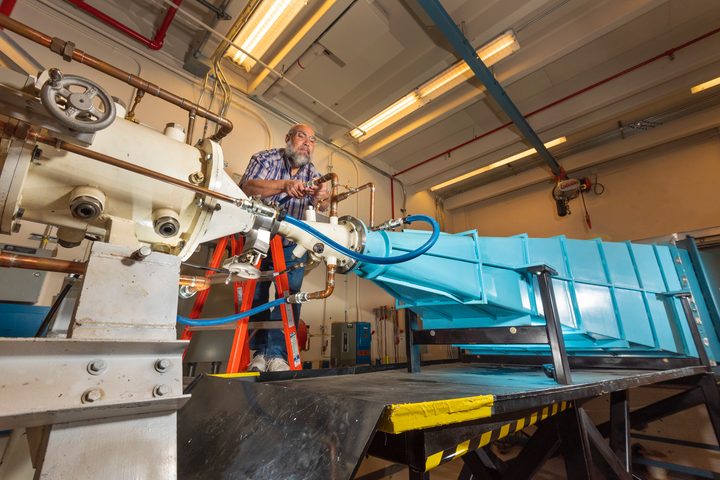
But just because the threat of an EMP emitted by a nuclear weapon exploded in the skies above us isn’t on the radar for most people doesn’t mean it’s not a real risk. With that in mind, researchers at Sandia National Laboratories have installed a new “friendly” EMP emitter called the ElectroMagnetic Environment Simulator.
No, it’s not a movie-style, magical undo button that would reverse the damage caused by an actual EMP blast, but rather a machine capable of simulating a similarly intense effect without having to explode a nuke to do so. Described as a “hippopotamus-sized” Marx generator, the large capacitor bank stores up electrical energy and can then direct it at a target inside of a test chamber.
The reason for doing that? To use the chamber as a testing ground for electronics components to see if they could survive an actual hostile EMP pulse. Since it’s possible for devices to be modified to survive such a blast, this could prove a useful test to put gadgets through. Although military devices use special EMP shields to protect against this possibility, most consumer electronics do not. That could change if manufacturers discover the extent to which, say, the power grid could be knocked out of action in the event of such an attack.
Ultimately, carrying out such modifications on everyday electronics may, paradoxically, decrease the likelihood that they would ever need to use such modifications. As a Sandia National Laboratories spokesperson told Digital Trends, that’s because showing this kind of planning might be enough to encourage “a possible opponent to hesitate releasing such a pulse because its effect would not be significant enough to offset a U.S. response.”
This isn’t the first time that the U.S. has used a pulse-producing machine for training for an EMP attack. Earlier versions of this machine date back as far as 1978. The current test facility was largely unused from 1994 through 2001, when it was brought back following the 9/11 attacks. This machine represents the latest iteration of that tech.