  1. Home
  2. Emerging Tech
  3. News

Robot improves your guitar playing by zapping you with a taser when you screw up

Add as a preferred source on Google
Electrocuting Practice Robot Short

With 2018 coming to a close, it’s only natural that our minds start turning to 2019 and all the things that we hope to achieve in it — whether that’s getting fit, picking up a new language, or learning to play a musical instrument which transforms us into the rock star we always knew we should be.

Recommended Videos

If the last of these three appeals to you the most, you may have a helping hand, courtesy of Ethan David, an Irish physics graduate and electrical engineer with a somewhat warped sense of humor. He has developed a robot that will help you learn to play the guitar better. Unfortunately, it does this by zapping you with a taser whenever the wrong note is played.

“It recognizes what frequency is being played using a microphone and the Fast Fourier Transform in Python,” David told Digital Trends. “That frequency can then be compared to a list of known frequencies for the specific notes in the musical scale. The notes for each song need to be loaded into Python beforehand. Then, as the program runs, it simply listens for the next correct note. If the note is correct, you continue. If the note is incorrect, a signal is sent to the Arduino to trigger the arm and the taser — hence delivering you an electric shock in the hope that it’d teach you to play the correct note next time. [It’s] a bit of good old negative reinforcement.”
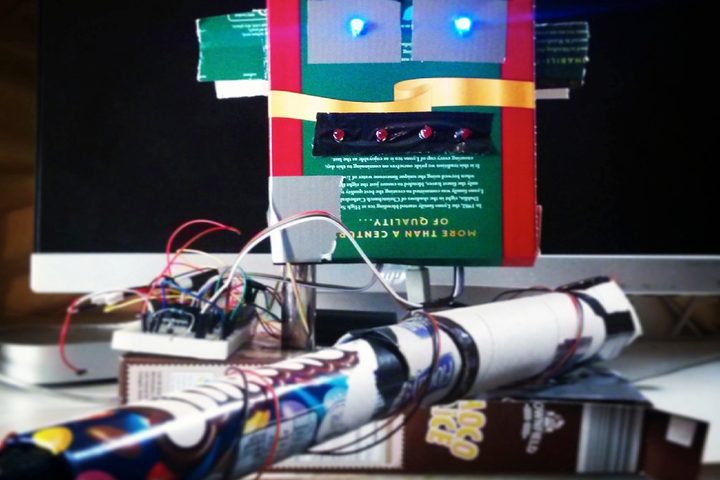
Image used with permission by copyright holder

David acknowledges that the robot isn’t quite perfect, though. No, not because it actively hurts its owner, but rather because it doesn’t totally possess the knowledge of good guitar-playing form necessary to turn you into the next Eddie Van Halen. That’s because it doesn’t have any understanding of rhythm, a crucial part of music. So long as you play the right note, it will keep you shock-free, regardless of whether you pull these off in a timely manner or stretch a 30-second guitar solo out to several hours. He hopes this will change in a future version, however.

“It shouldn’t be too difficult to create a time variable between each note, full beat, half beat, quarter beat, et cetera,” he said. “Then [you could] use a tempo variable that can be set to control the speed at which the song is played at. You could start slowly and get faster every time you get the sequence correct, and go back down if you play a wrong note.”

It’s definitely an innovative project, although we hope David understands if we opt for a slightly friendlier guitar-teaching tool up front. If that fails to teach us, though, we’ll be sure to keep this one in our back pocket!


Luke Dormehl
I'm a UK-based tech writer covering Cool Tech at Digital Trends. I've also written for Fast Company, Wired, the Guardian…
AI agent reportedly carried out an entire ransomware attack on its own
AI didn't just write malware. It apparently clocked in for work.
Cybersecurity

Cybersecurity researchers say they have documented what could be the first ransomware attack carried out almost entirely by an autonomous AI agent, marking a significant shift in how cyberattacks could be conducted in the future. According to cloud security firm Sysdig, they have uncovered a ransomware operation dubbed JadePuffer that appears to have relied on a large language model (LLM) agent to perform nearly every stage of the attack without continuous human intervention.

If confirmed, the incident suggests AI is moving beyond writing malicious code and into actively planning, adapting, and executing cyberattacks in real time.

Read more
The Washington Post predicted how tech will advance 50 years ago and the success rate is humbling
The Washington Post predicted 2026 tech in 1976. It got a lot right.
Representative Image

Fifty years ago, when floppy disks were cutting-edge and the personal computer revolution had barely begun, The Washington Post attempted a remarkably ambitious exercise: predict what life in 2026 would look like. Some of those predictions now read like science fiction. Others feel surprisingly ordinary because they have become part of everyday life.

In a retrospective published for America's 250th anniversary, the newspaper revisited science editor Thomas O'Toole's 1976 article Inventing the Future, comparing its forecasts with today's technological reality. The results reveal that while predicting exact timelines is nearly impossible, identifying long-term scientific trends can be remarkably accurate.

Read more
Australian government warns doctors over AI scribing tools as privacy and safety concerns grow
AI medical scribes face regulatory scrutiny in Australia amid safety concerns
Representative Image

The Australian government is urging healthcare professionals to exercise caution when using AI-powered medical scribing tools, as regulators examine whether stronger safeguards are needed around one of healthcare's fastest-growing technologies, according to a report by The Guardian.

AI scribes have rapidly gained popularity by recording, transcribing, and summarising doctor-patient conversations into clinical notes, reducing the administrative burden on healthcare workers. However, government officials now warn that the technology's rapid adoption has outpaced oversight, raising questions around patient privacy, informed consent, and the accuracy of medical records.

Read more