  1. Home
  2. Emerging Tech
  3. Health & Fitness
  4. News

Battery-free biosensor patch measures your health by drinking your sweat

Add as a preferred source on Google
Image used with permission by copyright holder

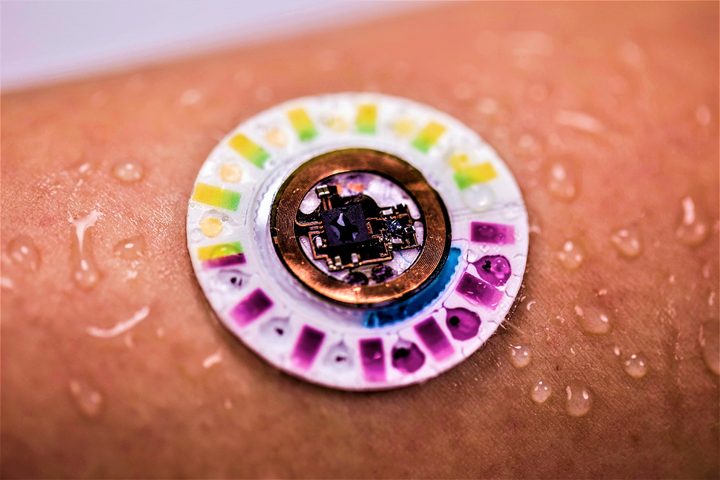
At present, the majority of wearable biomarker sensors require onboard batteries to power them. While that’s perfectly acceptable for some use cases, it’s not as well-suited for tasks such as continuous tracking for medical purposes. To solve this problem, researchers from Northwestern University have developed a battery-free soft skin patch that’s able to gather data about the body wirelessly by testing sweat components. In time, the team hopes that this technology will be useful for clinical applications such as cystic fibrosis diagnosis and rehabilitation tracking among stroke survivors.

“We’ve developed a thin, soft microfluidic analysis lab that can laminate to the surface of the skin, where it captures minute quantities of sweat and analyzes key biomarkers related to physiological health, electrolyte balance, and hydration state,” Professor John Rogers, a physical chemist and materials scientist at Northwestern, told Digital Trends. “It brings fluids and chemical analysis into the realm of a skin-interfaced wearable that can operate in real-time in the field. Specifically, it provides the reader with visual information on sweat loss and sweat rate, along with the pH and electrolyte levels, and wireless digital data on glucose and lactate levels — all based on sweat.”

Recommended Videos

The patch gathers sweat through small pore-like holes, which channel it into tiny collection chambers. Each chamber measures something different. Power is provided via radio waves emitted from connected devices, such as smartphones. This communication also allows the patch to feed back data, which is then read using near-field communication technology.

Unlike many of the projects we cover under the heading of “Emerging Technology,” Northwestern’s research has already led to one product. Having formed a startup called Epicore to commercialize the tech, Northwestern has licensed it to L’Oreal for a skin pH tracker shown off at the recent CES 2019 event. Rogers says that another sport-oriented application will be announced in the coming weeks. This could relate to allowing athletes to see how their bodies are holding up over the course of a competition.

Long-term, however, he believes it will have profound medical applications. “On a slightly longer timescale, we’re developing these platforms as diagnostics for cystic fibrosis and for kidney disease,” he noted.

A paper describing the research was recently published in the journal Science Advances.

Luke Dormehl
I'm a UK-based tech writer covering Cool Tech at Digital Trends. I've also written for Fast Company, Wired, the Guardian…
Google’s new AI gives robots better balance, smarter hands, and teamwork capabilities
Google just made robots a lot less clumsy and a lot more helpful.
Gemini robotics 2.0

Google DeepMind just brought sci-fi robots closer to reality, and it is very exciting. Building on its original Gemini Robotics model, the company has introduced Gemini Robotics 2, an AI system designed to help robots think, move, and even work together. Unlike most robots today, which rely on pre-programmed routines or someone controlling them remotely, this new system lets robots figure things out on their own when situations get unpredictable.

Can robots finally handle whole-body tasks?

Read more
Remember Samsung’s Ballie home robot? It may finally be inching closer to reality
Leaked app wireframes give the strongest hint yet that Samsung's Ballie home robot, first shown at CES 2020, might still be headed toward an actual release.
Samsung Ballie robot in a room next to a dog feeder.

Samsung's rolling home robot has been the industry's longest-running "will it ever actually ship" joke, and I'll admit I'd mostly given up on it. Now, there's finally a glimmer of hope.

Samsung first unveiled Ballie as a concept at CES 2020. Then, it showed it as a significantly upgraded version four years later. However, the company never confirmed a release date or committed to releasing it at all. 

Read more
Polar is yet another AI browser, but it goes beyond just automating the mundane web chores
Polar wants to turn your browser into an AI-powered productivity tool
Polar AI browser

The AI browser race is entering a new phase. After spending much of 2025 trying to reinvent web search with built-in chatbots, startups are increasingly shifting their attention toward browser agents that can automate repetitive work instead of simply answering questions. The latest company to embrace that transition is Polar, a startup founded by former Perplexity engineer Kevin Zhang, which has raised $5.7 million in seed funding led by Madrona.

Unlike the first generation of AI browsers that targeted everyday consumers, Polar is designed specifically for knowledge workers. Its premise is straightforward: instead of replacing Google Search, the browser aims to eliminate repetitive tasks that professionals perform across dozens of browser tabs every day.

Read more