  1. Home
  2. Emerging Tech
  3. News

New Horizons captures highest-resolution image yet of Ultima Thule

Add as a preferred source on Google

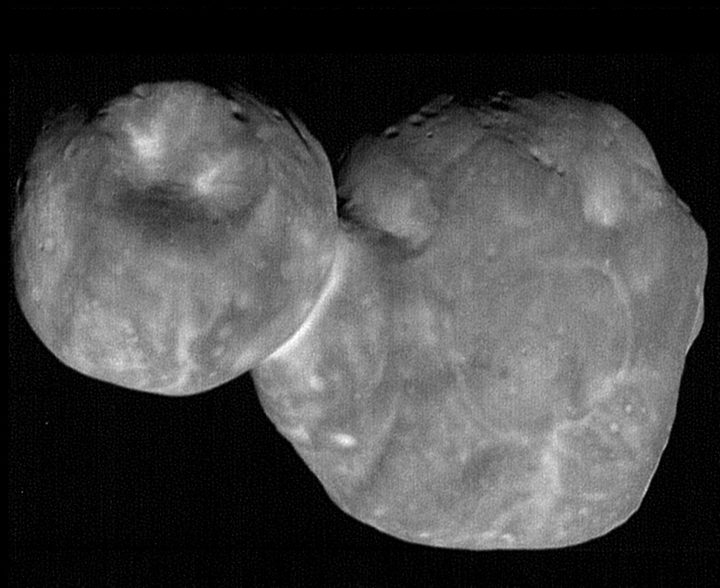
The most detailed images of Ultima Thule yet, obtained just minutes before the spacecraft’s closest approach at 12:33 a.m. EST on January 1. The images have a resolution of about 110 feet (33 meters) per pixel. This processed, composite picture combines nine individual images taken with the Long Range Reconnaissance Imager (LORRI), each with an exposure time of 0.025 seconds. NASA/Johns Hopkins Applied Physics Laboratory/Southwest Research Institute, National Optical Astronomy Observatory

NASA researchers have managed to capture the highest resolution image yet of Ultima Thule, the oldest object ever explored by spacecraft. The New Horizons probe visited the object on New Year’s Day and gathered information on its size and shape.

Recommended Videos

The new image was taken at 12:26 a.m. EST on January 1, 2019, when the spacecraft was just 4,109 miles (6,628 kilometers) from Ultima Thule and was a staggering 4.1 billion miles (6.6 billion kilometers) from Earth. It was particularly difficult to capture this image because the camera only has a narrow field of view and it had to be lined up and timed precisely with the object.

New Horizons Principal Investigator Alan Stern, of the Southwest Research Institute, was delighted that the team managed to capture the image. “Bullseye!” he said in a statement. “Getting these images required us to know precisely where both tiny Ultima and New Horizons were — moment by moment — as they passed one another at over 32,000 miles per hour in the dim light of the Kuiper Belt, a billion miles beyond Pluto. This was a much tougher observation than anything we had attempted in our 2015 Pluto flyby.”

The high resolution of the images has allowed scientists to get an even closer look at the object, including features that weren’t visible before like bright patches of terrain which are strangely circular and dark pits of craters that could have been caused by impacts from other bodies or collapse within Ultima Thule. The team is now working on understanding what the cause of these features could be.

These images are the highest resolution ever gathered by New Horizons as it journeys through the Kuiper Belt. The craft is now an impressive 4.13 billion miles (6.64 billion kilometers) from Earth and its operations continue to work perfectly even at this tremendous distance. To track the craft as it travels out towards new and unknown Kuiper Belt objects, you can follow along on the Where Is New Horizons website.

Georgina Torbet
Georgina has been the space writer at Digital Trends space writer for six years, covering human space exploration, planetary…
Starlink V5 is here, and it’s lighter, smarter, and far more efficient
The next-generation satellite internet kit promises improved efficiency while maintaining high-speed connectivity.
Starlink V4 vs V5

Not every hardware upgrade needs to be about speed. With Starlink V5, SpaceX is betting that a lighter design and lower power consumption matter just as much. The company has officially introduced its next-generation Starlink V5 kit, featuring a smaller and lighter design with significantly improved power efficiency.

Smaller, lighter, and far more efficient

Read more
Frontier joins the Starlink club with high-speed in-flight internet
The carrier plans to roll out SpaceX's satellite-powered Wi-Fi across its fleet starting in 2027.
Frontier Starlink partnership featured

If there's one thing budget airlines aren't exactly known for, it's great onboard Wi-Fi. In Frontier Airlines' case, it hasn't offered in-flight internet at all. That's about to change. Frontier Airlines has announced a partnership with SpaceX's Starlink to bring high-speed, low-latency internet across its fleet. Installations will begin in early 2027, making Frontier the first ultra-low-cost carrier in the United States to adopt Starlink's satellite-powered connectivity.

Streaming, browsing, and even gaming at 35,000 feet

Read more
OpenAI’s first hardware product sounds more like a companion than a speaker
The AI company is reportedly building a mobile home device that understands context and proactively helps users.
OpenAI press image

For months, rumors have suggested that OpenAI's first hardware product could be a wearable AI device, or perhaps even the beginning of its long-term smartphone ambitions. As it turns out, the company's first gadget may be something far simpler, yet arguably far more ambitious. It will help control smart-home appliances, play media, answer questions, respond to messages, and tap into the range of capabilities offered by OpenAI's ChatGPT, according to people familiar with the matter.

OpenAI's first AI device could end up being a speaker, following plenty of hype that the company is actually working on a wearable AI device and might even launch a smartphone down the road. According to a Bloomberg report, the speaker will serve as a human-like AI companion that will integrate directly with the smart home ecosystem.

Read more