  1. Home
  2. Emerging Tech
  3. News

Boaty McBoatface’s new Antarctic mission will be its toughest yet

Add as a preferred source on Google
Matt Cardy/Stringer/Getty Images

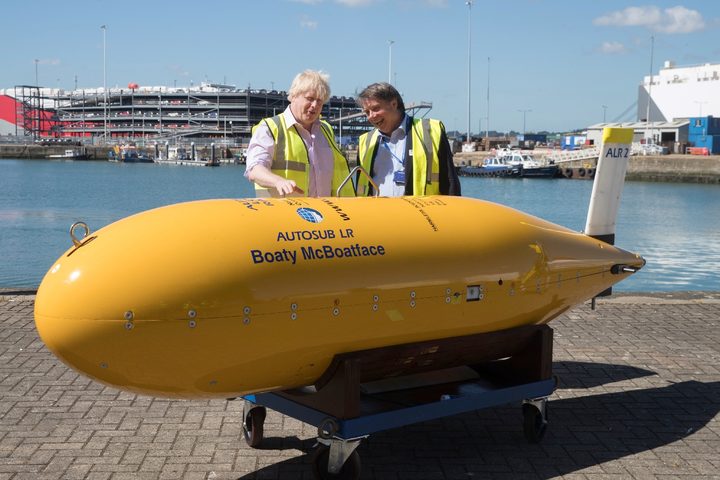
Boaty McBoatface’s Third Voyage sounds more like the closing entry in a Pixar movie trilogy than it does an impressive oceangoing feat set to take place later this year. In fact, it refers to the upcoming third mission for Autosub Long Range, the vessel nicknamed “Boaty McBoatface” as the consolation prize in a British public vote.

The challenging mission will see Boaty explore the ocean cavity beneath Thwaites Glacier in the Amundsen Sea sector of western Antarctica. Set to take place this fall, the mission will examine the effects of warming ocean waters on the glacier. This melting could trigger an unstable retreat of the West Antarctic ice sheet, which may result in sea levels rising by more than two meters. Data gathered by the good ship McBoatface will be used to produce more robust forecasts of future sea level rise.

Recommended Videos

“As with the previous mission where Autosub Long Range was sent beneath an Antarctic ice shelf, the major challenge is that presented by the presence of the ice shelf itself,” Peter Davis, a physical oceanographer with the British Antarctic Survey, told Digital Trends. “Once Autosub Long Range has entered the ice shelf cavity, there is no ability for it to communicate with the ship, nor is it able to surface to find its location via GPS. Therefore it must accurately navigate for the duration of its mission, ensuring it will exit the cavity and be recovered to the supporting research vessel. Whilst in the cavity it must also think for itself, avoiding any obstacles presented by the seabed and the ice base.”

Adding to Boaty’s headaches is the freezing ocean temperatures, which will severely impact the autonomous vessels’ battery life. As a result, the mission must be precisely planned to ensure that the vehicle retains enough power to complete its scientific objectives, while also being able to navigate and propel itself.

“By sending Autosub Long Range beneath Thwaites Glacier, we are sampling a critical area of the ocean that cannot be reached using traditional observation methods from ocean-based research ships,” Davis continued. “The information it gathers will give a unique picture of the ocean conditions within the ice shelf cavity. Autosub Long Range will measure the temperature and the salinity of the ocean beneath Thwaites Glacier, as well as the current speeds and the amount [of] turbulence in the water. These observations will help us better understand how Thwaites Glacier is responding to the changing climate, as well as what processes are setting the rate at which it is melting from beneath.”


Luke Dormehl
I'm a UK-based tech writer covering Cool Tech at Digital Trends. I've also written for Fast Company, Wired, the Guardian…
Researchers hid a prompt injection inside a PNG, and AI fell for it
Hacker

AI coding assistants like Claude are becoming every developer's favorite coworker. They can review code, explain confusing functions, and even write entire features with a single prompt. But new research suggests that this growing trust could also become their biggest weakness.

A team of security researchers (professor Sudipta Chattopadhyay and researcher Murali Ediga) has demonstrated an unusual attack that doesn't target the AI model directly. Instead, it targets what the AI doesn't pay enough attention to during code reviews. Rather than hiding malicious instructions in lines of code, the researchers tucked them inside an image file. Since many AI review tools treat images as decorative assets rather than as something worth inspecting, the pull request can appear perfectly harmless and sail through the review.

Read more
AI has already fallen into the wrong hands and they’re using it to make bombs
Logo, Text

Artificial intelligence has quickly become the go-to tool for everything from writing emails and summarizing meetings to helping students study or developers debug code. But the same technology that saves people time can also be misused, and a new report suggests that terrorist organizations are finding ways to do exactly that.

According to a research paper shared with The New York Times ahead of its publication, researchers found evidence that members of Boko Haram have been using popular AI chatbots to support both day-to-day activities and combat-related tasks. Interviews with 27 former members conducted in Nigeria over the past two years suggest that tools such as ChatGPT, Gemini, Claude, Grok, Meta AI, and DeepSeek were used to gather technical information, troubleshoot weapons, and even assist with planning attacks.

Read more
Claude Code can now browse the web without opening Chrome
The desktop app now includes an in-app browser that can read websites, click links, and interact with web apps.
Claude Code Featured

Developers spend a surprising amount of time bouncing between their code editor, browser tabs, API documentation, GitHub issues, and design files. Anthropic thinks Claude Code should simply do all of that without constantly asking users to switch windows. The company has announced a new in-app browser for Claude Code on desktop, allowing its AI coding assistant to open websites, read documentation, inspect designs, and interact with web pages directly from within the application.

A browser built into Claude Code

Read more