  1. Home
  2. Emerging Tech
  3. News

Body surrogate robot helps people with motor impairments care for themselves

Add as a preferred source on Google

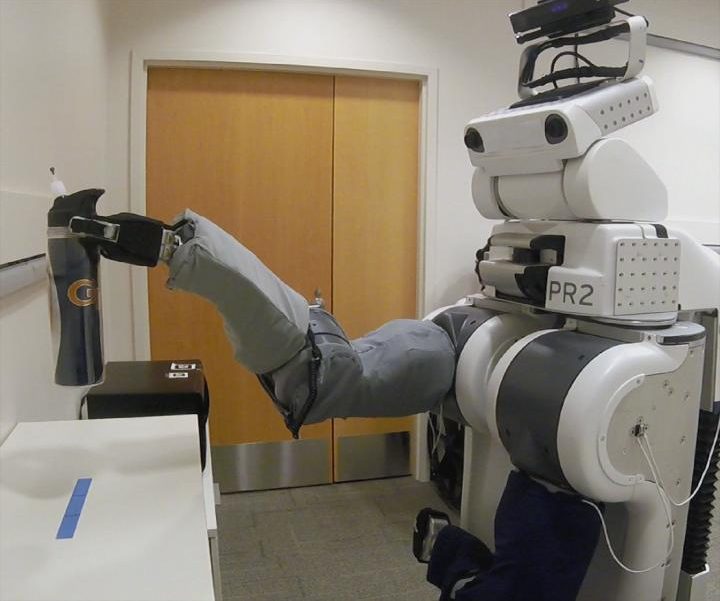
Showing its capabilities as a body surrogate, a PR2 controlled remotely by an individual with profound motor deficits picks up a cup in a research laboratory at the Georgia Institute of Technology. Phillip Grice, Georgia Tech

Robots might be coming for your job, but they can do tremendous good in the world as well. Assistive technologies can benefit people with disabilities by giving them greater independence and control over their lives, like the assistant robot developed by a team at Georgia Tech to help people who have severe motor impairments.

Recommended Videos

“Our goal is to give people with limited use of their own bodies access to robotic bodies so they can interact with the world in new ways,” Professor Charlie Kemp from the Wallace H. Coulter Department of Biomedical Engineering at Georgia Tech said in a statement.

The system they came up with is based on a robot called a PR2 mobile manipulator manufactured by Willow Garage. It is a wheeled robot with two arms and a head, and it can manipulate objects like water bottles, washcloths, hairbrushes, or an electric shaver. Crucially, the robot can be controlled using assistance technologies that users are already familiar with, such as eye tracking or head tracking. The interface shows a “robot’s eye view” from cameras inside the robot’s head, making it easier for the user to control.
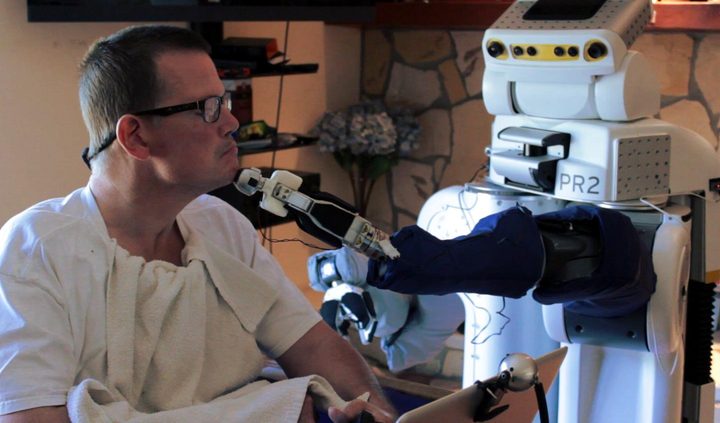
Robotic body surrogates can help people with profound motor deficits interact with the world. Here, Henry Evans, a California man who helped Georgia Tech researchers with improvements to a web-based interface, uses the robot to shave himself. Henry Clever/Phillip Grice

Potential users of the robot surrogates include people like Henry Evans, who worked with the team during their testing and who has very limited control of his body following a stroke. Evans used the robot to care for himself for a week and emphasized the value of having a system that he could operate completely independently, using small head movements to give it commands.

“The system was very liberating to me, in that it enabled me to independently manipulate my environment for the first time since my stroke,” Evans said. But he also pointed out that although the robot could already bring benefits to users as it exists today, it would need to be reduced in size and in cost before it could be made commercially available.

Phillip Grice, a recent Georgia Institute of Technology Ph.D. graduate and first author of the paper, was also pleased with the results: “Our results suggest that people with profound motor deficits can improve their quality of life using robotic body surrogates. We have taken the first step toward making it possible for someone to purchase an appropriate type of robot, have it in their home and derive real benefit from it.”

The results are published in the journal PLOS One.

Georgina Torbet
Georgina has been the space writer at Digital Trends space writer for six years, covering human space exploration, planetary…
Yet another study says AI is bad for elections, and the rabbit hole gets worse
AI may be an election bomb waiting for someone to light the fuse
Voters cast their ballots on Election Day

Another election, another study has concluded that asking an AI chatbot for political guidance is a spectacularly bad idea. Research conducted during Hungary’s 2026 parliamentary election found that ChatGPT and Google Gemini offered not just inaccurate but also inconsistent and unreliable voting advice. The chatbots misclassified voter profiles, overlooked relevant parties, recommended parties absent from the ballot, and sometimes produced materially different answers when given the same information repeatedly.

AI keeps failing the voter test

Read more
Samsung’s humanoid robot ambitions are real, but factories come first
Samsung’s new robotics division has humanoids in its sights, although its immediate business is far more practical factory automation
Robot Touch Human Finger

Samsung wants a place in the humanoid race, but its new robotics push begins with machines built for factories rather than homes.

The CEO-led RX robotics division will initially focus on manufacturing robots. Samsung has separately identified humanoids as a priority, although it hasn’t announced a commercial model or explained where one fits into the division’s immediate plans.

Read more
The future of AI may depend on this one behind-the-scenes change
Running Claude on Android.

Whenever a new AI model arrives, it's easy to get caught up in the bells and whistles. We talk about how much smarter it is, how quickly it answers questions, or how realistic its images have become. But here's the thing: none of that matters much if the AI can't reliably work with the apps and services people use every day.

That's why an upcoming update to the Model Context Protocol (MCP) caught my attention. It isn't a new chatbot or a fancy AI model. In fact, most people will never even know it's happening. But it could quietly make the AI ecosystem a lot healthier. If you've never heard of MCP before, don't worry. Think of it as a shared language that lets AI assistants safely talk to apps like Gmail, Slack, calendars, databases, and countless other services. Instead of every company inventing its own way to make those connections, MCP gives everyone a common rulebook.

Read more