Antimatter is a strange beast. Physicists believe that for every particle that exists in our universe, there is an antiparticle which is identical but has the opposite charge. But when antimatter meets matter, both particles are annihilated in a flash of energy. This leads to a tricky conundrum: if matter and antimatter were both produced in equal amounts by the Big Bang, why is there so much matter around us today, and so little antimatter?
Antimatter does occur naturally in radioactive processes, such as when Potassium-40 decays. In a delightful factoid, CERN researcher Marco Gersabeck writes this means that “your average banana (which contains Potassium) emits a positron every 75 minutes.” But overall, we have observed much, much more matter in the universe than antimatter.
A new experiment from CERN may hold the answer to this decades-long puzzle. Experiments have shown that particles like mesons, which consist of one quark and one anti-quark, can spontaneously turn into anti-mesons, and visa versa — but this process happens more in one direction than the other. Anti-quarks are more likely to turn into quarks than quarks are to turn into anti-quarks, which physicists refer to as a CP violation. Over time, this means more matter accrues in the universe.
These asymmetries, as they are known, have been observed in several types of quarks. In total, there are six types or “flavors” of quark (up, down, top, bottom, strange, and charm) and asymmetries have previously been observed in strange and bottom quarks, both of which are negatively charged. Theoretical work says the only type of positively charged quarks that should show asymmetry are charm quarks — although the effect would be very small and therefore hard to observe.
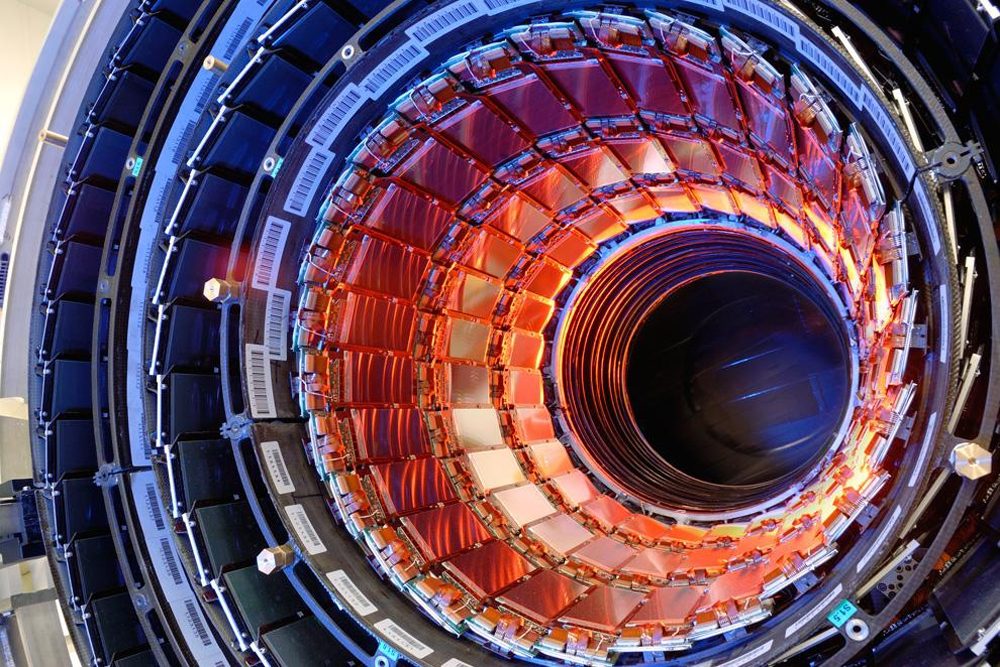
The new experiment looked at particles called D mesons which are made of charm quarks. Scientists were able to observe asymmetry in D mesons by looking at the particles created in collisions in the Large Hadron Collider (LHC). They looked at the full dataset from the seven years of LHC operations between 2011 and 2018, and checked for the decays of both D mesons and anti-D mesons. They found tiny but statistically significant differences between the two, providing the first evidence of asymmetry in charm quarks.
It is possible that the asymmetry observed here was not due to the same mechanism as the asymmetry of strange and bottom quarks. But even so, that would still be an exciting finding — because it raises the possibility of other types of matter-antimatter asymmetries.
“The result is a milestone in the history of particle physics,” Eckhard Elsen, CERN Director for Research and Computing, said in a statement. “Ever since the discovery of the D meson more than 40 years ago, particle physicists have suspected that CP violation also occurs in this system, but it was only now, using essentially the full data sample collected by the experiment, that the LHC collaboration has finally been able to observe the effect.”