  1. Home
  2. Emerging Tech
  3. Outdoors
  4. News

Forget ice — this cooler harnesses the power of the sun to chill your food

Add as a preferred source on Google
GoSun Chill Solar Cooler

A few years ago, the Coolest Cooler burst onto Kickstarter and quickly raked in more than $13 million to bring it to market. While lengthy delays turned into a controversial project, a new type of cooler just landed on a crowdfunding platform with its own goal of reinventing the humble food and drink chiller. And this one promises to be with customers in just a few months.

Recommended Videos

This time around, however, it’s taking a somewhat different approach. While the Coolest Cooler focused on party features like in-built Bluetooth speakers, the GoSun Chill’s innovation involves its method of keeping food chilled. Rather than relying on anything as boring as ice, it uses brushless compressor motors and lithium-ion batteries for cooling. You can charge it using a power cord, or — more impressively — using solar panel charging to keep your beverages icy. Where else could you use the sun’s rays to cool things down? Heck, you can even use the excess power from the detachable 144wh Powerbank to charge your devices multiple times.

“Portable fridges have demanded large power needs and must be plugged into a running vehicle — typically trucks — or a generator,” Patrick Sherwin, CEO of manufacturer GoSun, told Digital Trends. “GoSun’s engineers brought together an efficient brushless compressor with a compact, high output battery pack to create a cooler that never needs ice. With the flexible solar panel or solar table, you can continue to power the GoSun Chill, so you don’t need to resupply throughout the day.”
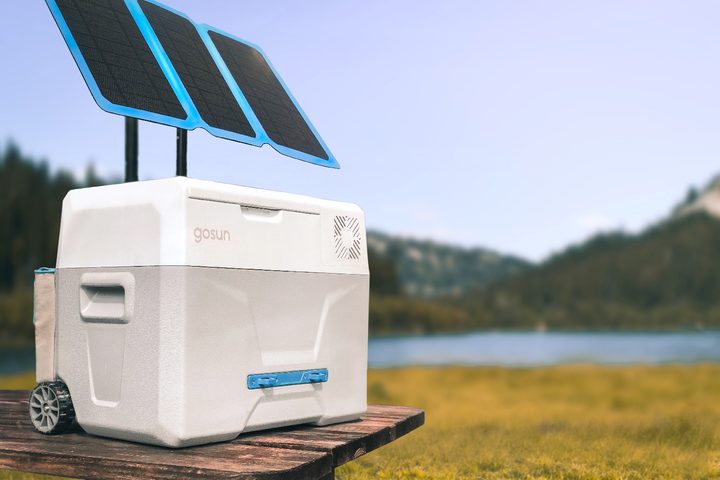
Image used with permission by copyright holder

GoSun isn’t known for its coolers. Its best-known products are the opposite of a cooler: Its solar ovens, which have shipped more than 30,000 units, including 1,500 to the American Red Cross. Pushing the fuel-free frontier, GoSun now wants to offer the next step in what it says as its dream of an outdoor kitchen. “The GoSun Chill provides both cooling and power for devices, plus it is compatible with our latest hybrid solar and electric oven, the GoSun Fusion,” Sherwin continued.

Although GoSun Chill is cool (no pun intended) from a technological point of view, there are other reasons to consider it, too. While it’s similar in size to a standard cooler, the 40-liter cooler can fit 40% more food and drink inside, since there’s no ice using up valuable internal space.

As ever, we offer our usual warnings about the risks inherent in crowdfunding campaigns. However, if you’re happy to take the risk, head over to Indiegogo and pledge your cash. Prices start at $549 for the early bird model with solar panel, while a version without the solar tech comes in at $479. Shipping is set to take place in August.

Luke Dormehl
I'm a UK-based tech writer covering Cool Tech at Digital Trends. I've also written for Fast Company, Wired, the Guardian…
Home robots can already walk. The hard part is stopping them from crushing your glassware
1X’s NEO uses tactile sensing and force control to handle fragile objects, aiming at the kind of household work humanoids still struggle to do.
Baby, Person, Electronics

A robot can look convincing while walking across a stage and still be useless in a kitchen. Picking up a wet glass demands precision, quick corrections, and enough restraint to avoid squeezing too hard. 1X is tackling that problem with new tendon-driven hands for NEO, its humanoid home robot.

1X says each hand has 25 degrees of freedom, with 22 across the fingers and palm and another three in the wrist. Its joints can yield when pushed instead of staying rigid, giving NEO a better chance of handling household objects without treating every collision like a wrestling match.

Read more
This tiny gadget called Moodi could save your thumb during long reading sessions
This tiny remote thinks your finger deserves a vacation
DuRoBo Moodi

Digital reading has become more comfortable thanks to larger displays and e-paper screens, but one small annoyance remains: constantly reaching over to tap or swipe every page. DuRoBo believes it has a solution. The company has unveiled Moodi, its first Bluetooth page-turning remote, designed to make reading, browsing, and media control more comfortable across e-readers, tablets, and smartphones.

Unlike conventional page-turners that focus solely on e-books, Moodi doubles as a compact Bluetooth remote for scrolling through articles, controlling multimedia playback, and navigating long-form content. The device looks towards ergonomic accessories that aim to reduce repetitive hand movements during extended screen time.

Read more
Camera sensor breakthrough promises sharper images without hulking up your phone’s thickness
Camera sensors just got thinner. Your excuses for blurry photos didn't.
Representative Image

Researchers at Nagoya University have developed a new type of transparent optical sensor that could significantly reduce the size of camera sensors while improving image quality. Published in the journal ACS Nano, the study demonstrates how gallium-doped zinc oxide (GZO) nanosheets can detect red, green, and blue (RGB) light within a single pixel, potentially replacing the decades-old Bayer filter design used in nearly every digital camera today.

If commercialized, the technology could enable thinner smartphone cameras, higher-resolution medical imaging devices, and more compact sensors for automotive and aerospace applications, all while simplifying manufacturing.

Read more