  1. Home
  2. Emerging Tech
  3. News

The earliest galaxies shone brightly in the young universe

Add as a preferred source on Google

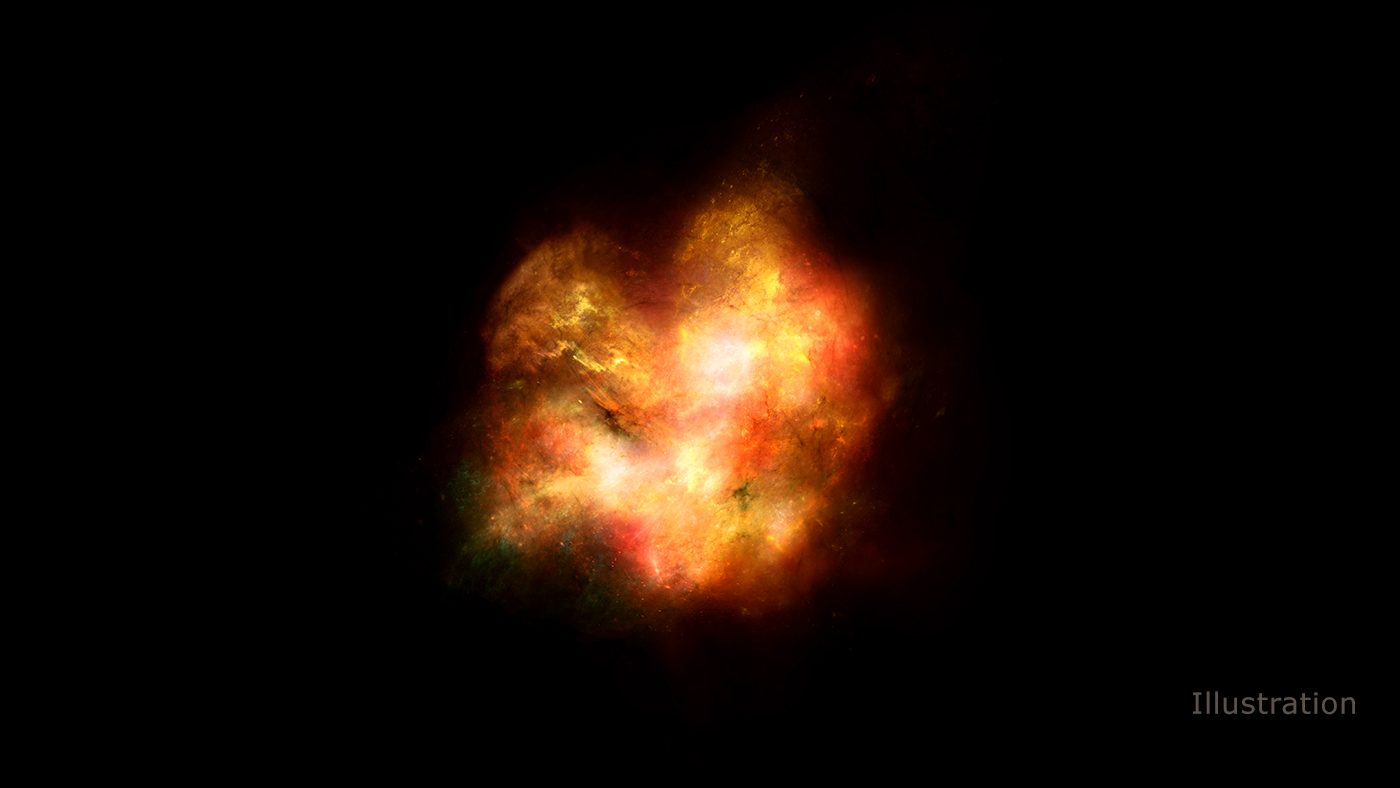
This artist’s illustration shows what one of the very first galaxies in the universe might have looked like. High levels of violent star formation and star death would have illuminated the gas filling the space between stars, making the galaxy largely opaque and without a clear structure. James Josephides (Swinburne Astronomy Productions)

Observations from NASA’s Spitzer Space Telescope have shown the earliest galaxies in the universe were brighter than previously thought, shedding light onto the way that the universe evolved.

Recommended Videos

The new study has revealed that the earliest galaxies formed in our universe were much brighter than galaxies are today. This enhanced brightness was specific to certain wavelengths of infrared light, but it applied to a large number of galaxies in this early period of less than 1 billion years after the Big Bang.

“We did not expect that Spitzer, with a mirror no larger than a Hula-Hoop, would be capable of seeing galaxies so close to the dawn of time,” Michael Werner, Spitzer’s project scientist at NASA’s Jet Propulsion Laboratory in Pasadena, California, said in a statement. “But nature is full of surprises, and the unexpected brightness of these early galaxies, together with Spitzer’s superb performance, puts them within range of our small but powerful observatory.”

The findings give more information about a period of transition in the early universe called the Epoch of Reionization. This was the time at which the smooth substance of the universe, called the intergalactic medium, began to form into the first luminous sources such as stars, galaxies, and quasars. Before this, light struggled to cross space as is was blocked by the hydrogen, so the universe was generally opaque.

This change happened between 100 million and 200 million years after the Big Bang, and scientists are still not quite sure what caused the birth of the earliest stars. At some point the hydrogen gas that made up the intergalactic medium began to coalesce into stars, which then formed galaxies. This is known as reionization because electrons were stripped away from the hydrogen, forming hydrogen ions.

“These results by Spitzer are certainly another step in solving the mystery of cosmic reionization,” Pascal Oesch, an assistant professor at the University of Geneva and a co-author of the study, said in the same statement. “We now know that the physical conditions in these early galaxies were very different than in typical galaxies today. It will be the job of the James Webb Space Telescope to work out the detailed reasons why.”

The findings are published in the journal Monthly Notices of the Royal Astronomical Society.

Georgina Torbet
Georgina has been the space writer at Digital Trends space writer for six years, covering human space exploration, planetary…
Anti-surveillance clothing is getting cheaper, but don’t expect an invisibility cloak
Affordable shirts now claim to confuse facial recognition, although their protection depends heavily on the camera and software watching you
Chart, Plot, Adult

Anti-surveillance clothing is starting to look less like an art-school experiment and more like something you could actually wear outside. Shirts designed to confuse facial recognition systems now cost about as much as ordinary streetwear, although buying one won’t make you disappear.

The Guardian reports that designers are using face-like prints, unusual cuts and infrared lights to interfere with computer vision. These techniques target specific weaknesses, so their success depends on what happens to be watching you.

Read more
This spinning drone hides in plain sight using a visual illusion
This drone doesn't turn invisible. It tricks your brain into thinking it has.
Phantom Twist

For decades, engineers have chased the dream of an invisible drone. The usual approaches have involved transparent materials, camouflage coatings, or complex optical systems that bend light around an object. Researchers at Northwestern University decided to take a completely different route. Instead of hiding the drone itself, they chose to fool the human eye.

The result is Phantom Twist, an experimental drone that spins so rapidly it almost disappears into the background. It's not technically invisible, but to anyone watching, it looks more like a faint blur than a flying machine.

Read more
This smart knitted fabric can flip switches, count your steps, and even change shape
Grandma's knitting just entered its Iron Man era
Representative Image

For most of us, knitting brings to mind sweaters, scarves, and perhaps an ambitious grandmother determined to make winter more fashionable. Researchers at Harvard University, however, have a far more futuristic vision. They've transformed ordinary knitted fabric into a programmable material capable of changing shape, acting as an electrical switch, sensing movement, and potentially forming the foundation of tomorrow's wearable technology.

The research, published in Advanced Functional Materials by scientists at the Harvard John A. Paulson School of Engineering and Applied Sciences (SEAS), demonstrates how machine-knitted textiles can "snap" between multiple stable shapes without relying on motors or rigid mechanical parts.

Read more