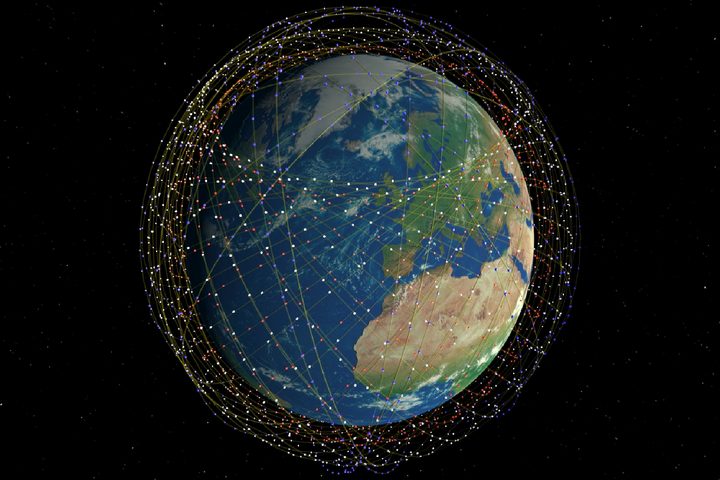
SpaceX successfully launched 60 satellites last month that will become part of a larger network designed to provide internet to all reaches of the globe. The company’s Starlink constellation of satellites isn’t the only of its kind. Other companies including OneWeb, Samsung, and Boeing have plans to build their own satellite internet clusters. Facebook and Amazon have also suggested they may explore the idea. While these man made constellations may finally help deliver internet connectivity to rural and underserved areas, they may also have the adverse effect of cluttering the sky. Astronomers are worried that satellite clusters may soon block out our view of the stars, according to the New York Times.
As more and more satellites start to crowd the sky — something that, to be fair, was already happening — our view of space may start to only reach as far as those vessels orbiting the planet. In the case of SpaceX’s Starlink satellites, the solar panels equipped to keep them operating end up delivering a reflection of the sun’s light back to earth. Company CEO Elon Musk has promised this won’t be a problem, claiming that they will go dark when stars are visible.
Others are not so sure about those claims. Alex Parker, a planetary astronomer and the director of the Project for Exploration Science Pathfinder Research for Enhancing Solar System Observations (ESPRESSO), has raised concerns about the brightness of the Starlink satellites in particular. “I know people are excited about those images of the train of SpaceX Starlink satellites, but it gives me pause,” he wrote on Twitter. “They’re bright, and there are going to be a lot of them. If SpaceX launches all 12,000, they will outnumber stars visible to the naked eye.”
Parker explained that, according to a model he produced, as many as 500 Starlink satellites will be visible during a midsummer’s midnight in Seattle. Carlos Niederstrasser, a rocket scientist and master systems engineer at Northrop Grumman, conducted his own analysis and reported that as many as 18 satellites would still visible at midnight in some high altitude locations.
Following many reported sightings of the Starlink satellites — including ones that claim the vessels produce as light as bright as Polaris, the North Star, when traveling overhead — Musk promised to address some of the concerns. But he also appeared somewhat dismissive of the complaints. “There are already 4900 satellites in orbit, which people notice [about] zero percent of the time,” he wrote on Twitter. “Starlink won’t be seen by anyone unless looking very carefully & will have [about] zero percent impact on advancements in astronomy.”
Others still have doubts. Another report from Spaceweather.com said that the SpaceX crafts create light flares 50% brighter than Sirius, the brightest star in the sky. If those issues go unaddressed or are exacerbated, the results could be noticeable to more than just astronomers and people who watch the skies for a living. Astronomer Tyler Nordgren told the New York Times that Starlink and other satellite constellations like it have “the potential to change what a natural sky looks like.”