As the Apple Watch’s ECG-reading tech has made clear, wearable devices have moved well beyond high-tech gimmicks and become genuine lifesavers. The latest demonstration of this is a new device, developed by researchers from the Army Medical University and China Academy of Engineering Physics. Their “hybrid instrument” uses two different light measurement techniques to build an accurate profile of the body’s blood circulation. In doing so, it could be useful for quickly and accurately identifying strokes, one of the leading causes of death worldwide. Because strokes must be diagnosed within a few hours for effective treatment to take place, this may prove a significant tool for physicians — and potential future patients, too.
“We have fabricated a hybrid diffuse optical device that combines near-infrared diffuse optical spectroscopy and diffuse correlation spectroscopy to monitor the [body’s] total hemoglobin concentration, tissue oxygen saturation, and blood flow index noninvasively, which may be helpful to distinguish the type of stroke at [an] emergency site,” Detian Wang, one of the researchers on the project, told Digital Trends.
Near-infrared diffuse optical spectroscopy, also known as NIRS-DOS, is a technique which analyzes multispectral tissue-scattered light intensity signals to work out the concentrations of things like water, tissue oxy-hemoglobin, and deoxy-hemoglobin. These measurements can then be used to figure out tissue oxygen saturation and blood volume. Diffuse correlation spectroscopy (DCS) is used to monitor the body’s hemoglobin concentration. All of these calculations can be made rapidly using custom software developed by the team.
“A stroke can be diagnosed by CT and MRI in the hospital, but it will often miss the best treatment opportunity because of the pre-hospital delay and very limited treatment window of 3 to 4.5 hours,” Hua Feng, another researcher who worked on the project, told us. “Our developed optical diagnostic device is sensitive to hemodynamic parameters, safe, noninvasive, cheap, and portable — which can be equipped in the ambulance, therefore our device can diagnose the stroke at the emergency site.”
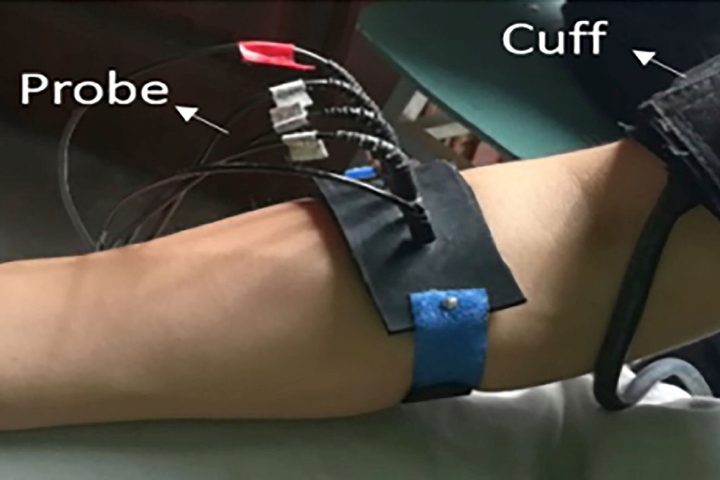
Liguo Zhu, a third member of the research team, said that the team plans to commercialize the technology, although further clinical studies are needed. It also remains to be seen what form the finished device would take. In studies, the researchers strapped one of their devices to a patient’s forearm and then used an inflatable arm cuff to block off blood circulation around the bicep to affect the oxygen and blood level readings.
A paper describing the work was recently published in the journal AIP Advances.