1. Home
  2. Emerging Tech
  3. News

What’s that liquid? IBM’s flavor-identifying ‘e-tongue’ will tell you

Add as a preferred source on Google
IBM Hypertaste: An AI-assisted e-tongue for fast and portable fingerprinting of complex liquids

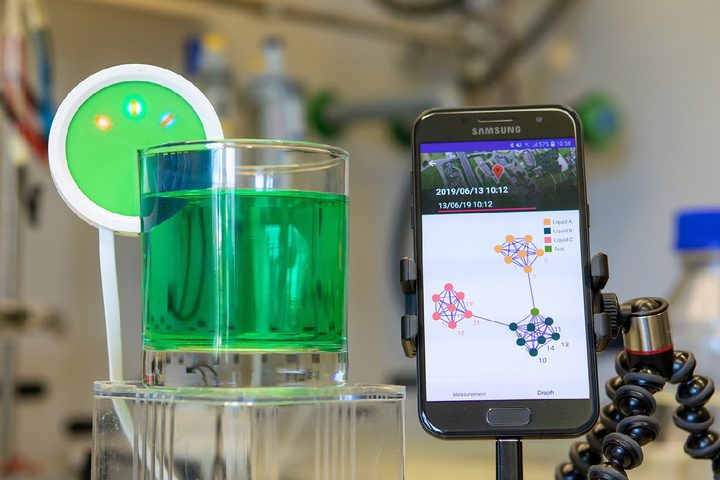
With its Watson technology, IBM has helped create a pretty convincing artificial brain. But now it’s seemingly ready to move onto other body parts as well — and it’s settled on the tongue as a next step. As developed by computer scientists at IBM Research, the A.I.-assisted e-tongue is a portable device, equipped with special sensors, that allow it to taste and identify different liquids.

Recommended Videos

“We’re very good as humans at being able to recognize different liquids,” Patrick Ruch, one of the researchers working on the e-tongue project, told Digital Trends. “While we can’t necessarily work out the exact quantities of components within liquids, we can do things like recognize the same liquid over and over again. That’s something we set out to replicate with this project.”

The handheld tongue (which isn’t quite as gross as it sounds) takes the form of a sensor array, which can be dipped in different liquids to sample their taste. Using pattern matching technology, augmented by machine learning, it’s able to work out the composition of the liquids it tastes and match them to different liquids already in its data set.

In a demonstration this week at the 11th World Conference of Science Journalists in Lausanne, Switzerland, the e-tongue was demonstrated by distinguishing between different brands of local bottled water. It managed to do this both accurately and consistently.
IBM Research

“What we’ve developed with this project is an end-to-end solution to convert chemical fingerprints into digital fingerprints,” Ruch continued.

One obvious application for this technology would be in the culinary industry, he said, where it could be used for things like sampling the vintage of different red wines. However, its classification use cases go far beyond that.

“It could be very useful for any scenario in which you want to check the composition of a particular liquid very quickly,” Ruch noted. “For instance, if you want to check that a particular food has come from the producer it says on the label this could be used. You can also imagine it in the case of non-foodstuffs, where an industrial supplier is supplying you with raw materials and you want to be sure that it’s always coming from the same place. You can easily re-label liquid, but you can’t change the chemical identity of the liquid without changing its function.”

He suggested that it could additionally be used for things like sampling different biofluids, such as urine, to make health-related diagnoses.

“The goal is definitely to grow the database of liquids,” Ruch said. “We’ve shown off the platform as a proof-of-principle, so the next step would be to create modifications depending on the use case.”


Luke Dormehl
I'm a UK-based tech writer covering Cool Tech at Digital Trends. I've also written for Fast Company, Wired, the Guardian…
Yet another study says AI is bad for elections, and the rabbit hole gets worse
AI may be an election bomb waiting for someone to light the fuse
Voters cast their ballots on Election Day

Another election, another study has concluded that asking an AI chatbot for political guidance is a spectacularly bad idea. Research conducted during Hungary’s 2026 parliamentary election found that ChatGPT and Google Gemini offered not just inaccurate but also inconsistent and unreliable voting advice. The chatbots misclassified voter profiles, overlooked relevant parties, recommended parties absent from the ballot, and sometimes produced materially different answers when given the same information repeatedly.

AI keeps failing the voter test

Read more
Samsung’s humanoid robot ambitions are real, but factories come first
Samsung’s new robotics division has humanoids in its sights, although its immediate business is far more practical factory automation
Robot Touch Human Finger

Samsung wants a place in the humanoid race, but its new robotics push begins with machines built for factories rather than homes.

The CEO-led RX robotics division will initially focus on manufacturing robots. Samsung has separately identified humanoids as a priority, although it hasn’t announced a commercial model or explained where one fits into the division’s immediate plans.

Read more
The future of AI may depend on this one behind-the-scenes change
Running Claude on Android.

Whenever a new AI model arrives, it's easy to get caught up in the bells and whistles. We talk about how much smarter it is, how quickly it answers questions, or how realistic its images have become. But here's the thing: none of that matters much if the AI can't reliably work with the apps and services people use every day.

That's why an upcoming update to the Model Context Protocol (MCP) caught my attention. It isn't a new chatbot or a fancy AI model. In fact, most people will never even know it's happening. But it could quietly make the AI ecosystem a lot healthier. If you've never heard of MCP before, don't worry. Think of it as a shared language that lets AI assistants safely talk to apps like Gmail, Slack, calendars, databases, and countless other services. Instead of every company inventing its own way to make those connections, MCP gives everyone a common rulebook.

Read more