  1. Home
  2. Emerging Tech
  3. News

Mars 2020 rover enters its final year of engineering before launch

Add as a preferred source on Google

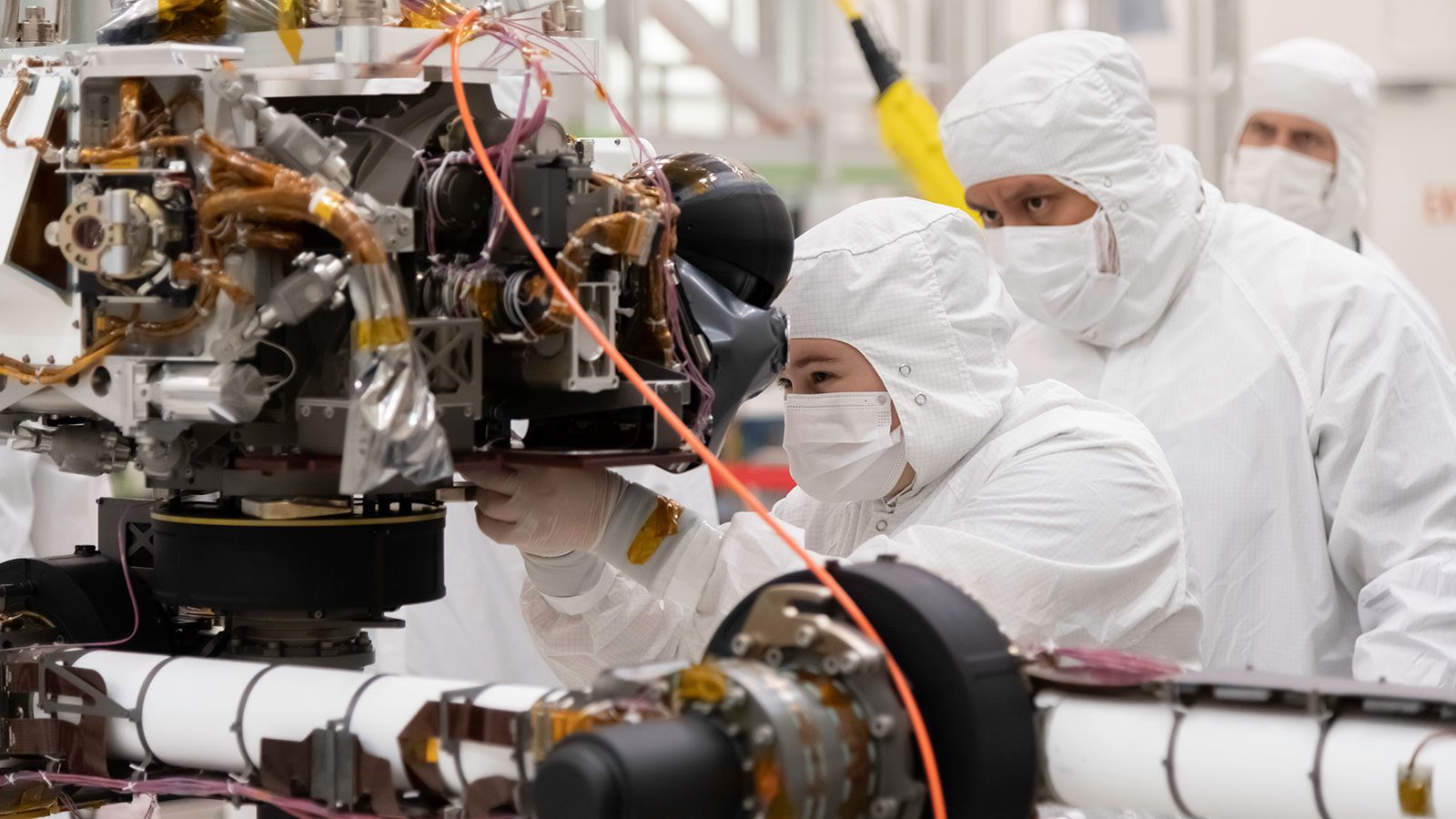
Engineers at JPL install a sensor-filled turret on the end of the rover’s seven-foot-long (2.1-meter-long) robotic arm. The image was taken on July 11, 2019. NASA/JPL-Caltech

The countdown has begun for the last year of development before the Mars 2020 launches. The launch window opens on July 17, 2020, and runs until August 5, 2020, when the rover will be launched on its journey to Mars from Cape Canaveral Air Force Station in Florida.

Recommended Videos

Engineers at NASA have been hard at work on the rover, installing its camera, wheels, and robotic arm, and testing the spacecraft which will carry the rover’s ability to withstand the extreme environment of space. And progress on finalizing the rover is right on track, according to NASA.

“Back when we started this project in 2013, we came up with a timeline to chart mission progress,” John McNamee, Mars 2020 project manager at NASA’s Jet Propulsion Laboratory (JPL), said in a statement. “That every single major spacecraft component on a project with this level of innovation is synching right now with that timeline is a testament to the innovation and perseverance of a great team.”

In the image above, you can see the sensor turret being installed on the end of the rover’s robotic arm. The turret holds more cameras, several scientific detection tools like SHERLOC and PIXL, and a drill and coring mechanism for collecting samples from hard rock.

NASA also shared a video clip showing the JPL team at work installing the legs and wheels onto the rover. Watching it, you can get an idea of how much work and coordination is required to assemble something as complex and precise as a rover. All of the engineers wear “bunny suits” to avoid any contamination of the delicate rover components as they work in the JPL’s clean room.


A team of engineers at NASA’s Jet Propulsion Laboratory in Pasadena, California, install the legs and wheels – otherwise known as the mobility suspension – on the Mars 2020 rover. The imagery for this accelerated time-lapse was taken on June 13, 2019, from a camera above the Spacecraft Assembly Facility’s High Bay 1 clean room. Credit: NASA/JPL-Caltech
We’ll be counting down the days until the launch of Mars 2020, which will take approximately seven months to travel to Mars after its launch and is scheduled to land on the red planet on February 18, 2021.

Georgina Torbet
Georgina has been the space writer at Digital Trends space writer for six years, covering human space exploration, planetary…
Yet another study says AI is bad for elections, and the rabbit hole gets worse
AI may be an election bomb waiting for someone to light the fuse
Voters cast their ballots on Election Day

Another election, another study has concluded that asking an AI chatbot for political guidance is a spectacularly bad idea. Research conducted during Hungary’s 2026 parliamentary election found that ChatGPT and Google Gemini offered not just inaccurate but also inconsistent and unreliable voting advice. The chatbots misclassified voter profiles, overlooked relevant parties, recommended parties absent from the ballot, and sometimes produced materially different answers when given the same information repeatedly.

AI keeps failing the voter test

Read more
Samsung’s humanoid robot ambitions are real, but factories come first
Samsung’s new robotics division has humanoids in its sights, although its immediate business is far more practical factory automation
Robot Touch Human Finger

Samsung wants a place in the humanoid race, but its new robotics push begins with machines built for factories rather than homes.

The CEO-led RX robotics division will initially focus on manufacturing robots. Samsung has separately identified humanoids as a priority, although it hasn’t announced a commercial model or explained where one fits into the division’s immediate plans.

Read more
The future of AI may depend on this one behind-the-scenes change
Running Claude on Android.

Whenever a new AI model arrives, it's easy to get caught up in the bells and whistles. We talk about how much smarter it is, how quickly it answers questions, or how realistic its images have become. But here's the thing: none of that matters much if the AI can't reliably work with the apps and services people use every day.

That's why an upcoming update to the Model Context Protocol (MCP) caught my attention. It isn't a new chatbot or a fancy AI model. In fact, most people will never even know it's happening. But it could quietly make the AI ecosystem a lot healthier. If you've never heard of MCP before, don't worry. Think of it as a shared language that lets AI assistants safely talk to apps like Gmail, Slack, calendars, databases, and countless other services. Instead of every company inventing its own way to make those connections, MCP gives everyone a common rulebook.

Read more