  1. Home
  2. Emerging Tech
  3. News

Soft robots can be formed into firm shapes using light and magnets

Add as a preferred source on Google

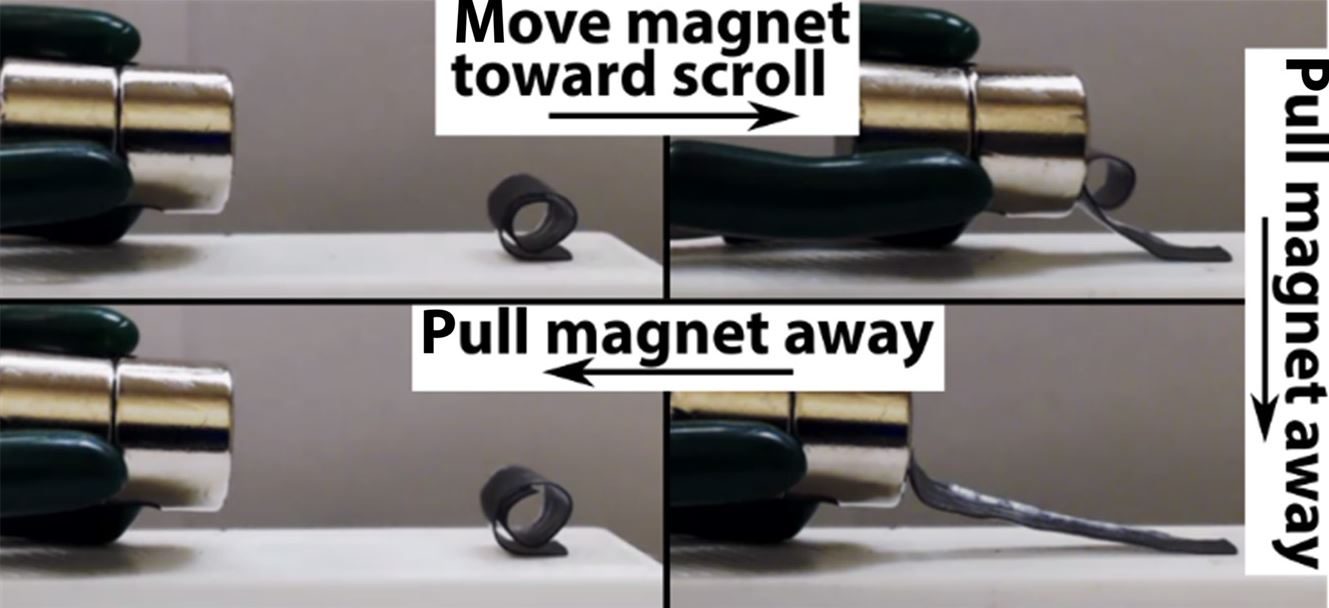
Actuation of an IROGRAN scroll by moving the magnet toward the scroll and pulling the scroll open. The scroll abruptly closes when the magnet is pulled further away. Liu et al., 2019, Photothermally and magnetically controlled reconfiguration of polymer composites for soft robotics

Soft robots may be the future, but there are challenges with their use. Some applications require stiff material which will hold its shape, and soft materials just won’t do the job. Now, scientists have come one step closer to overcoming this challenge by creating soft robots that can be reconfigured into firm shapes.

Recommended Videos

It works by creating robots from a polymer which has tiny particles of iron embedded within it, making it magnetic. Most of the time, the material is firm and keeps its shape. But if it is heated using light from an LED, it becomes pliable and can be reconfigured into different shapes. And once in this pliable form, the robots can be controlled by applying a magnetic field. To”lock” the shape, the scientists just remove the LED light.

“We’re particularly excited about the reconfigurability,” Joe Tracy, a professor of materials science and engineering at North Carolina State University and a co-author of the paper, said in a statement. “By engineering the properties of the material, we can control the soft robot’s movement remotely; we can get it to hold a given shape; we can then return the robot to its original shape or further modify its movement; and we can do this repeatedly. All of those things are valuable, in terms of this technology’s utility in biomedical or aerospace applications.”

The scientists tested the robots and found that they could be configured into “grabbers” which lift and move objects, or into “flowers” with petals that fold and bend.

“We are not limited to binary configurations, such as a grabber being either open or closed,” Jessica Liu, a Ph.D. student and lead author of the paper, explained. “We can control the light to ensure that a robot will hold its shape at any point.”

The next step for the researchers is to tweak the material that the soft robots are made of. If they can create polymers that respond at different temperatures, they will be able to use the robots in different settings.

The findings are published in the journal Science Advances.

Georgina Torbet
Georgina has been the space writer at Digital Trends space writer for six years, covering human space exploration, planetary…
This spinning drone hides in plain sight using a visual illusion
This drone doesn't turn invisible. It tricks your brain into thinking it has.
Phantom Twist

For decades, engineers have chased the dream of an invisible drone. The usual approaches have involved transparent materials, camouflage coatings, or complex optical systems that bend light around an object. Researchers at Northwestern University decided to take a completely different route. Instead of hiding the drone itself, they chose to fool the human eye.

The result is Phantom Twist, an experimental drone that spins so rapidly it almost disappears into the background. It's not technically invisible, but to anyone watching, it looks more like a faint blur than a flying machine.

Read more
This smart knitted fabric can flip switches, count your steps, and even change shape
Grandma's knitting just entered its Iron Man era
Representative Image

For most of us, knitting brings to mind sweaters, scarves, and perhaps an ambitious grandmother determined to make winter more fashionable. Researchers at Harvard University, however, have a far more futuristic vision. They've transformed ordinary knitted fabric into a programmable material capable of changing shape, acting as an electrical switch, sensing movement, and potentially forming the foundation of tomorrow's wearable technology.

The research, published in Advanced Functional Materials by scientists at the Harvard John A. Paulson School of Engineering and Applied Sciences (SEAS), demonstrates how machine-knitted textiles can "snap" between multiple stable shapes without relying on motors or rigid mechanical parts.

Read more
Starlink V5 is here, and it’s lighter, smarter, and far more efficient
The next-generation satellite internet kit promises improved efficiency while maintaining high-speed connectivity.
Starlink V4 vs V5

Not every hardware upgrade needs to be about speed. With Starlink V5, SpaceX is betting that a lighter design and lower power consumption matter just as much. The company has officially introduced its next-generation Starlink V5 kit, featuring a smaller and lighter design with significantly improved power efficiency.

Smaller, lighter, and far more efficient

Read more