  1. Home
  2. Emerging Tech
  3. News

Artificial skin gives haptic feedback, could let you feel VR

Add as a preferred source on Google

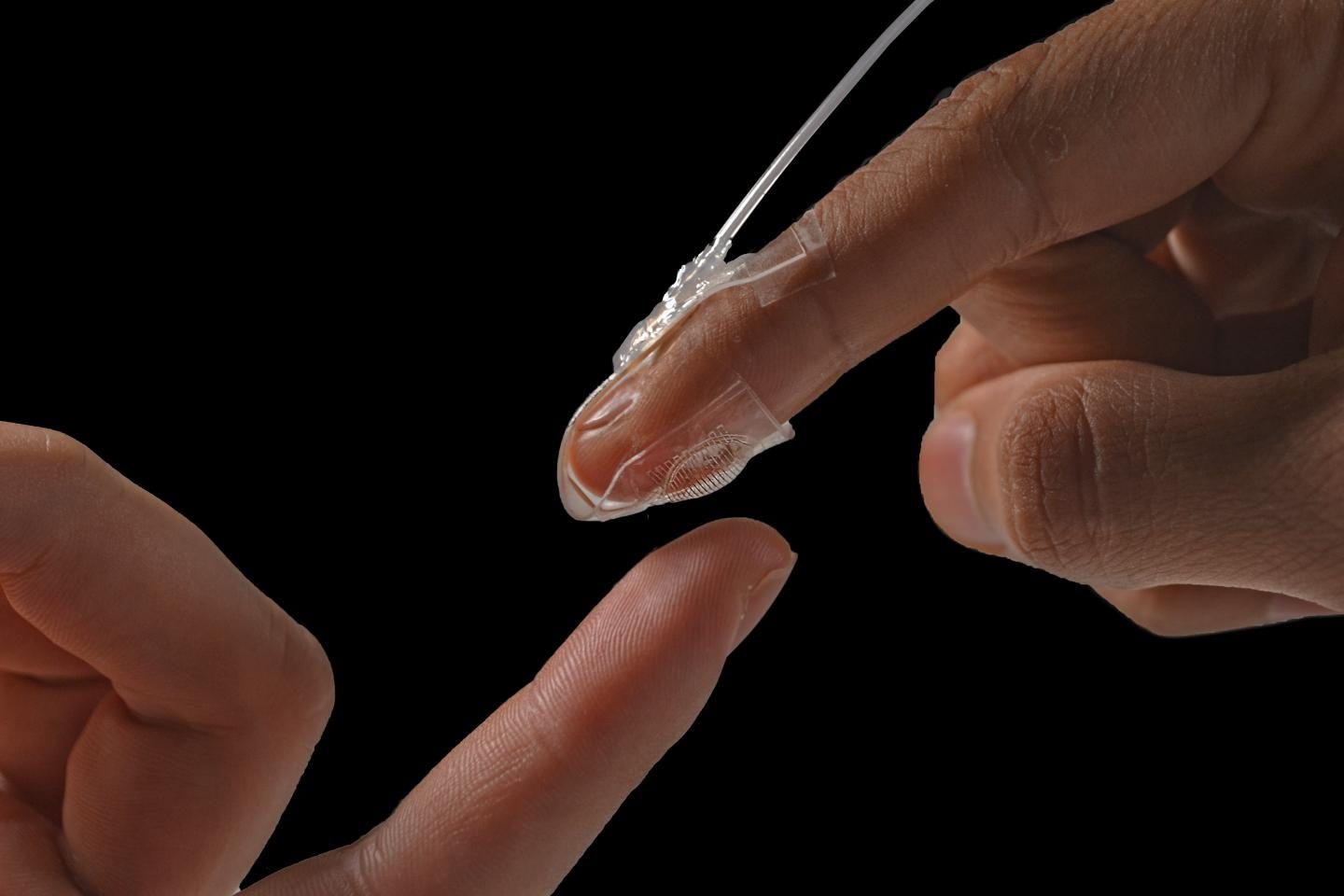
The skin’s system of soft sensors and actuators enables the artificial skin to conform to the exact shape of a wearer’s wrist. EPFL

We’ve become accustomed to haptic feedback being a part of our interactions with our smartphones and other devices. Our sense of touch is a big part of the way that we interact with our environment, and small inputs can convey a lot of information. However, as anyone who has tried out haptic feedback VR tools can attest, bringing a sense of touch into interactions is key to making them feel immersive.

Recommended Videos

Now, researchers at the Swiss Federal Institute of Technology Lausanne (EPFL) have come up with a flexible artificial skin which can provide haptic feedback and could be used for everything from VR to medical rehabilitation. The skin is made of silicone and electrodes, and it can conform to shapes such as wrapping around a fingertip or wrist to provide feedback in the form of pressure or vibration.

The skin has sensors embedded within it that can detect deformations so that the feedback can be adjusted in response to movements, making it more useable and giving more realistic feedback. “This is the first time we have developed an entirely soft artificial skin where both sensors and actuators are integrated,” Harshal Sonar, researcher at EPFL and the lead author of the study, said in a statement. “This gives us closed-loop control, which means we can accurately and reliably modulate the vibratory stimulation felt by the user. This is ideal for wearable applications, such as for testing a patient’s proprioception in medical applications.”

Artificial skin could help rehabilitation and enhance virtual reality

The artificial skin is stretchable as well as flexible and can be stretched up to four times its original length. That means it should be able to withstand the rigors of daily movements, so it could be developed into a tool for patients who have lost their sense of touch. It could also be used to create highly immersive VR experiences.

“The next step will be to develop a fully wearable prototype for applications in rehabilitation and virtual and augmented reality,” Sonar said. “The prototype will also be tested in neuroscientific studies, where it can be used to stimulate the human body while researchers study dynamic brain activity in magnetic resonance experiments.”

The research is published in the journal Soft Robotics.

Georgina Torbet
Georgina has been the space writer at Digital Trends space writer for six years, covering human space exploration, planetary…
Starlink V5 is here, and it’s lighter, smarter, and far more efficient
The next-generation satellite internet kit promises improved efficiency while maintaining high-speed connectivity.
Starlink V4 vs V5

Not every hardware upgrade needs to be about speed. With Starlink V5, SpaceX is betting that a lighter design and lower power consumption matter just as much. The company has officially introduced its next-generation Starlink V5 kit, featuring a smaller and lighter design with significantly improved power efficiency.

Smaller, lighter, and far more efficient

Read more
Frontier joins the Starlink club with high-speed in-flight internet
The carrier plans to roll out SpaceX's satellite-powered Wi-Fi across its fleet starting in 2027.
Frontier Starlink partnership featured

If there's one thing budget airlines aren't exactly known for, it's great onboard Wi-Fi. In Frontier Airlines' case, it hasn't offered in-flight internet at all. That's about to change. Frontier Airlines has announced a partnership with SpaceX's Starlink to bring high-speed, low-latency internet across its fleet. Installations will begin in early 2027, making Frontier the first ultra-low-cost carrier in the United States to adopt Starlink's satellite-powered connectivity.

Streaming, browsing, and even gaming at 35,000 feet

Read more
OpenAI’s first hardware product sounds more like a companion than a speaker
The AI company is reportedly building a mobile home device that understands context and proactively helps users.
OpenAI press image

For months, rumors have suggested that OpenAI's first hardware product could be a wearable AI device, or perhaps even the beginning of its long-term smartphone ambitions. As it turns out, the company's first gadget may be something far simpler, yet arguably far more ambitious. It will help control smart-home appliances, play media, answer questions, respond to messages, and tap into the range of capabilities offered by OpenAI's ChatGPT, according to people familiar with the matter.

OpenAI's first AI device could end up being a speaker, following plenty of hype that the company is actually working on a wearable AI device and might even launch a smartphone down the road. According to a Bloomberg report, the speaker will serve as a human-like AI companion that will integrate directly with the smart home ecosystem.

Read more