Growing meat in a lab has the potential to change the face of food production, offering an alternative to current meat production methods that’s both greener and more ethical. But, shallow creatures that we are, lab-grown meat is going to have to taste like the real thing before a large number of people are willing to give it a try. That’s where new research from Harvard’s John A. Paulson School of Engineering and Applied Sciences (SEAS) comes into play.
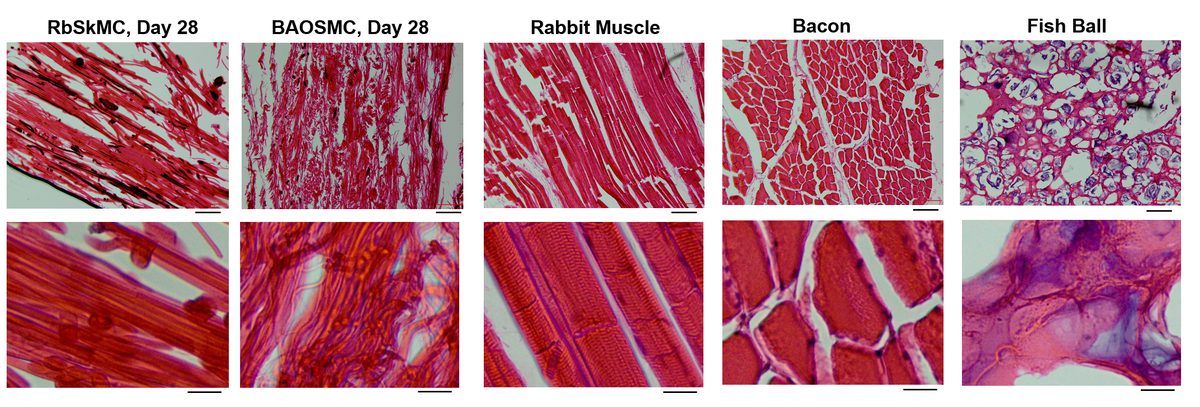
Scientists in Professor Kit Parker’s lab at SEAS have developed a new method of growing rabbit and cow muscle cells on edible gelatin scaffolds. Sound kinda gross? Perhaps, but the important thing is that the results more accurately mimic the texture and consistency of real meat.
“One of the main challenges holding back industrial production of ‘lab-grown’ or ‘cultured’ meat is the requirement for muscle cells to attach to something when they are growing in 3D,” Dr. Luke MacQueen, a research scholar in Parker’s lab, told Digital Trends. “We found a way to convert gelatin, an edible component of natural meats, into 3D fiber networks that allow muscle cells to attach and grow in 3D. The combination of cells and scaffolds makes a tissue. Meat is mostly skeletal muscle tissue so our scaffolds cultured with muscle cells are a first step toward cultured meat.”
The nanofiber production process pioneered by the team was inspired by cotton candy machines. They begin by feeding a solution of gelatin dissolved in water into a rotating reservoir with small holes in its walls. The rotation forces the gelatin solution out through the holes, forming “gelatin jets” which travel through the air for around 10 centimeters before being dehydrated in an ethanol bath. Finally, the gelatin fibers are freeze-dried and stored for future use.
“We have a lot of work in progress on this topic,” MacQueen continued. “Some of that involves new scaffold formulations, including plant proteins, and some involves new cell types, like stem cells and fat. We are planning to commercialize this research.”
A paper describing this research, titled “Muscle tissue engineering in fibrous gelatin: Implications for meat analogs,” was recently published in the journal Nature Science of Food.