  1. Home
  2. Emerging Tech
  3. News

Artificial intelligence can now identify a bird just by looking at a photo

Add as a preferred source on Google
Image used with permission by copyright holder

Artificial intelligence technology has proven itself useful in many different areas, and now birdwatching has gotten the A.I. treatment. A new A.I. tool can identify up to 200 different species of birds just by looking at one photo. 

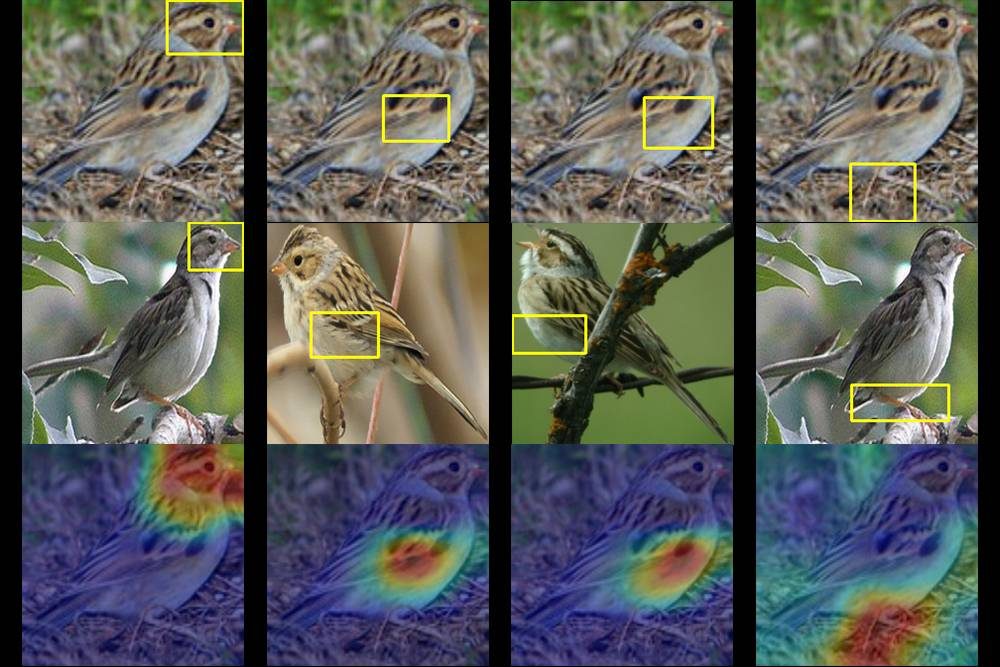
The technology comes from a team at Duke University that used over 11,000 photos of 200 bird species to teach a machine to differentiate them. The tool was shown birds from ducks to hummingbirds and was able to pick out specific patterns that match a particular species of bird. 

Recommended Videos

“Along the way, it spits out a series of heat maps that essentially say: ‘This isn’t just any warbler. It’s a hooded warbler, and here are the features — like its masked head and yellow belly — that give it away,’” wrote Robin Smith, senior science writer in Duke’s communications department, in a blog post about the new technology. 

The researchers included Duke computer science Ph.D. student Chaofan Chen, Duke undergraduate Oscar Li, team members from the Prediction Analysis Lab, and Duke professor Cynthia Rudin. The team found that the machine learning correctly identified bird species 84% of the time. 

Essentially, the technology is similar to facial-recognition software, which remembers faces on social media sites to suggest tags or to identify people in surveillance videos. Unlike other controversial facial-recognition software, however, the technology from Duke is meant to be transparent in how the machine learns identifiable features. 

“[Rudin] and her lab are designing deep learning models that explain the reasoning behind their predictions, making it clear exactly why and how they came up with their answers. When such a model makes a mistake, its built-in transparency makes it possible to see why,” the blog post reads. 

The hope is to take this technology to another level so it can be used to classify areas in medical images, such as identifying a lump in a mammogram. 

“It’s case-based reasoning,” Rudin said. “We’re hoping we can better explain to physicians or patients why their image was classified by the network as either malignant or benign.”

Digital Trends reached out to Duke University to find out what other ways the new tool can be used for, but we haven’t heard back. 

Allison Matyus
Former Digital Trends Contributor
Allison Matyus is a general news reporter at Digital Trends. She covers any and all tech news, including issues around social…
Former Perplexity engineer launches new Polar AI browser which aims to automate repetitive tasks
Polar wants to turn your browser into an AI-powered productivity tool
Polar AI browser

The AI browser race is entering a new phase. After spending much of 2025 trying to reinvent web search with built-in chatbots, startups are increasingly shifting their attention toward browser agents that can automate repetitive work instead of simply answering questions. The latest company to embrace that transition is Polar, a startup founded by former Perplexity engineer Kevin Zhang, which has raised $5.7 million in seed funding led by Madrona.

Unlike the first generation of AI browsers that targeted everyday consumers, Polar is designed specifically for knowledge workers. Its premise is straightforward: instead of replacing Google Search, the browser aims to eliminate repetitive tasks that professionals perform across dozens of browser tabs every day.

Read more
I use ChatGPT Pro everyday, and these 3 features keep me subscribed
ChatGPT on iPhone

I've used ChatGPT for years, but for the longest time, I never felt the need to pay for it. Instead, I subscribed to Claude Pro because it fit my workflow better. Between regular chat and Cowork, it gave me everything I needed in one place, so paying for another AI subscription didn't make sense.

That changed when OpenAI introduced ChatGPT Work. I was curious enough to give ChatGPT Pro a proper shot, expecting to test one new feature and move on. Instead, I ended up using it far more than I expected. The more I relied on it in my day-to-day work, the more I realized it offered a few things I didn't want to give up. Those are the three features that have kept me happily subscribed ever since.

Read more
The music industry wants AI slop kicked off the charts, and it finally has a plan
Universal, Sony, and Warner are pushing global charts to block AI slop songs.
Spotify music player

I've caught myself bopping along to a new viral quite a few times, only to realize that it was created using artificial intelligence. Turns out the labels are just as fed up with this as I am.

So what exactly are labels asking for?

Read more