  1. Home
  2. Emerging Tech
  3. News

Rare super-Neptune exoplanet spotted in nearby binary system

Add as a preferred source on Google

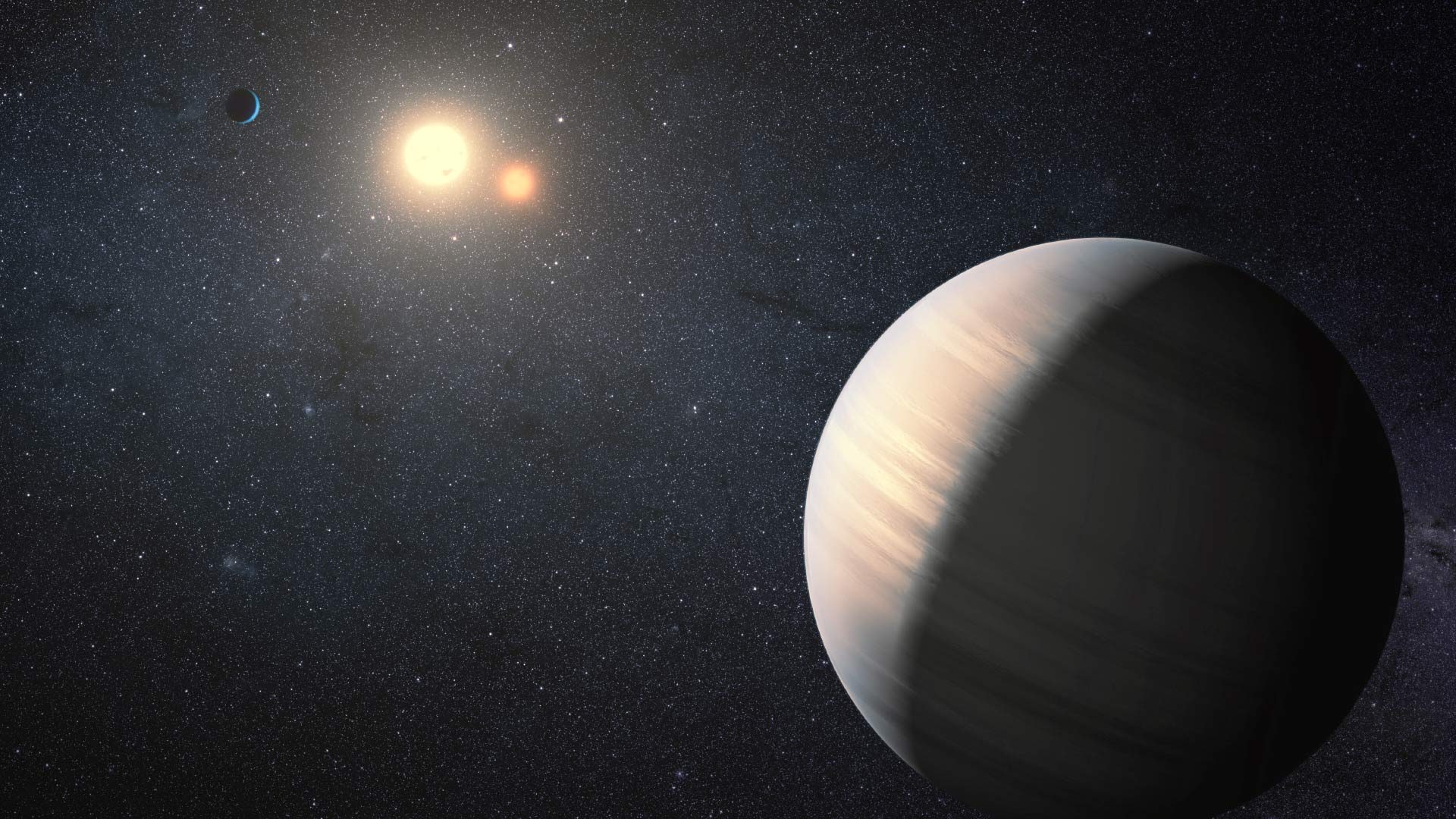
An artist’s impression of two exoplanets orbiting a pair of red dwarfs. NASA / JPL-Caltech / T. Pyle / Sci-News.com

Astronomers using the Italian Telescopio Nazionale Galileo and the High Resolution Echelle Spectrometer on the Keck Telescope have discovered a rare type of exoplanet called a super-Neptune, located rather close by at a distance of just 11.6 light-years from Earth. This type of planet is larger than Neptune and around five to seven times the size of Earth. This is different than the type of exoplanets typically located by our current tools, which are usually super-Earths or gas giants similar to Jupiter or Saturn.

Recommended Videos

This particular super-Neptune is located in the Gliese 15 binary system, in which planets move around two red dwarf stars. Astronomers first became interested in this system in 2014, when they located a super-Earth orbiting around the larger star, called Gliese 15A. This super-Earth, named Gliese 15Ab, comes very close to the star with an orbital period of just 11.44 days, so it has extremely high surface temperatures of 530 degrees Fahrenheit (276 degrees Celsius).

Now, astronomers have spotted a second planet in orbit around Gliese 15A, which has a mass that is 36 times that of the Earth.

The team discovered the planet using a method called radial velocity or Doppler spectroscopy. This method analyzes tiny movements of stars, as the stars are affected by the planets that move around them. Even though the planets are much smaller than the stars, they still exert a gravitational force on the bodies around which they move. Astronomers can look for evidence of these small wobbles of stars to deduce the existence of an exoplanet.

Using a tool called a spectrometer that measures light in a specific band of the electromagnetic spectrum, astronomers can see how light from a star shifts toward the blue or red side of the spectrum due to the Doppler effect. If there is a regular cycle of redshifting to blueshifting, that suggests the star is moving back and forth, which in turn suggests the presence of a planet.

“With its period of 7,600 days (20.8 years), Gliese 15Ac is the longest-period sub-Jovian planet detected up to date with the radial velocity method,” Dr. Pinamonti and colleagues wrote in their paper. “With the confirmed presence of two widely spaced planetary-mass companions, Gliese 15A is now the multi-planet system closest to our sun.”

The findings are published in the journal Astronomy & Astrophysics.

Georgina Torbet
Georgina has been the space writer at Digital Trends space writer for six years, covering human space exploration, planetary…
Google’s new AI gives robots better balance, smarter hands, and teamwork capabilities
Google just made robots a lot less clumsy and a lot more helpful.
Gemini robotics 2.0

Google DeepMind just brought sci-fi robots closer to reality, and it is very exciting. Building on its original Gemini Robotics model, the company has introduced Gemini Robotics 2, an AI system designed to help robots think, move, and even work together. Unlike most robots today, which rely on pre-programmed routines or someone controlling them remotely, this new system lets robots figure things out on their own when situations get unpredictable.

Can robots finally handle whole-body tasks?

Read more
Remember Samsung’s Ballie home robot? It may finally be inching closer to reality
Leaked app wireframes give the strongest hint yet that Samsung's Ballie home robot, first shown at CES 2020, might still be headed toward an actual release.
Samsung Ballie robot in a room next to a dog feeder.

Samsung's rolling home robot has been the industry's longest-running "will it ever actually ship" joke, and I'll admit I'd mostly given up on it. Now, there's finally a glimmer of hope.

Samsung first unveiled Ballie as a concept at CES 2020. Then, it showed it as a significantly upgraded version four years later. However, the company never confirmed a release date or committed to releasing it at all. 

Read more
Polar is yet another AI browser, but it goes beyond just automating the mundane web chores
Polar wants to turn your browser into an AI-powered productivity tool
Polar AI browser

The AI browser race is entering a new phase. After spending much of 2025 trying to reinvent web search with built-in chatbots, startups are increasingly shifting their attention toward browser agents that can automate repetitive work instead of simply answering questions. The latest company to embrace that transition is Polar, a startup founded by former Perplexity engineer Kevin Zhang, which has raised $5.7 million in seed funding led by Madrona.

Unlike the first generation of AI browsers that targeted everyday consumers, Polar is designed specifically for knowledge workers. Its premise is straightforward: instead of replacing Google Search, the browser aims to eliminate repetitive tasks that professionals perform across dozens of browser tabs every day.

Read more