  1. Home
  2. Emerging Tech
  3. News

Hubble observes mammoth gamma-ray burst with highest-ever energy levels

Add as a preferred source on Google

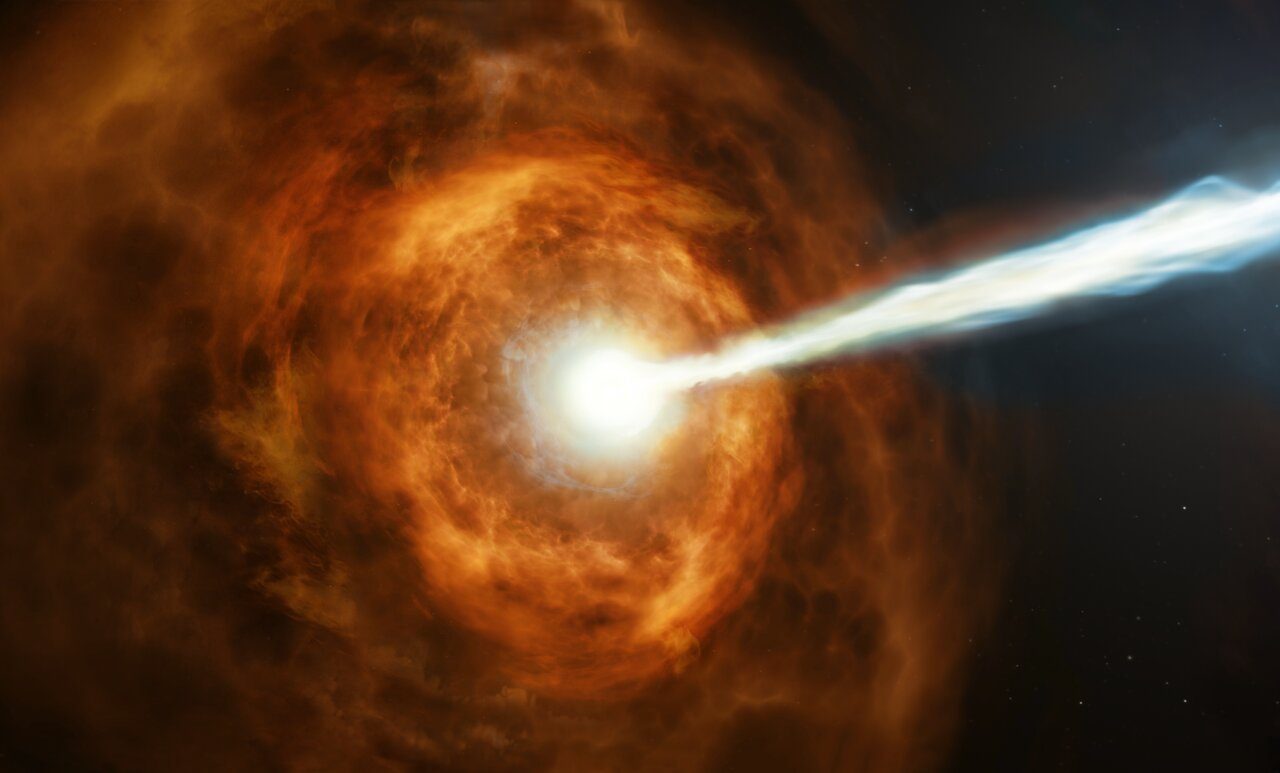
An artist’s impression of gamma-ray burst GRB 190114C, recently investigated by the Hubble Space Telescope. ESA/Hubble, M. Kornmesser

The Hubble Space Telescope has observed the highest-energy ever gamma-ray burst, called GRB 190114C. Gamma-ray bursts are “the most powerful explosions in the universe,” according to the European Space Agency, and this particular burst was even brighter and longer-lasting than most. It was first detected in January this year by other telescopes, and since then Hubble has trained its view on the source to learn more about the burst.

Recommended Videos

A gamma-ray burst is an emission of large amounts of gamma rays, which are similar to visible light but much higher energy. The light from the burst had energy of 1Tera electron volt (TeV), which is equivalent to one trillion times the energy that visible light has per photon. Scientists have been hoping to observe light from such a burst, so now they can look into what caused this extreme event.

“Hubble’s observations suggest that this particular burst was sitting in a very dense environment, right in the middle of a bright galaxy five billion light-years away,” one of the lead authors, Andrew Levan of the Institute for Mathematics, Astrophysics & Particle Physics Department of Astrophysics at Radboud University in the Netherlands, explained in a statement. “This is really unusual, and suggests that might be why it produced this exceptionally powerful light.”

In addition to Hubble, scientists also gathered data about the burst from the European Southern Observatory’s Very Large Telescope and the Atacama Large Millimeter/submillimeter Array. By observing the pair of interacting galaxies that were the source of the burst, they could see that it stemmed from the nuclear region of a massive galaxy. This indicates that the extreme energy generated is related to a denser environment than a typical burst.

“Scientists have been trying to observe very-high-energy emission from gamma-ray bursts for a long time,” lead author Antonio de Ugarte Postigo of the Instituto de Astrofísica de Andalucía in Spain said in the same statement. “This new observation is a vital step forward in our understanding of gamma-ray bursts, their immediate surroundings, and just how matter behaves when it is moving at 99.999% of the speed of light.”

The findings are published in the journal Nature.

Georgina Torbet
Georgina has been the space writer at Digital Trends space writer for six years, covering human space exploration, planetary…
The Apple Car may be dead, but it became the foundation of Apple Intelligence
A decade of work on a canceled car project reportedly laid the groundwork for Apple Intelligence.
Apple Intelligence in Apple Car

The Apple Car may have never left the garage, but it apparently gave birth to Apple's AI ambitions. According to Bloomberg's Mark Gurman, Apple's canceled autonomous vehicle project, one that consumed more than a decade of work and over $10 billion before being scrapped in 2024, ended up laying the technological foundation for Apple Intelligence. In a rather ironic twist, one of Apple's most expensive failures may also become one of its most important long-term investments.

The Apple Car forced Apple to think like an AI company

Read more
Researchers hid a prompt injection inside a PNG, and AI fell for it
Hacker

AI coding assistants like Claude are becoming every developer's favorite coworker. They can review code, explain confusing functions, and even write entire features with a single prompt. But new research suggests that this growing trust could also become their biggest weakness.

A team of security researchers (professor Sudipta Chattopadhyay and researcher Murali Ediga) has demonstrated an unusual attack that doesn't target the AI model directly. Instead, it targets what the AI doesn't pay enough attention to during code reviews. Rather than hiding malicious instructions in lines of code, the researchers tucked them inside an image file. Since many AI review tools treat images as decorative assets rather than as something worth inspecting, the pull request can appear perfectly harmless and sail through the review.

Read more
AI has already fallen into the wrong hands and they’re using it to make bombs
Logo, Text

Artificial intelligence has quickly become the go-to tool for everything from writing emails and summarizing meetings to helping students study or developers debug code. But the same technology that saves people time can also be misused, and a new report suggests that terrorist organizations are finding ways to do exactly that.

According to a research paper shared with The New York Times ahead of its publication, researchers found evidence that members of Boko Haram have been using popular AI chatbots to support both day-to-day activities and combat-related tasks. Interviews with 27 former members conducted in Nigeria over the past two years suggest that tools such as ChatGPT, Gemini, Claude, Grok, Meta AI, and DeepSeek were used to gather technical information, troubleshoot weapons, and even assist with planning attacks.

Read more