  1. Home
  2. Emerging Tech
  3. News

Pore over the geography of Saturn’s moon Titan with first global geologic map

Add as a preferred source on Google

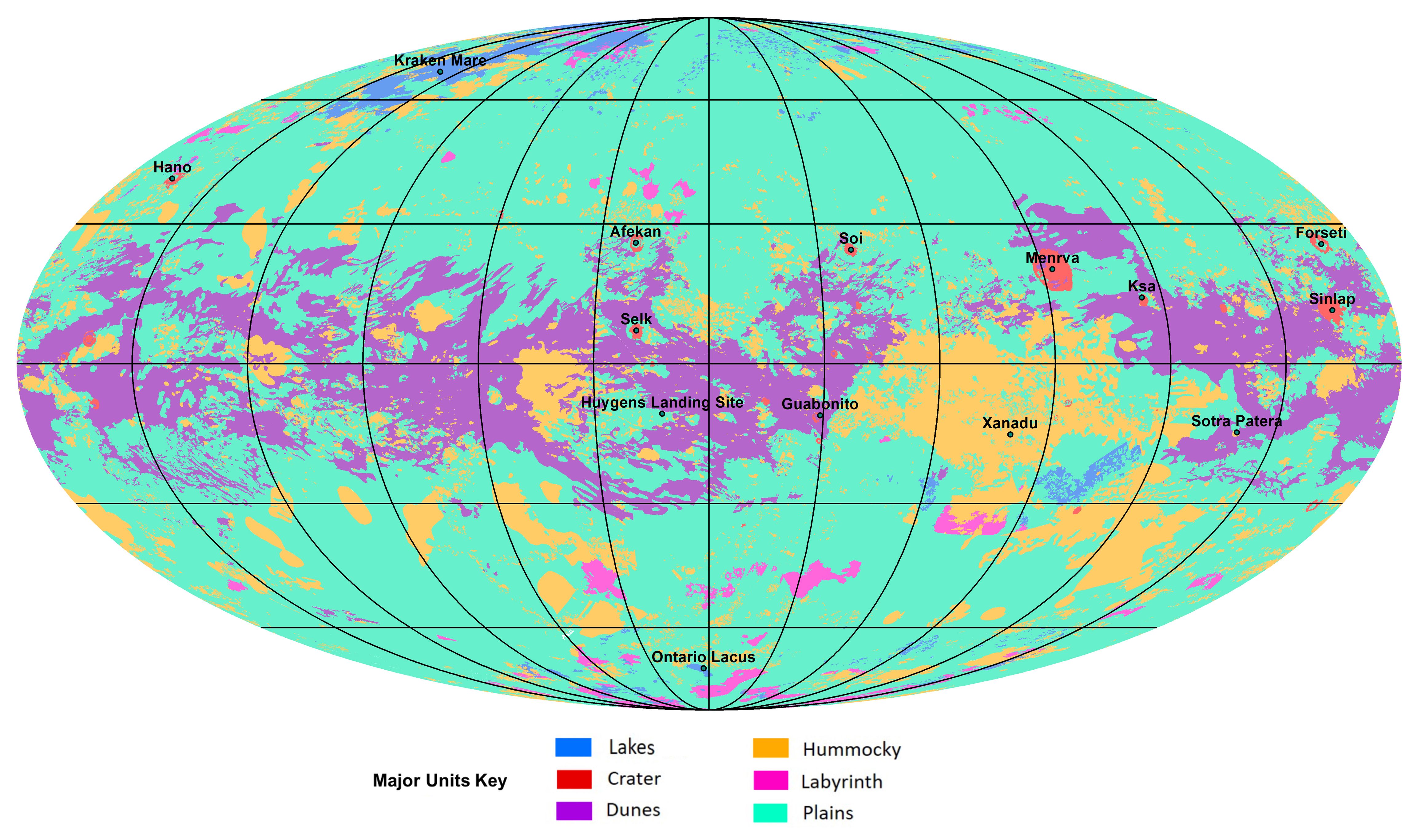
The first global geologic map of Titan is based on radar and visible-light images from NASA’s Cassini mission, which orbited Saturn from 2004 to 2017. Labels point to several of the named surface features. NASA/JPL-Caltech/ASU

A NASA team has created the first global map of Titan, the largest moon of Saturn, showing the different geological features on the distant body. The map was created using data from the Cassini spacecraft, which despite being deliberately destroyed in Saturn’s atmosphere two years ago, continues to provide data that drive scientific insights.

Recommended Videos

On the map of Titan shown above, as with many maps of Earth, the black lines represent latitude and longitude, marked in this case in increments of 30 degrees. The map uses what is called a Mollweide projection, so objects near the poles retain their relative size to objects near the equator. The shape of the objects at the poles is distorted though. The colors indicate different geological units found on Titan, like broad, flat plains in turquoise or hummocky areas with many hills and some mountains in yellow.

As you can see from the spattering of blue near the northern pole, Titan has many lakes. These lakes aren’t made of water though, as it’s far too cold for liquid water to exist on the moon. Instead, the lakes are composed of liquid methane and ethane. These substances are gas on Earth but liquid in the freezing surface temperatures of 98.29 K (−179 °C or −290 °F). These liquids rain down from Titan’s atmosphere, forming a system similar to our water cycle here on Earth.

“Titan has an active methane-based hydrologic cycle that has shaped a complex geologic landscape, making its surface one of most geologically diverse in the solar system,” Rosaly Lopes, a planetary geologist with NASA and lead author of research used to develop the map, said in a statement. “Despite the different materials, temperatures, and gravity fields between Earth and Titan, many surface features are similar between the two worlds and can be interpreted as being products of the same geologic processes. The map shows that the different geologic terrains have a clear distribution with latitude, globally, and that some terrains cover far more area than others.”

You can download a high-definition version of the map here if you want to see more details. And if you’re hoping for a closer look at this remarkable moon, then good news — NASA is sending a drone there for its Dragonfly mission, set to launch in 2026.
Georgina Torbet
Georgina has been the space writer at Digital Trends space writer for six years, covering human space exploration, planetary…
Polar is yet another AI browser, but it goes beyond just automating the mundane web chores
Polar wants to turn your browser into an AI-powered productivity tool
Polar AI browser

The AI browser race is entering a new phase. After spending much of 2025 trying to reinvent web search with built-in chatbots, startups are increasingly shifting their attention toward browser agents that can automate repetitive work instead of simply answering questions. The latest company to embrace that transition is Polar, a startup founded by former Perplexity engineer Kevin Zhang, which has raised $5.7 million in seed funding led by Madrona.

Unlike the first generation of AI browsers that targeted everyday consumers, Polar is designed specifically for knowledge workers. Its premise is straightforward: instead of replacing Google Search, the browser aims to eliminate repetitive tasks that professionals perform across dozens of browser tabs every day.

Read more
I use ChatGPT Pro everyday, and these 3 features keep me subscribed
ChatGPT on iPhone

I've used ChatGPT for years, but for the longest time, I never felt the need to pay for it. Instead, I subscribed to Claude Pro because it fit my workflow better. Between regular chat and Cowork, it gave me everything I needed in one place, so paying for another AI subscription didn't make sense.

That changed when OpenAI introduced ChatGPT Work. I was curious enough to give ChatGPT Pro a proper shot, expecting to test one new feature and move on. Instead, I ended up using it far more than I expected. The more I relied on it in my day-to-day work, the more I realized it offered a few things I didn't want to give up. Those are the three features that have kept me happily subscribed ever since.

Read more
The music industry wants AI slop kicked off the charts, and it finally has a plan
Universal, Sony, and Warner are pushing global charts to block AI slop songs.
Spotify music player

I've caught myself bopping along to a new viral quite a few times, only to realize that it was created using artificial intelligence. Turns out the labels are just as fed up with this as I am.

So what exactly are labels asking for?

Read more