  1. Home
  2. Emerging Tech
  3. News

Hear the Earth’s magnetic field sing as it is bombarded by a solar storm

Add as a preferred source on Google

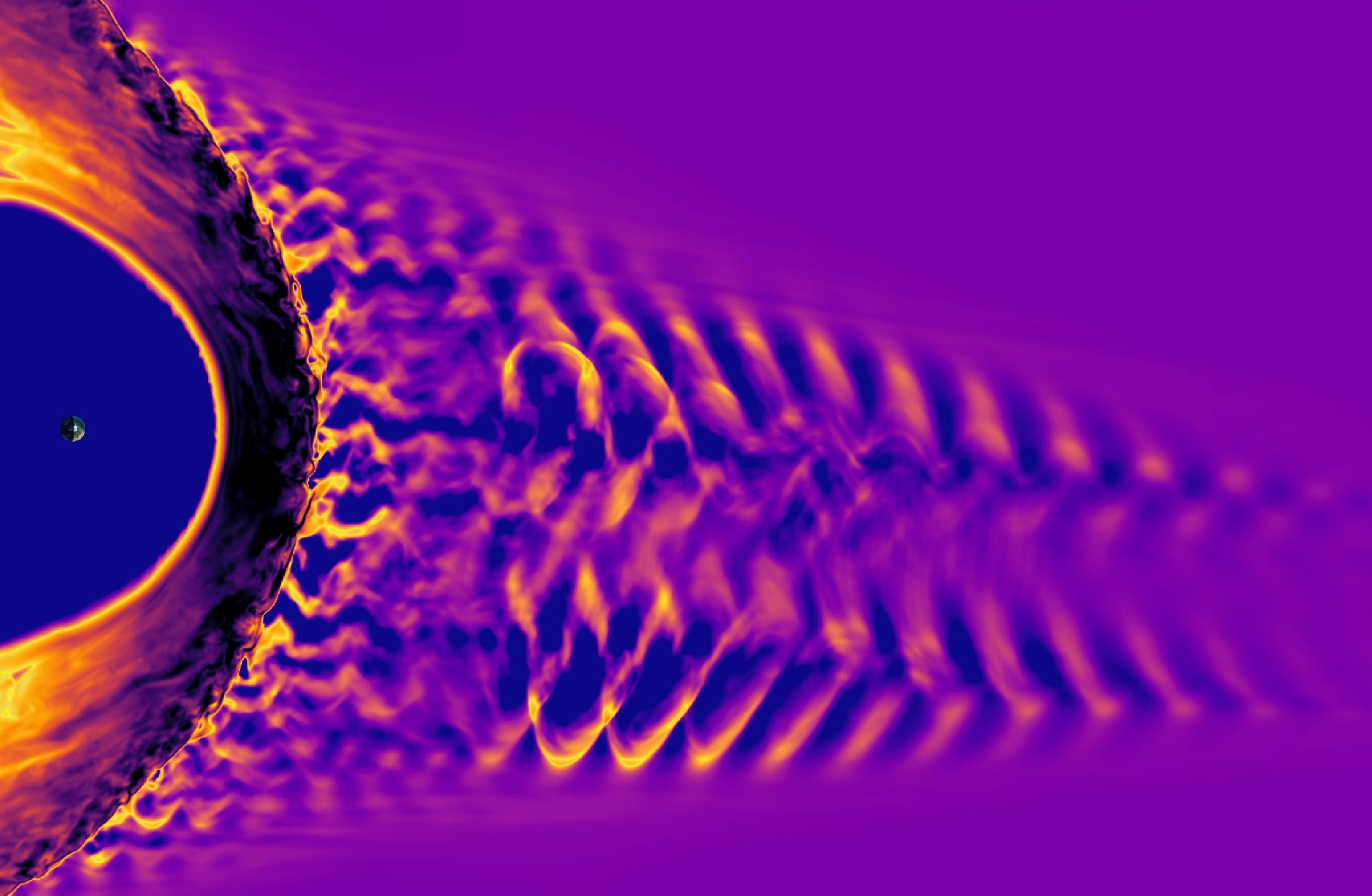
In this image, Earth is the dot to the left of the image and the large arc around it is our planet’s magnetic bow shock. The swirling pattern to the right is the foreshock region where the solar wind breaks into waves as it encounters reflected particles from the bow shock. The image was created using the Vlasiator model, a computer simulation developed at the University of Helsinki to study Earth’s magnetic interaction with the solar wind. Vlasiator team, University of Helsinki

The sun doesn’t only shine light and heat down on our planet — it also bombards the Earth with solar winds consisting of electrically charged particles. These solar winds spread out through the solar system are responsible for space weather and can trigger bursts of energy when they interact with the planet’s magnetosphere. Now, researchers from the European Space Agency have caught these solar winds in action, by recording the sound of a solar storm colliding with the Earth’s magnetic field.

Eerie space chatter spewing from the Sun

The eerie sounds are a ‘sonification’ of the magnetic waves generated by the incoming solar winds. The first clip, with data from 2003, was taken during a period of relative calm in the space weather. The second clip, using data from 2005, shows the sounds of a full-on solar storm.

Recommended Videos

To create those sounds, researcher Lucile Turc and colleagues took data of the fluctuations in the planet’s magnetic field and translated those frequencies into sound waves. You can hear how the sounds recorded during the solar storm are higher pitched than those in the calm period. The sounds during the solar storm are also more complex, showing how the magnetic fields resonate in a complicated way.

When solar storms reach our planet, they first interact with a region called the foreshock. When particles bounce off the magnetic field from our planet’s molten core, they interfere with incoming particles, creating magnetic waves. “Our study reveals that solar storms profoundly modify the foreshock region,” Turc said in a statement. “It’s like the storm is changing the tuning of the foreshock.”

The way that these complex patterns in space affect us here on the surface is a question that scientists are still investigating. Behind the foreshock is a region called the bow shock which slows down the charged particles of solar winds. Scientists have conjectured that a magnetosphere like the one our planet has may even be an essential component for life to flourish, as it protects inhabitants from harsh solar radiation.

The research is published in the journal Geophysical Research Letters.

Georgina Torbet
Georgina has been the space writer at Digital Trends space writer for six years, covering human space exploration, planetary…
Polar is yet another AI browser, but it goes beyond just automating the mundane web chores
Polar wants to turn your browser into an AI-powered productivity tool
Polar AI browser

The AI browser race is entering a new phase. After spending much of 2025 trying to reinvent web search with built-in chatbots, startups are increasingly shifting their attention toward browser agents that can automate repetitive work instead of simply answering questions. The latest company to embrace that transition is Polar, a startup founded by former Perplexity engineer Kevin Zhang, which has raised $5.7 million in seed funding led by Madrona.

Unlike the first generation of AI browsers that targeted everyday consumers, Polar is designed specifically for knowledge workers. Its premise is straightforward: instead of replacing Google Search, the browser aims to eliminate repetitive tasks that professionals perform across dozens of browser tabs every day.

Read more
I use ChatGPT Pro everyday, and these 3 features keep me subscribed
ChatGPT on iPhone

I've used ChatGPT for years, but for the longest time, I never felt the need to pay for it. Instead, I subscribed to Claude Pro because it fit my workflow better. Between regular chat and Cowork, it gave me everything I needed in one place, so paying for another AI subscription didn't make sense.

That changed when OpenAI introduced ChatGPT Work. I was curious enough to give ChatGPT Pro a proper shot, expecting to test one new feature and move on. Instead, I ended up using it far more than I expected. The more I relied on it in my day-to-day work, the more I realized it offered a few things I didn't want to give up. Those are the three features that have kept me happily subscribed ever since.

Read more
The music industry wants AI slop kicked off the charts, and it finally has a plan
Universal, Sony, and Warner are pushing global charts to block AI slop songs.
Spotify music player

I've caught myself bopping along to a new viral quite a few times, only to realize that it was created using artificial intelligence. Turns out the labels are just as fed up with this as I am.

So what exactly are labels asking for?

Read more