  1. Home
  2. Emerging Tech
  3. News

These robots taser weeds to death so farmers don’t need chemical herbicides

Add as a preferred source on Google
Image used with permission by copyright holder
Promotional image for Tech For Change. Person standing on solar panel looking at sunset.
This story is part of Tech for Change: an ongoing series in which we shine a spotlight on positive uses of technology, and showcase how they're helping to make the world a better place.

Imagine if every time a weed appeared in your garden, a bolt of lightning came down from the heavens and zapped it off the face of the planet. Were this the case, you could be fairly certain of two things: That you had a higher power firmly on side and that you probably don’t want to be walking around your garden with all that deadly lightning flying about.

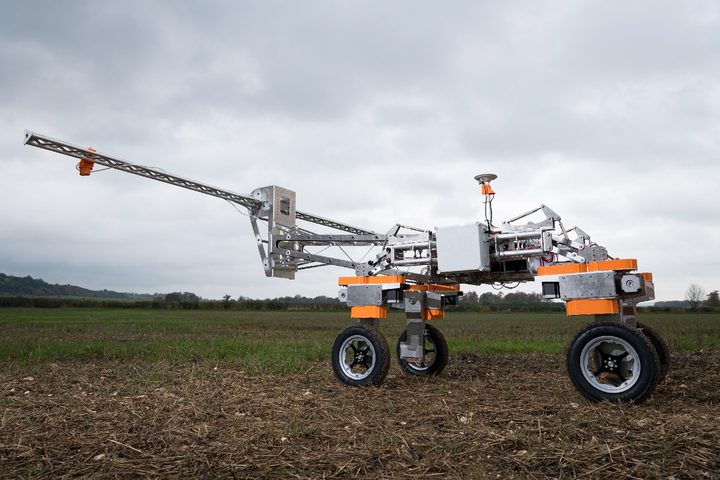
A similar but more realistic solution has presented itself in the form of a new agricultural robotics startup called the Small Robot Company. The U.K.-based firm offers a trio of robots that will kill weeds with electricity.

Recommended Videos

“Our first farm-ready robot, Tom, is now in four of our trial farms — including [U.K. supermarket] Waitrose and the National Trust,” Sam Watson Jones, co-founder of the Small Robot Company, told Digital Trends. “He’s delivering our first commercial service: Weed mapping. Once you know where all the weeds are, you can zap them individually.”

Tom is capable of covering 20 hectares (50 acres) per day, sorting plants from weeds. It will then pass this information on to Dick, a robot that uses a chemical-free weed killing method in which electricity is used to boil weeds from the inside. Dick will begin field trials in the new year, with commercial service starting in 2021. The final member of the team, Harry, will then follow in 2022. Harry is an automated planting robot which can sow seeds and record their exact location.

“One of the biggest challenges facing humanity today is how will we feed 9 billion people sustainably by 2050,” Watson Jones said. “Using artificial intelligence and next-generation geolocation technology, we can see every single plant in the field — and are now starting to care for them individually. This is a data set that has never existed before, and will entirely change what’s possible on the farm. We’ll be able to plant different plants alongside each other, harvesting them at different times, breaking down monocultures, and farming much more in line with nature. The ultimate sustainable farming model.”

The company is planning to start out in the U.K. market, focused on wheat. Longer term, it hopes to also use the technology for arable crops including barley, soy, and rice. “We’ve had interest from all over the world, including China, India and South America,” Watson Jones said.

Luke Dormehl
I'm a UK-based tech writer covering Cool Tech at Digital Trends. I've also written for Fast Company, Wired, the Guardian…
Chrome is getting better at understanding the breaks and punctations you never say out loud
Voice typing in Chrome is about to feel much more natural
Google Chrome on Android Featured

Google is quietly making voice dictation in Chrome feel a lot more natural. With the latest Chrome 151 Beta, the company is introducing a new capability that allows the browser's speech recognition engine to automatically infer punctuation based on the way people speak, eliminating the need to explicitly say commands like "comma" or "full stop."

The update may sound minor at first glance, but it addresses one of the biggest frustrations with voice typing: speaking naturally often produces text that lacks punctuation unless users consciously dictate every punctuation mark. By teaching Chrome to understand pauses, rhythm, and speech patterns, Google is taking another step toward making conversations with computers feel more human.

Read more
Horror films play music to warn about danger. These headphones use the same trick to save you from robots
Spherephones replaces factory alarms with music that tells you what is coming and from where.
spherephones-georgia-tech

The ear has always processed what is coming before the eye does. In horror movies, the music always tells you something bad is coming. Now researchers at Georgia Tech are using the same idea in real life to keep factory workers safe around robots.

They have built a wearable headset called Spherephones that converts nearby robot movement into spatial music, giving you a warning before a machine gets too close. It helps the user stay aware without breaking their attention.

Read more
Elon Musk refutes report claiming that an AI device is in development at SpaceX
The billionair's two-word denial on X doesn't explain what part of the Wall Street Journal's report he's disputing.
Elon Musk speaking into a microphone with a blue background

Elon Musk has denied a Wall Street Journal report claiming SpaceX showed investors a prototype AI device before its recent IPO. "Utterly false," Musk wrote on X, responding to a post about the report that has since been deleted, offering no further explanation.

A denial that leaves more questions than it answers

Read more