  1. Home
  2. Emerging Tech
  3. News

European Space Agency launches Cheops satellite to investigate exoplanets

Add as a preferred source on Google

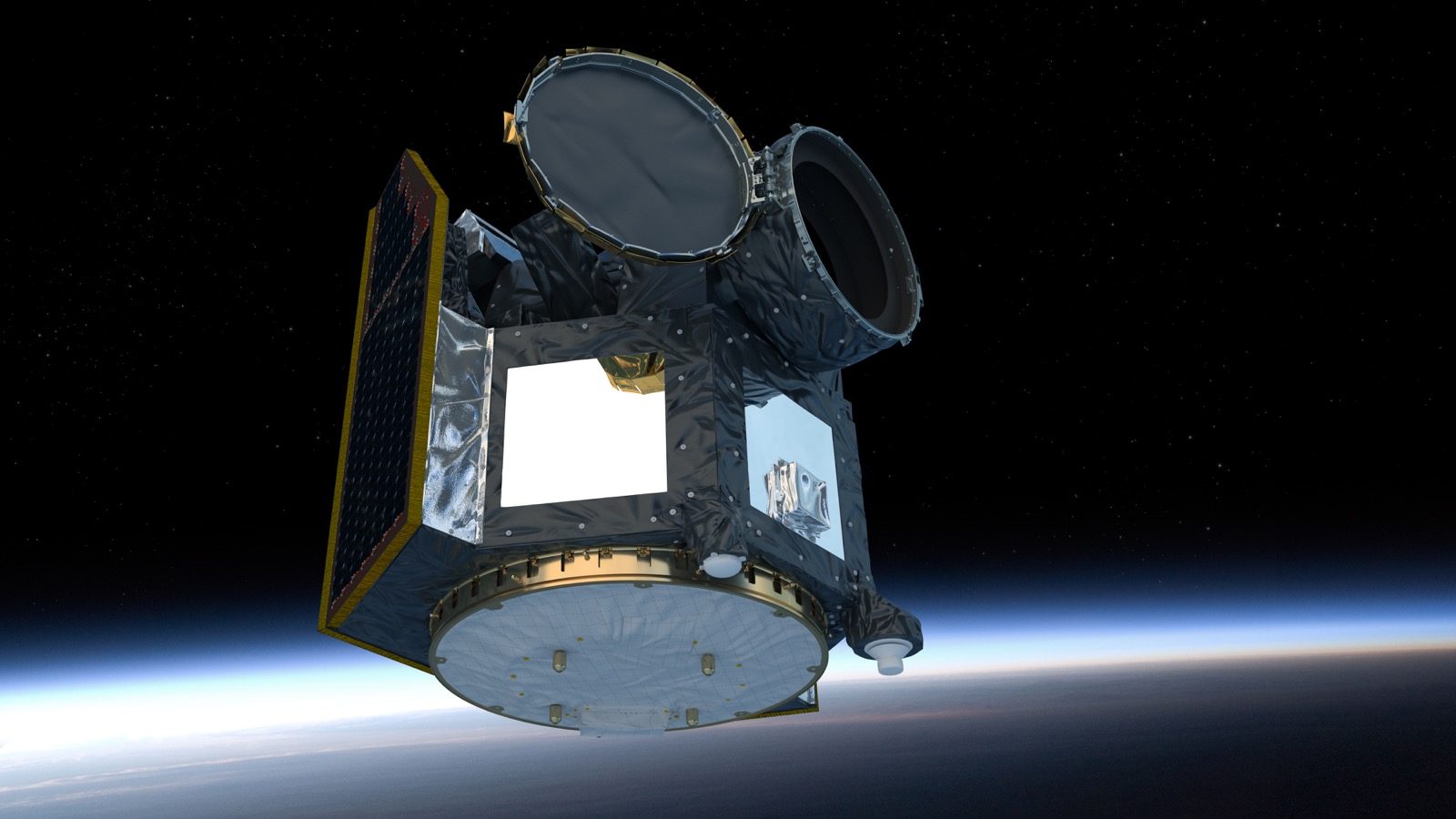
Artist's impression of Cheops, ESA's Characterising Exoplanet Satellite, in orbit above Earth.
Artist’s impression of Cheops, ESA’s Characterizing Exoplanet Satellite, in orbit above Earth. In this view the satellite’s telescope cover is open. ESA / ATG medialab

This decade has seen an explosion of research into exoplanets — planets orbiting stars other than our sun — with missions like NASA’s TESS discovering potentially habitable worlds, nearby planets, and a baby gas giant. Now, the European Space Agency (ESA) is beginning its own exoplanet mission with the launch of the Cheops satellite.

Recommended Videos

The Characterizing Exoplanet Satellite, aka Cheops, is the first ESA mission focused on exoplanets, and it will primarily look for new information about already-discovered planets.

“Cheops will take exoplanet science to a whole new level,” Günther Hasinger, ESA Director of Science, said in a statement. “After the discovery of thousands of planets, the quest can now turn to characterization, investigating the physical and chemical properties of many exoplanets and really getting to know what they are made of and how they formed.”

The satellite launched this week from Europe’s Spaceport in Kourou, French Guiana aboard a Soyuz-Fregat rocket.

ESA’s Characterising Exoplanet Satellite, Cheops, lifts off from Europe’s Spaceport in Kourou, French Guiana.
ESA’s Characterizing Exoplanet Satellite, Cheops, lifts off from Europe’s Spaceport in Kourou, French Guiana. Image used with permission by copyright holder

By observing planets as they transit across their stars, the satellite can see how much light from the star they block, which helps researchers measure their size. Armed with this information and data on the mass of the planets, the researchers can estimate the planets’ density, which tells them whether the planet is gaseous like Jupiter or rocky like Earth. The mission could also reveal moons or rings around some planets, and could detect information about the atmospheres of others.

“We are very excited to see the satellite blast off into space,” Kate Isaak, ESA Cheops project scientist, said in the same statement. “There are so many interesting exoplanets and we will be following up on several hundred of them, focusing in particular on the smaller planets in the size range between Earth and Neptune. They seem to be the commonly found planets in our Milky Way galaxy, yet we do not know much about them.

“Cheops will help us reveal the mysteries of these fascinating worlds, and take us one step closer to answering one of the most profound questions we humans ponder: Are we alone in the Universe?”

Georgina Torbet
Georgina has been the space writer at Digital Trends space writer for six years, covering human space exploration, planetary…
This spinning drone hides in plain sight using a visual illusion
This drone doesn't turn invisible. It tricks your brain into thinking it has.
Phantom Twist

For decades, engineers have chased the dream of an invisible drone. The usual approaches have involved transparent materials, camouflage coatings, or complex optical systems that bend light around an object. Researchers at Northwestern University decided to take a completely different route. Instead of hiding the drone itself, they chose to fool the human eye.

The result is Phantom Twist, an experimental drone that spins so rapidly it almost disappears into the background. It's not technically invisible, but to anyone watching, it looks more like a faint blur than a flying machine.

Read more
This smart knitted fabric can flip switches, count your steps, and even change shape
Grandma's knitting just entered its Iron Man era
Representative Image

For most of us, knitting brings to mind sweaters, scarves, and perhaps an ambitious grandmother determined to make winter more fashionable. Researchers at Harvard University, however, have a far more futuristic vision. They've transformed ordinary knitted fabric into a programmable material capable of changing shape, acting as an electrical switch, sensing movement, and potentially forming the foundation of tomorrow's wearable technology.

The research, published in Advanced Functional Materials by scientists at the Harvard John A. Paulson School of Engineering and Applied Sciences (SEAS), demonstrates how machine-knitted textiles can "snap" between multiple stable shapes without relying on motors or rigid mechanical parts.

Read more
Starlink V5 is here, and it’s lighter, smarter, and far more efficient
The next-generation satellite internet kit promises improved efficiency while maintaining high-speed connectivity.
Starlink V4 vs V5

Not every hardware upgrade needs to be about speed. With Starlink V5, SpaceX is betting that a lighter design and lower power consumption matter just as much. The company has officially introduced its next-generation Starlink V5 kit, featuring a smaller and lighter design with significantly improved power efficiency.

Smaller, lighter, and far more efficient

Read more