  1. Home
  2. Emerging Tech
  3. News

NASA’s Mars 2020 rover will search for evidence of ancient life on red planet

Add as a preferred source on Google

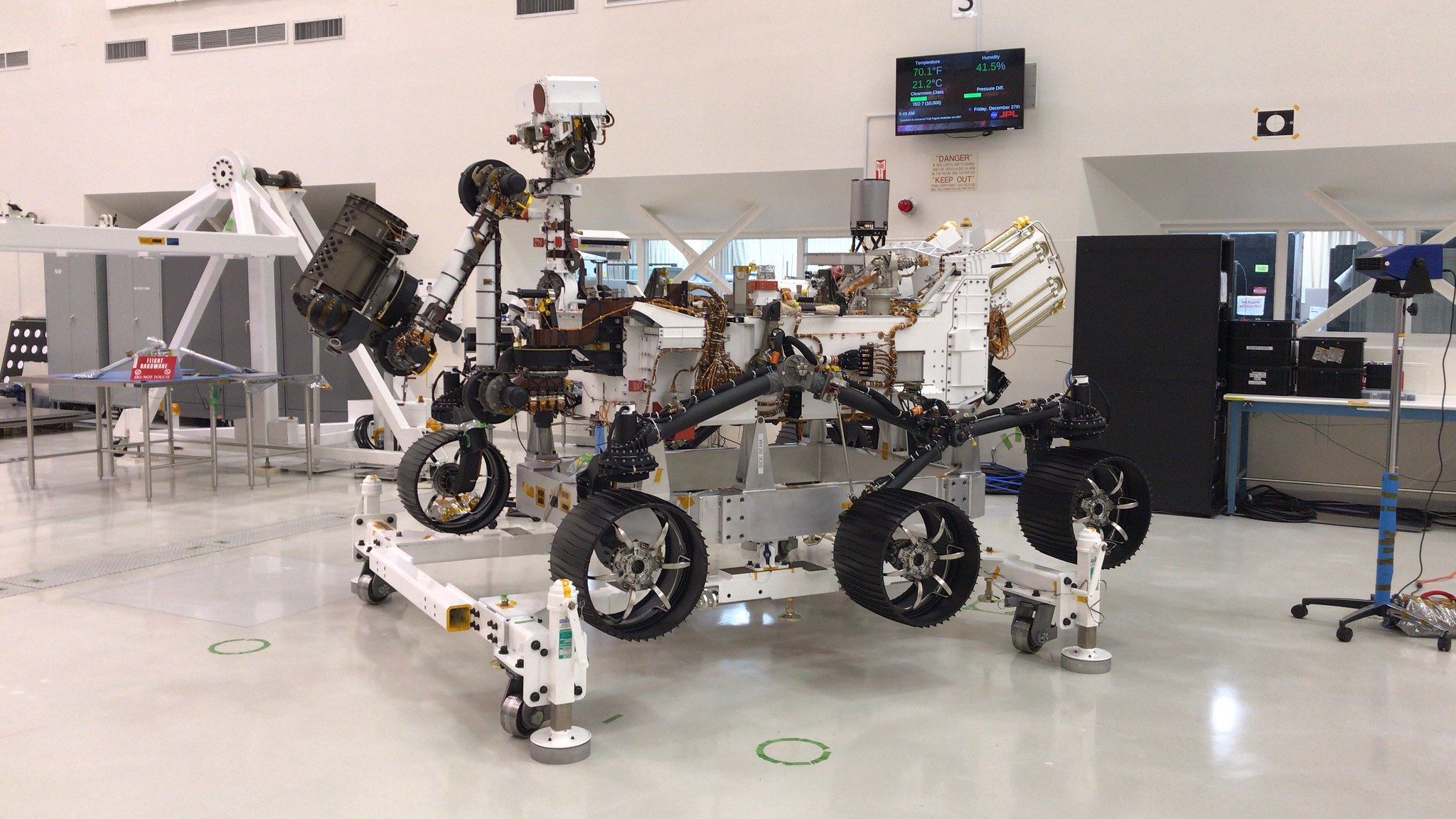
NASA's Mars 2020 Rover
NASA’s Mars 2020 Rover is shown off to journalists at the Jet Propulsion Laboratory on December 27 2019. NASA/JPL-Caltech

After years of work, NASA’s Mars 2020 rover is ready to explore an alien world. With construction and testing at NASA’s clean room facility now completed, the rover will be packed up and shipped to Florida ahead of final testing before it is strapped to a rocket and launched on its journey to Mars in a few months’ time.

Recommended Videos

The rover has an ambitious mission: To search for evidence that life once existed on the red planet. “Mars 2020 is looking for signs of ancient life,” Zach Ousnamer, a Mechanical Engineer on the Mars 2020 Rover project at the Jet Propulsion Laboratory, said in an interview posted by NASA. “We’re going to land in the Jezero Crater which is an ancient river delta, and here on Earth, we know those are hot spots for life. So we’re going to go to one on Mars in hopes of finding life there.”

NASA already has a number of instruments on and around Mars, including the Curiosity rover, the InSight lander, and the Mars Reconnaissance Orbiter spacecraft. But the Mars 2020 rover will have new tools and updated instruments which allow it to perform tasks which existing explorers can’t.

When Ousnamer was asked how the instruments on the Mars 2020 rover compare to those on Curiosity, he pointed to several new features on the latest rover. “We’re flying seven new instruments,” he said. “Some of them are similar to those flown on Curiosity but upgraded. We have, for instance, a new instrument MOXIE, which is generating oxygen on the surface of Mars.”

Being able to generate oxygen on the planet is a vital part of preparing for an eventual manned mission to the surface, both for breathing and creating fuel, and MOXIE should be able to produce around 10 grams of oxygen per hour by converting the carbon dioxide which is abundant in the Martian atmosphere.

Other tools in the rover are focused on scientific discovery. “We have SuperCam on the top of the head of the remote sensing mast, doing laser-induced breakdown spectroscopy,” Ousnamer explained. That will allow scientists to identify the chemical composition of rocks and soil that the rover encounters in the Martian environment.

“And then the big thing that is different from Curiosity is that inside the rover is the Adaptive Caching Assembly. That’s a whole suite which takes samples of Mars, puts them in a canister, hermetically seals them, and leaves those on the surface in the hope that in a future mission, we can bring them back to study here on Earth.”

The Mars 2020 mission is set to launch between July 17 and August 5 next year.

Georgina Torbet
Georgina has been the space writer at Digital Trends space writer for six years, covering human space exploration, planetary…
Starlink V5 is here, and it’s lighter, smarter, and far more efficient
The next-generation satellite internet kit promises improved efficiency while maintaining high-speed connectivity.
Starlink V4 vs V5

Not every hardware upgrade needs to be about speed. With Starlink V5, SpaceX is betting that a lighter design and lower power consumption matter just as much. The company has officially introduced its next-generation Starlink V5 kit, featuring a smaller and lighter design with significantly improved power efficiency.

Smaller, lighter, and far more efficient

Read more
Frontier joins the Starlink club with high-speed in-flight internet
The carrier plans to roll out SpaceX's satellite-powered Wi-Fi across its fleet starting in 2027.
Frontier Starlink partnership featured

If there's one thing budget airlines aren't exactly known for, it's great onboard Wi-Fi. In Frontier Airlines' case, it hasn't offered in-flight internet at all. That's about to change. Frontier Airlines has announced a partnership with SpaceX's Starlink to bring high-speed, low-latency internet across its fleet. Installations will begin in early 2027, making Frontier the first ultra-low-cost carrier in the United States to adopt Starlink's satellite-powered connectivity.

Streaming, browsing, and even gaming at 35,000 feet

Read more
OpenAI’s first hardware product sounds more like a companion than a speaker
The AI company is reportedly building a mobile home device that understands context and proactively helps users.
OpenAI press image

For months, rumors have suggested that OpenAI's first hardware product could be a wearable AI device, or perhaps even the beginning of its long-term smartphone ambitions. As it turns out, the company's first gadget may be something far simpler, yet arguably far more ambitious. It will help control smart-home appliances, play media, answer questions, respond to messages, and tap into the range of capabilities offered by OpenAI's ChatGPT, according to people familiar with the matter.

OpenAI's first AI device could end up being a speaker, following plenty of hype that the company is actually working on a wearable AI device and might even launch a smartphone down the road. According to a Bloomberg report, the speaker will serve as a human-like AI companion that will integrate directly with the smart home ecosystem.

Read more