  1. Home
  2. Emerging Tech
  3. News

Mars Express image shows the boundary between the planet’s hemispheres

Add as a preferred source on Google

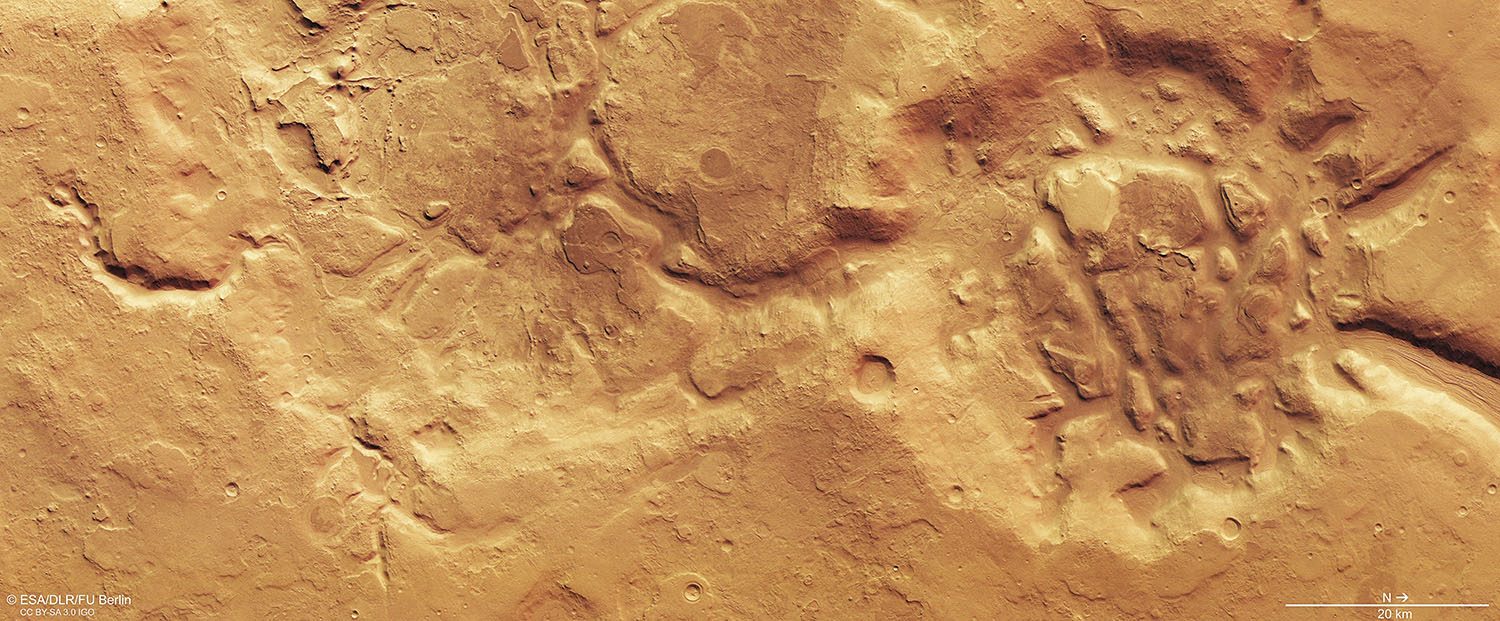
Mars is very much a world of two halves – as highlighted by this new image from ESA’s Mars Express, which shows where the planet’s dramatically different hemispheres come together as one.
Mars is very much a world of two halves — as highlighted by this new image from ESA’s Mars Express, which shows where the planet’s dramatically different hemispheres come together as one. ESA/DLR/FU Berlin

The European Space Agency (ESA)’s Mars Express orbiter has captured this image of the Martian surface, showing the boundary between the planet’s north and south hemispheres. The two hemispheres are strikingly different. The northern hemisphere of Mars is generally smooth and flat, consisting of low plains with few impact craters. The southern hemisphere, however, is mountainous and covered in craters, with many areas of past volcanic activity.

Recommended Videos

To see the boundary between the two more clearly, the ESA also released this colored version of the image which represents elevation. The purple and blue areas are low, while the yellow and reds have higher altitudes. The bottom half of the image shows a high ridge, with a boundary beyond which lower plains lie.
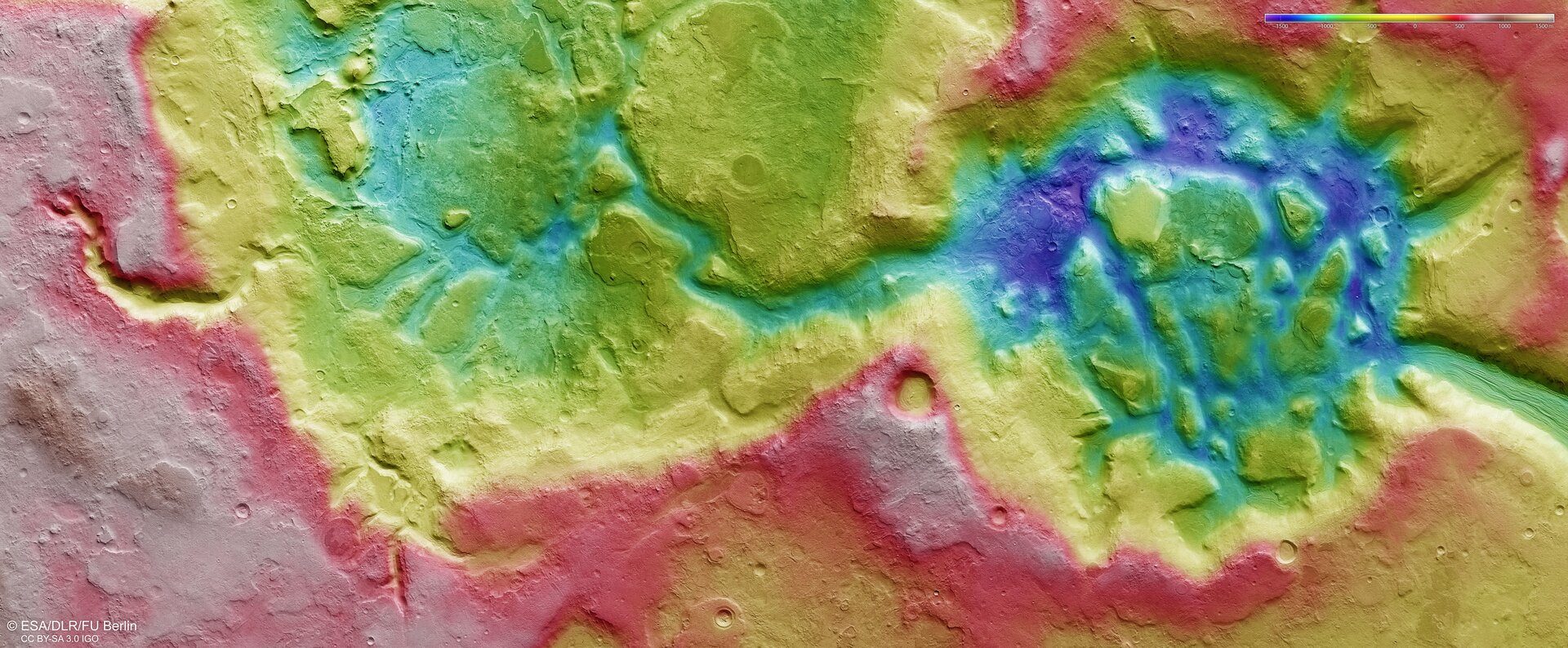
This colour-coded topographic image shows a region of Mars’ surface named Nilosyrtis Mensae, based on data gathered by the Mars Express High Resolution Stereo Camera on 29 September 2019 during orbit 19908.
This color-coded topographic image shows a region of Mars’ surface named Nilosyrtis Mensae, based on data gathered by the Mars Express High Resolution Stereo Camera on September 29, 2019 during orbit 19908. ESA/DLR/FU Berlin, CC BY-SA 3.0 IGO

The area which separates the two hemispheres is called a “dichotomy boundary.” In this area, there are broken sections of ground called “fretted terrain,” and in this particular image, the region of fretted terrain is called  Nilosyrtis Mensae.

“Nilosyrtis Mensae has a labyrinthian appearance, with numerous channels and valleys carving through the terrain,” the ESA explained in a blog post. “Water, wind and ice have been strongly affecting this region, dissecting and eroding the terrain, along with changes in martian geology: valleys have formed over time and sliced across the region, and once-defined impact craters have slowly degraded, their walls and features gradually wearing away.”

The area is of interest not only because it is a boundary region, but also because it may contain clues to the history of water on Mars. There are ridges and grooves on the surface in the area which seem to have been made by a flowing material such as ice. At a distant time in the planet’s history, ice glaciers may have flowed across the surface of the planet, leaving impressions in the rock which are still visible today.


Georgina Torbet
Georgina has been the space writer at Digital Trends space writer for six years, covering human space exploration, planetary…
Researchers hid a prompt injection inside a PNG, and AI fell for it
Hacker

AI coding assistants like Claude are becoming every developer's favorite coworker. They can review code, explain confusing functions, and even write entire features with a single prompt. But new research suggests that this growing trust could also become their biggest weakness.

A team of security researchers (professor Sudipta Chattopadhyay and researcher Murali Ediga) has demonstrated an unusual attack that doesn't target the AI model directly. Instead, it targets what the AI doesn't pay enough attention to during code reviews. Rather than hiding malicious instructions in lines of code, the researchers tucked them inside an image file. Since many AI review tools treat images as decorative assets rather than as something worth inspecting, the pull request can appear perfectly harmless and sail through the review.

Read more
AI has already fallen into the wrong hands and they’re using it to make bombs
Logo, Text

Artificial intelligence has quickly become the go-to tool for everything from writing emails and summarizing meetings to helping students study or developers debug code. But the same technology that saves people time can also be misused, and a new report suggests that terrorist organizations are finding ways to do exactly that.

According to a research paper shared with The New York Times ahead of its publication, researchers found evidence that members of Boko Haram have been using popular AI chatbots to support both day-to-day activities and combat-related tasks. Interviews with 27 former members conducted in Nigeria over the past two years suggest that tools such as ChatGPT, Gemini, Claude, Grok, Meta AI, and DeepSeek were used to gather technical information, troubleshoot weapons, and even assist with planning attacks.

Read more
Claude Code can now browse the web without opening Chrome
The desktop app now includes an in-app browser that can read websites, click links, and interact with web apps.
Claude Code Featured

Developers spend a surprising amount of time bouncing between their code editor, browser tabs, API documentation, GitHub issues, and design files. Anthropic thinks Claude Code should simply do all of that without constantly asking users to switch windows. The company has announced a new in-app browser for Claude Code on desktop, allowing its AI coding assistant to open websites, read documentation, inspect designs, and interact with web pages directly from within the application.

A browser built into Claude Code

Read more