1. Home
  2. Emerging Tech
  3. News

Mayflower Autonomous Ship is headed to sea to test its self-driving boat tech

Add as a preferred source on Google
Entering the Mind of the Mayflower

Last year, Digital Trends wrote about an ambitious project that seeks to dispatch an unmanned autonomous ship across the Atlantic Ocean on the 400th anniversary of the voyage of the Mayflower. While this first-of-its-kind journey won’t take place until the this fall, IBM and marine research organization Promare announced Thursday that the “A.I. Captain” that will power the self-steering vessel is ready to go to sea for a month of testing. This trial, which will take place on a manned research vessel off the coast of Plymouth in the U.K., will test out the onboard A.I. and edge computing system to see how well it navigates.

Recommended Videos

“The complexity and danger of the ocean is definitely the biggest challenge for this mission,” Don Scott, chief technology officer of the Mayflower Autonomous Ship (MAS), told Digital Trends. “It’s not like A.I. Captain starts performing an action and then stays along that path. To be effective, the A.I. Captain will have to constantly evaluate and reevaluate the situation, and make decisions based on the changing local and forecast environment.”

In theory, navigating at sea is comparatively easy next to, say, a self-driving car driving on a busy city street. But there’s plenty that could unexpectedly go wrong. The ocean is an ever-changing dynamic environment and the Mayflower will need to be able to deal with this level of complexity, on its own, in the middle of the ocean with intermittent connectivity.
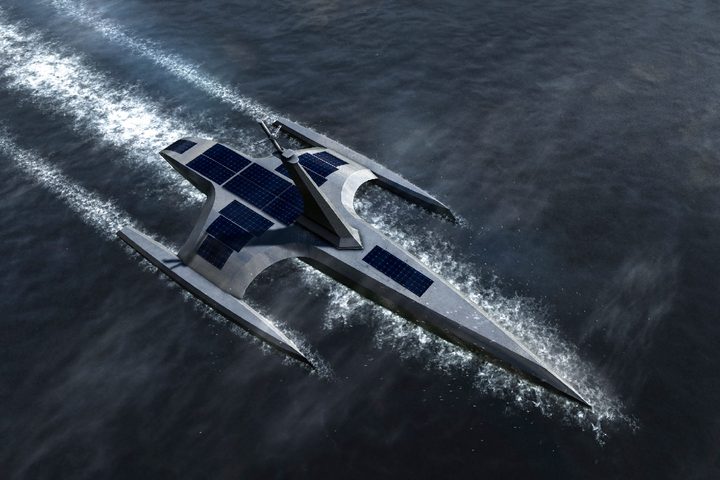
Mayflower Autonomous Ship

“The Mayflower Autonomous Ship is the perfect situation where theory and thoughtful rumination are forced to address reality,” Scott said. “In this case, the hard reality is the open ocean. In order for MAS to succeed, we need to advance not only our knowledge and capabilities of A.I.-based autonomy and all of its composite components, but also make it work at sea.”

Rob High, chief technology officer of IBM Edge Computing told Digital Trends that a fully autonomous ship introduces a different set of challenges than a self-driving car.

“A fully autonomous ship in the middle of the ocean must be able to recover without the benefit of human intervention,” High said. “Building a ship which is able to self assess and understand the changing limits for its mission based on its evolving condition is very challenging. It will rely to a large extent on failure prediction and localized compute power. That’s where edge computing comes into play. We can think of the Mayflower Autonomous Ship as an edge device. IBM is providing the edge systems that enable it to operate independently in some of the harshest conditions of the world.”

Can it pull it off? We won’t know until September, but this at-sea testing will certainly offer more than a few clues.


Luke Dormehl
I'm a UK-based tech writer covering Cool Tech at Digital Trends. I've also written for Fast Company, Wired, the Guardian…
Researchers hid a prompt injection inside a PNG, and AI fell for it
Hacker

AI coding assistants like Claude are becoming every developer's favorite coworker. They can review code, explain confusing functions, and even write entire features with a single prompt. But new research suggests that this growing trust could also become their biggest weakness.

A team of security researchers (professor Sudipta Chattopadhyay and researcher Murali Ediga) has demonstrated an unusual attack that doesn't target the AI model directly. Instead, it targets what the AI doesn't pay enough attention to during code reviews. Rather than hiding malicious instructions in lines of code, the researchers tucked them inside an image file. Since many AI review tools treat images as decorative assets rather than as something worth inspecting, the pull request can appear perfectly harmless and sail through the review.

Read more
AI has already fallen into the wrong hands and they’re using it to make bombs
Logo, Text

Artificial intelligence has quickly become the go-to tool for everything from writing emails and summarizing meetings to helping students study or developers debug code. But the same technology that saves people time can also be misused, and a new report suggests that terrorist organizations are finding ways to do exactly that.

According to a research paper shared with The New York Times ahead of its publication, researchers found evidence that members of Boko Haram have been using popular AI chatbots to support both day-to-day activities and combat-related tasks. Interviews with 27 former members conducted in Nigeria over the past two years suggest that tools such as ChatGPT, Gemini, Claude, Grok, Meta AI, and DeepSeek were used to gather technical information, troubleshoot weapons, and even assist with planning attacks.

Read more
Claude Code can now browse the web without opening Chrome
The desktop app now includes an in-app browser that can read websites, click links, and interact with web apps.
Claude Code Featured

Developers spend a surprising amount of time bouncing between their code editor, browser tabs, API documentation, GitHub issues, and design files. Anthropic thinks Claude Code should simply do all of that without constantly asking users to switch windows. The company has announced a new in-app browser for Claude Code on desktop, allowing its AI coding assistant to open websites, read documentation, inspect designs, and interact with web pages directly from within the application.

A browser built into Claude Code

Read more