Here on Earth, we’re all taking care to wash our hands for at least 20 seconds. But cleanliness is not only important on this planet — it’s important for the Curiosity rover on Mars as well.
Curiosity is gathering samples from across the red planet as it travels up the massive Mount Sharp. The rover drills into the bedrock, scoops up bits of rock and soil, and then transfers this sample to one of its two analysis instruments on board: the Sample Analysis at Mars (SAM) suite, which analyzes the sample for the presence of organic compounds and gases, or the Chemical and Mineralogy (CheMin) instrument, a spectrometer which measures the levels of minerals in the sample.
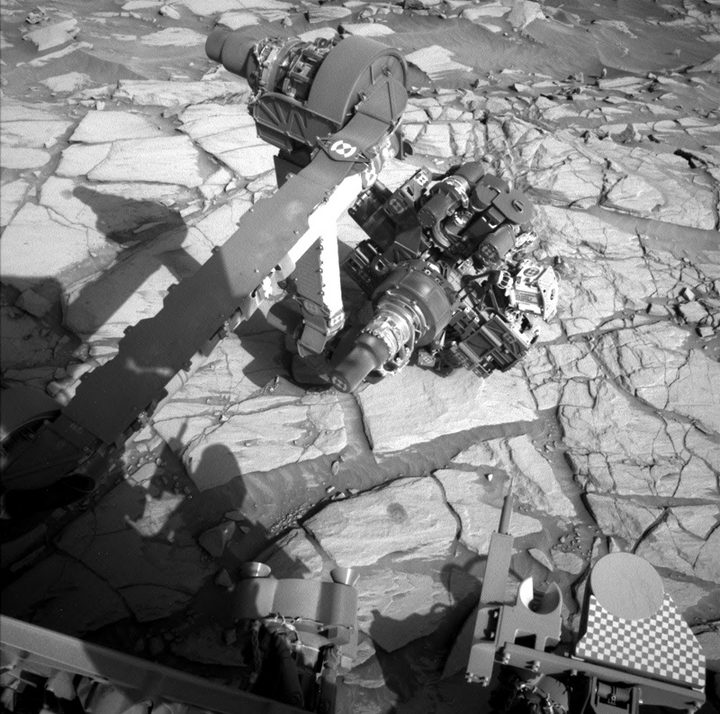
But the engineers controlling the rover need to be careful to ensure that each sample is not contaminated with material from any other sample. The Curiosity team explained how they achieve this while collecting a sample from the Edinburgh drill site in a blog post:
“Of course, the lack of water and soap prevents the rover from ‘washing,’ but we still have to make sure the rover’s instruments stay as clean as possible after touching a new surface. On Monday’s plan, we placed the rover’s arm over the drill tailings from our Edinburgh drill hole to study them with APXS [Alpha Particle X-Ray Spectrometer, a tool for measuring what chemical elements are present] and MAHLI [Mars Hand Lens Imager, one of Curiosity’s cameras].
In today’s plan, we’ll retract the arm from that position and stow it so we can drive away. During that process, we swing the turret back and forth to shake off and remove any bits of sand or dust that may have been clinging to APXS so when we next use it, APXS only measures materials at the new location and nothing that came with us from Edinburgh.”
With the latest drill site inspected, Curiosity will now move on to capturing more images of the dramatic Greenheugh Pediment where it is currently located. It will take a long-distance mosaic image of the area before taking a short drive to another patch of soil for its next round of study. As spring is just beginning on Mars, Curiosity will also be on the lookout for dust devils as these typically spike at this time of year.