1. Home
  2. Space
  3. News

NASA’s Solar Dynamics Observatory spots biggest solar flare since 2017

Add as a preferred source on Google

Our sun is an ever-changing and dynamic system, and NASA’s Solar Dynamics Observatory recently spotted the largest solar flare seen since 2017.

Periodically, the sun will flash brighter in an event called a solar flare, often accompanied by a huge burst of plasma arcing out from the sun’s surface called a coronal mass ejection. These flares are associated with an increased sunspot activity, in which dark spots appear on the surface of the sun.

Recommended Videos

While solar flares can be potentially damaging to satellite communications and electrical grids here on Earth, you needn’t worry about this recent flare — it has not passed the threshold set by the U.S. government’s Space Weather Prediction Center which would require an alert.

The flare is of interest though, as it indicates that the sun may be entering a new phase of its cycle.
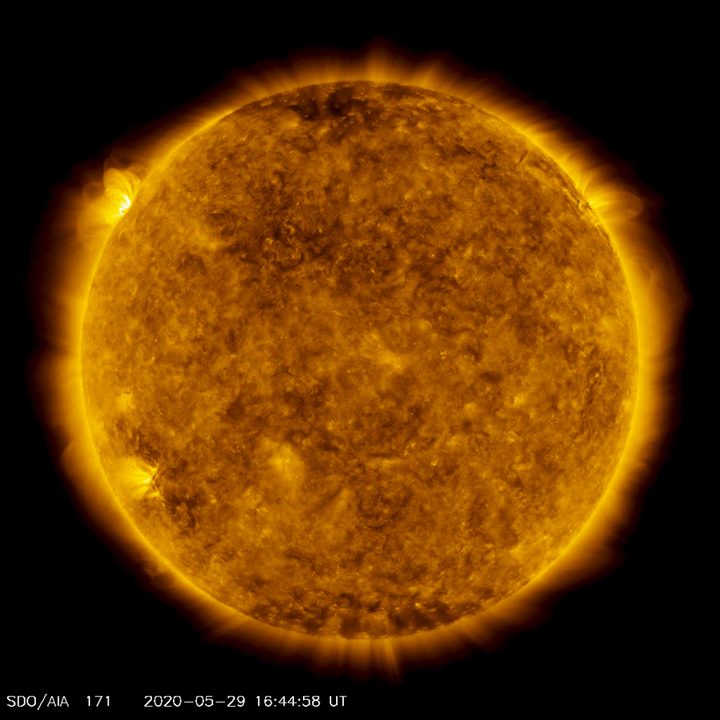
May 29, 2020 solar flare
On the upper left side of this image from May 29, 2020, from NASA’s Solar Dynamics Observatory — shown here in the 171-angstrom wavelength, which is typically colorized in gold — one can see a spot of light hovering above the left horizon. This light emanates from solar material tracing out magnetic field lines that are hovering over a set of sunspots about to rotate over the left limb of the Sun. NASA/Solar Dynamics Observatory/Joy Ng

The sun’s activity varies over an 11-year cycle, during which the number of sunspots and the amount of solar flare activity changes. The sun is thought to currently be in a period of minimal activity, called a solar minimum, and the appearance of this large solar flare could indicate that the solar minimum is coming to an end. That would mark the end of the current solar cycle, designated Solar Cycle 24, and the beginning of Solar Cycle 25.

In order to know whether the solar minimum is actually coming to a close, scientists need to continue monitoring the total number of sunspots appearing on the sun’s surface. But this will take some time, as NASA explains in a blog post: “It takes at least six months of solar observations and sunspot-counting after a minimum to know when it’s occurred. Because that minimum is defined by the lowest number of sunspots in a cycle, scientists need to see the numbers consistently rising before they can determine when exactly they were at the bottom.

“That means solar minimum is an instance only recognizable in hindsight: It could take six to 12 months after the fact to confirm when minimum has actually passed.”

Georgina Torbet
Georgina has been the space writer at Digital Trends space writer for six years, covering human space exploration, planetary…
China’s answer to SpaceX’s reusable rockets literally catches boosters in a net
SpaceX catches boosters on legs. China just used a net.
Ammunition, Missile, Weapon

SpaceX's playbook for recovering a rocket booster generally involves legs, a precisely controlled vertical landing, and either a concrete pad or a drone ship. 

China just managed to pull off something similar, but in a slightly different way, and on July 10, it tested the method as well.

Read more
Dimming the sun sounds unhinged, but this new study on El Niño makes a surprisingly good case for it
A natural test case, Australia's worst-ever wildfire season, suggests the idea deserves serious consideration.
Nature, Outdoors, Sky

When I first saw "scientists propose dimming the sun," I rolled my eyes. It sounds like a science fiction movie cooked up after watching many climate documentaries. But a new study, published on July 8, 2026, in the journal Science Advances, seems to have a genuinely compelling argument.

A Super El Niño is currently forming in the Pacific, feared to be the most intense in decades. It could escalate floods, wildfires, and extreme heat events worldwide. However, Researchers at UC San Diego's Scripps Institution of Oceanography, led by climate scientists Kate Ricke and Jessica Wan, are now proposing one of the most interesting solutions I’ve come across.

Read more
You can now walk through space and gaze into a black hole at this VR exhibit
Smithsonian Starstruck lets you drift past dying stars and see the origin point of the universe for as little as $18 a person.
Smithsonian Starstruck featured

Most planetarium shows ask you to sit still and look up. The Smithsonian's new VR exhibit takes a different approach, letting visitors walk through the vast expanse of the universe, drifting past stars, planets, and a black hole to get a physical sense of its true scale.

A $29 ticket to the edge of the galaxy

Read more