General Motors branched out into in-car connectivity well before the term became a buzzword thrown around annually at CES. Its OnStar suite of technology is nearly a quarter of a century old. It has received several major updates in the past 25 years, but its core mission remains the same: It exists to make driving more convenient.
What does OnStar do?

OnStar has evolved considerably since it was introduced on 1997 models at the 1996 edition of the Chicago Auto Show. It bundles a growing list of safety, connectivity, and convenience features into a single, factory-developed system. It notably includes Automatic Crash Response, which calls emergency services if the car’s on-board sensors detect a collision, and Stolen Vehicle Assistance, which helps authorities locate your car by using GPS data.
If you’re stuck, you can press the blue OnStar button (which is normally integrated into the rearview mirror) to ask for directions. An OnStar advisor can look up your point of interest — whether it’s a town or a Taco Bell — and send turn-by-turn directions to your car’s navigation system, assuming it’s equipped with one. If you’re caught in severe weather, like a blizzard, you can call OnStar and ask the advisor to give you the best way around it.
OnStar also includes roadside assistance, hands-free calling, and an in-car Wi-Fi hotspot, among other features. In short, it’s like an electronic co-pilot that’s ready to get you out of a sticky situation 24/7. And, while smartphones offer similar services, General Motors stresses OnStar’s benefit is that you’re always talking with a real human.
Some of OnStar’s features are available on a smartphone or a tablet. The purpose-designed app lets you keep track of where the car is, which is helpful if you want to make sure your kids are in class and not at the local skate park.
Is OnStar available everywhere?
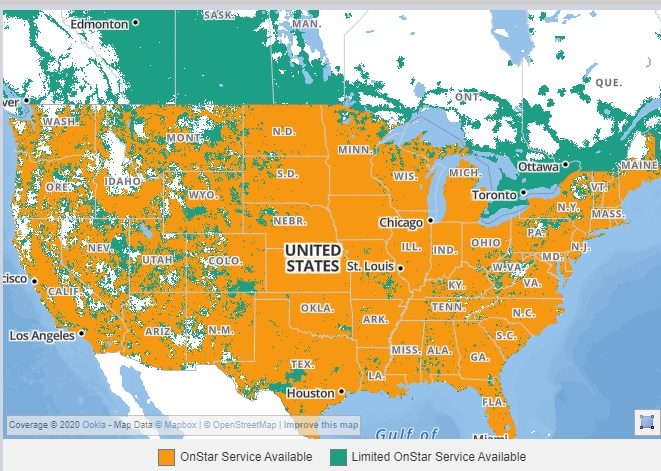
OnStar is available from coast to coast, though the service is a little bit patchy on the west side of the country. Some users in Canada can connect to it, too. The map above shows where OnStar is available and where it’s hit or miss.
How much does OnStar cost?

How much you’ll pay for OnStar depends on the features you want to add to your car. There are six plans available: App Access, Remote Access, Unlimited Access, Safety & Security, Safety & Security + Remote Access, and Safety & Security + Unlimited Access. App Access is the most basic plan, and it includes navigation, built-in Amazon Alexa connectivity, and in-car audio streaming. It costs $15 per month as of August 2020.
At the other end of the spectrum, the Safety & Security + Unlimited Access plan sets drivers back $45 a month, but it includes all of the aforementioned features and more. On-demand vehicle diagnostics is part of it, for example. General Motors charges $15 a month for Remote Access, $25 a month for Unlimited or Safety & Security (though the latter is available at $250 a year), and either $35 a month or $350 a year for Safety & Security + Remote Access.
Which cars are available with OnStar?

Nearly every car in the General Motors portfolio is compatible with OnStar, including models made by Chevrolet, Buick, GMC, and Cadillac. Odds are you’ll get OnStar regardless of whether you’re shopping for a 2020 Corvette or a 2020 Regal. Cars not made by General Motors are not available with OnStar, so don’t expect your 2021 Ford Bronco to come with the blue button on its rearview mirror. However, Ford’s Sync technology is a very similar system.