1. Home
  2. Space
  3. News

Could there once have been two stars in our solar system?

Add as a preferred source on Google

Could our sun have had a partner star during the early days of the solar system? A new study suggests our sun may have had a binary companion, like the system of the planet Tatooine from the original Star Wars movie.
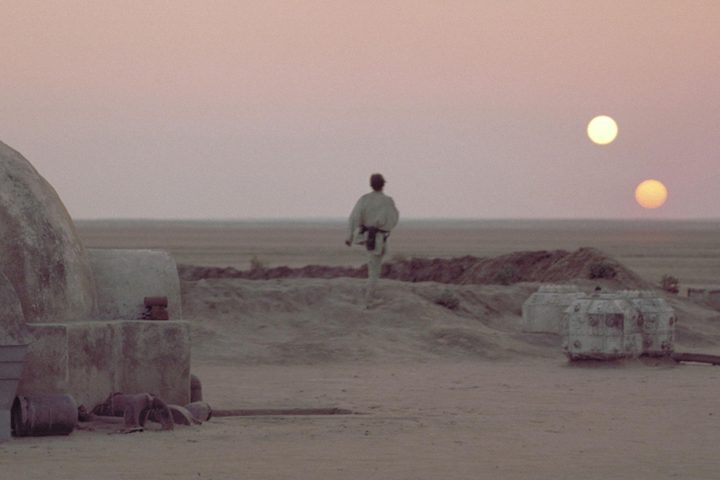
Twin suns seen from the fictional planet Tatooine in Star Wars Image used with permission by copyright holder

A team of researchers from Harvard put forth the theory that our region of space may have had another star present during the formation of the solar system. That would explain the presence of the Oort cloud, a collection of icy bodies orbiting the sun beyond Neptune. Scientists aren’t sure exactly how this cloud formed, and the presence of another star early could help explain it.

Recommended Videos

“Previous models have had difficulty producing the expected ratio between scattered disk objects and outer Oort cloud objects,” lead author Amir Siraj explained in a statement. “The binary capture model offers significant improvement and refinement, which is seemingly obvious in retrospect: Most sun-like stars are born with binary companions.”
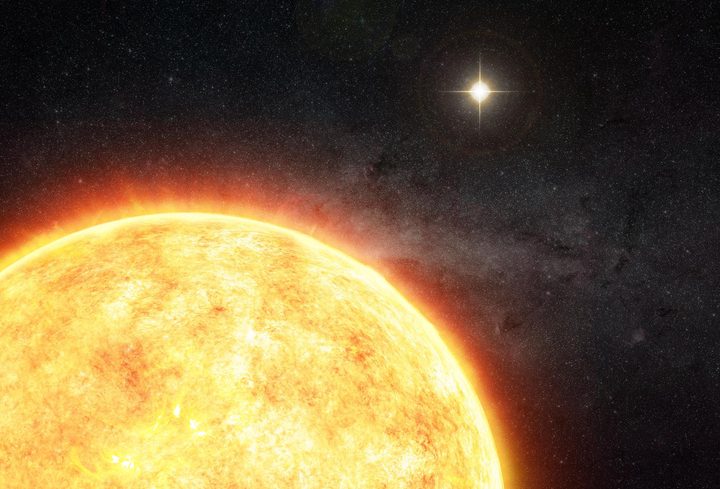
Artist’s conception of a potential solar companion, which theorists believe was developed in the Sun’s birth cluster and later lost. If proven, the solar companion theory would provide additional credence to theories that the Oort cloud formed as we see it today, and that Planet Nine was captured rather than formed in place. M. Weiss

Not only would the presence of another star help explain the Oort Cloud, it could even provide a clue to the origin of life on Earth. “Objects in the outer Oort Cloud may have played important roles in Earth’s history, such as possibly delivering water to Earth and causing the extinction of the dinosaurs,” said Siraj. “Understanding their origins is important.”

This potential companion also has links to another mystery of our solar system: The possible presence of Planet Nine, a hypothetical planet some believe orbits beyond Neptune.

“The puzzle is not only regarding the Oort clouds, but also extreme trans-Neptunian objects, like the potential Planet Nine,” co-author Avi Loeb said in the statement. “It is unclear where they came from, and our new model predicts that there should be more objects with a similar orbital orientation to Planet Nine.”

The research is published in The Astrophysical Journal Letters.

Georgina Torbet
Georgina has been the space writer at Digital Trends space writer for six years, covering human space exploration, planetary…
China’s answer to SpaceX’s reusable rockets literally catches boosters in a net
SpaceX catches boosters on legs. China just used a net.
Ammunition, Missile, Weapon

SpaceX's playbook for recovering a rocket booster generally involves legs, a precisely controlled vertical landing, and either a concrete pad or a drone ship. 

China just managed to pull off something similar, but in a slightly different way, and on July 10, it tested the method as well.

Read more
Dimming the sun sounds unhinged, but this new study on El Niño makes a surprisingly good case for it
A natural test case, Australia's worst-ever wildfire season, suggests the idea deserves serious consideration.
Nature, Outdoors, Sky

When I first saw "scientists propose dimming the sun," I rolled my eyes. It sounds like a science fiction movie cooked up after watching many climate documentaries. But a new study, published on July 8, 2026, in the journal Science Advances, seems to have a genuinely compelling argument.

A Super El Niño is currently forming in the Pacific, feared to be the most intense in decades. It could escalate floods, wildfires, and extreme heat events worldwide. However, Researchers at UC San Diego's Scripps Institution of Oceanography, led by climate scientists Kate Ricke and Jessica Wan, are now proposing one of the most interesting solutions I’ve come across.

Read more
You can now walk through space and gaze into a black hole at this VR exhibit
Smithsonian Starstruck lets you drift past dying stars and see the origin point of the universe for as little as $18 a person.
Smithsonian Starstruck featured

Most planetarium shows ask you to sit still and look up. The Smithsonian's new VR exhibit takes a different approach, letting visitors walk through the vast expanse of the universe, drifting past stars, planets, and a black hole to get a physical sense of its true scale.

A $29 ticket to the edge of the galaxy

Read more