  1. Home
  2. Wearables
  3. News

The human battery: Smart backpack generates power as you walk

Add as a preferred source on Google
Promotional image for Tech For Change. Person standing on solar panel looking at sunset.
This story is part of Tech for Change: an ongoing series in which we shine a spotlight on positive uses of technology, and showcase how they're helping to make the world a better place.
 

Backpacks are good for carrying your belongings, as they distribute the weight of the pack evenly across the body so it’s supported by the body’s strong back and abdominal muscles. But that’s not to say that they couldn’t be better. A backpack that’s overloaded or contains bulky items will still be heavy, and a long hike carrying an overstuffed pack will take its toll the next day.

Recommended Videos

Researchers in China have found a way to make a smart backpack that feels 20% lighter, however — and, no, it doesn’t involve taking one-fifth of the contents out of your pack before setting off. It’s about giving the backpack a car-style suspension system instead.

“Two elastomers, two sliding rails, and two pulley blocks are all symmetrically arranged on two sides of its frame,” Jia Cheng, an associate professor in the department of mechanical engineering at Beijing’s Tsinghua University, told Digital Trends. “One terminal end of an elastomer is fastened to the top acrylic plate, while the other one is to the frame, through two fixed pulleys. The load is fixed on the top acrylic plate, and the top acrylic plate can move upward and downward on the sliding rails.”

The weights of the load and the top acrylic plate are balanced by the elastic force from the two elastomers. As a result of the fixed connection between the backpack frame and the body, the frame synchronously moves up and down with the mass center of the wearer’s body as they walk.
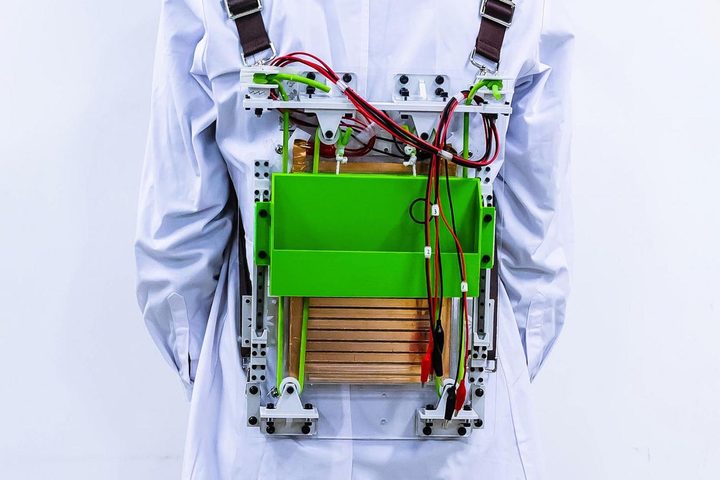
Smart backpack
Tsinghua University/ACS Nano

“Without the upward and downward movements of the load when walking, the wearer will feel lighter than before,” Cheng said. “… The absolute displacement of the load to the ground is nearly zero, and there is no vertical sway.”

That’s not all

A backpack that feels lighter would be enough for many researchers. But clearly not for Cheng and team. The prototype backpack is also able to harvest mechanical energy from human movements and use this to power onboard electronics. It does this with the aid of a triboelectric nanogenerator (TENG).

No, you probably won’t be able to ditch the main power supply for your desktop computer by instead running on a treadmill as you work. However, the researchers have shown that a setup such as this can power LEDs, an electric watch, and fluorescent tubes. In environments where there is no power available, such as for rescuers in a disaster zone, a backpack like this onecould prove invaluable.

A paper describing the work was recently published in the journal ACS Nano.

Luke Dormehl
I'm a UK-based tech writer covering Cool Tech at Digital Trends. I've also written for Fast Company, Wired, the Guardian…
Garmin’s new Fitbit Air rival has 80 workout modes and avoids the frustrating subscription trap
Garmin CIRQA entered the screenless fitness band fight with 10-day battery and no monthly fee
Garmin CIRQA featured image

The screenless fitness-band revival has gained another serious contender, and Garmin is arriving with a refreshing approach. The new Garmin CIRQA Smart Band just debuted for $199.99 and offers up to 10 days of battery life while also featuring continuous health monitoring and support for more than 80 activities. It has no display, leaving Garmin Connect to handle every chart, score, and workout summary. Garmin ensures that a subscription is not required to access its features.

Garmin packed its fitness ecosystem into a silent wristband

Read more
The Galaxy Watch Ultra 2 is finally ready to dive, and the Watch 9 40mm gets a bigger battery
Galaxy Watch Ultra 2 may finally close the diving gap with the Apple Watch Ultra 3
The Samsung Galaxy Watch Ultra's case and screen.

Samsung’s upcoming smartwatches may have another couple of meaningful upgrades hiding up their sleeves. Newly leaked promotional images suggest the smaller Galaxy Watch 9 will receive a much larger battery than previously reported, while the Galaxy Watch Ultra 2 could finally be certified for recreational diving.

The images were shared by an X account using the @evleaks handle, although the prominent leaker Evan Blass has previously said the account does not belong to him. They appear to be official Samsung marketing materials and reveal a few details that were missing from earlier specification leaks.

Read more
Bose’s next QuietComfort headphones could steal the Ultra’s best features
Bose QuietComfort deal

For the last few years, Bose has been in a slightly awkward position. Its standard QuietComfort headphones have remained an easy recommendation, but they've also felt a little... forgotten. While the Ultra lineup grabbed the spotlight with new features and a refreshed design, the regular QuietComfort stayed the same. That may finally be about to change.

A new leak suggests Bose is preparing a QuietComfort (2nd Gen) model, and if it's accurate, this looks like Bose bringing its mainstream headphones much closer to its premium offering.

Read more