
The world is noisy. Walk through a busy public space and you’ll be inundated with sounds, many of which you’ve got little choice but to listen to. Think traffic sounds, other people’s chatter, loudspeaker announcements asking someone who isn’t you to move a car that isn’t yours. How, in that cacophonous milieu, is it possible to send a targeted message to a specific person without adding to the din, and without them having to carry a device in order to hear what you’re saying?
Holoplot, a company based in Berlin, has been working on just such a problem for years — and with some impressive results. Holoplot’s technology utilizes 3D beamforming technology and smart algorithms to create transformative sound experiences. Specifically, its technology is able to generate multiple sound fields simultaneously, each one featuring its own content, equalization, level, shape, and position. That means being able to create multiple sound experiences within one room.
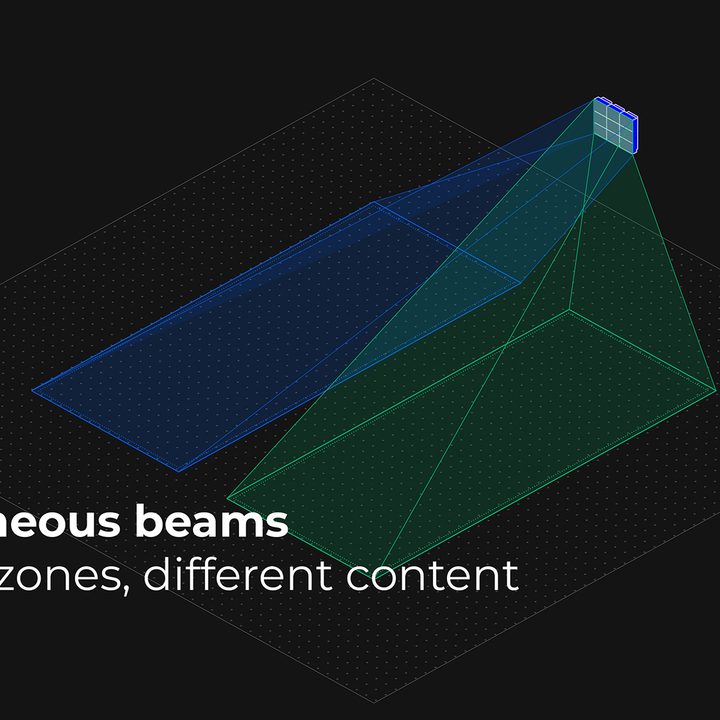
Imagine, for example, being able to send out a narrow beam of audio that can only be heard by one specific person standing in one specific area. In demos, Holoplot beams two sets of audio to two different people, standing shoulder to shoulder. While you might occasionally hear a small amount of spillover, like the muted noises coming from the headphones of a person next to you, for the most part, these sounds are limited to the intended listener.
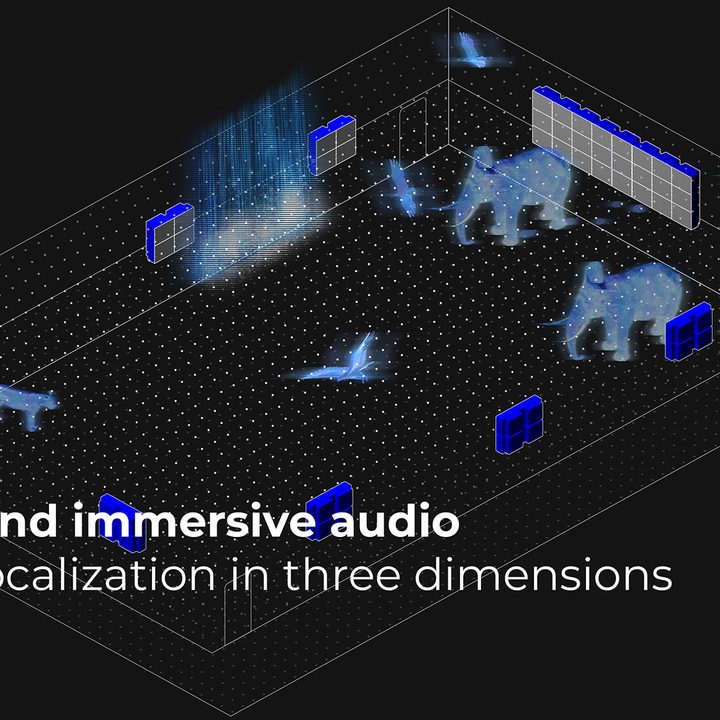
“We can create different zones so that, as you’re walking through — for example — a theme park installation, you might have one corner where you can hear animals such as lions,” Roman Sick, CEO of Holoplot, told Digital Trends. “Then you walk a few meters and suddenly you’re in a very different space, [and now you can hear] water. Or you could have a very personal, targeted voice explaining to you something that you’re looking at [in a museum setting].”
Enter beamforming
Beamforming technology has been around for years, used in applications like antennas and underwater sonar. In more recent times, it’s been baked into the technology many of us use on a daily basis, often in ways we may not even think involves such a high-tech concept. For example, laptops are often equipped with an array of microphones that applies some manner of beamforming to better reject background noise when picking up a voice signal. It’s also increasingly been used in loudspeaker arrays, including Apple’s HomePod smart speaker (the first generation of which is now sadly deceased), which used it to provide a better quality of music playback experience for the listener.
“In a nutshell, beamforming relies on the principle of constructive and destructive wave interference,” Filippo Fazi, a professor with the Signal Processing, Audio and Hearing Group at the Institute of Sound and Vibration Research in the U.K.’s University of Southampton told Digital Trends. “An instant snapshot of the sound field generated by a loudspeaker can be physically interpreted as [a] spatial pressure pattern, with alternating zones where the air pressure is either slightly above or slightly below the atmospheric pressure.”
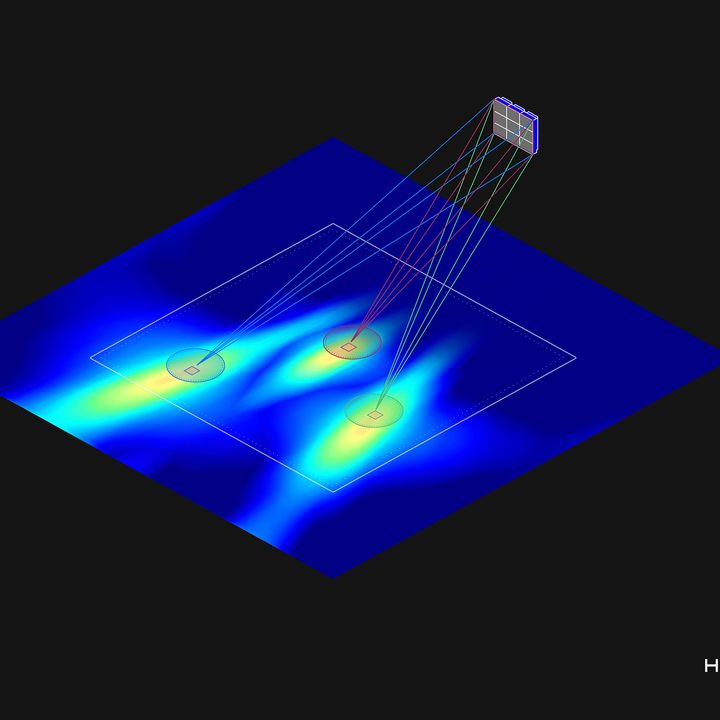
Sound can be described as a rapid variation of pressure in space and time. If one takes two loudspeakers and drives them with carefully designed signals, it’s possible to ensure both generate an increase of acoustic pressure at a specific point in space. This sum of sound signals is called “constructive interference” and can be used to maximize the sound pressure level at a desired point in space.
Holoplot’s technology takes beamforming tech and demonstrates it on an impressive scale. A couple of years back, a trial of its technology was carried out at Frankfurt Central Station, the busiest train station in Germany. Visitors reaching the bottom of an escalator suddenly heard clear instructions telling them where they should go next. People just a couple of feet behind them heard no such message — although the hearer was none the wiser about this fact.
“Interestingly, the person that is receiving the sound doesn’t always know that not everyone else is having the same experience,” Sick continued. “Because that is so [clear] they think that all the people next to [them] have received the same. But, really, it’s only them or a small group of people that have received the audio signal. Others might have received something else or nothing at all.”
Recently, Holoplot debuted its new X1 product line, creating loudspeakers aimed at high performance scenarios, ranging from concerts to theme parks. “You can now target subsets of the audience with specific content … where you [might] have one language in one part and another language in another part, all coming from the same source at the same time,” he said.
Transforming sound for good
Beamforming has the potential to transform sound for good. Where previously sound was messy, spilling out into surrounding areas, acoustics can now be focused like a laser. “Does beamforming with loudspeaker arrays work?” Filippo Fazi said. “Yes, it does, and it is quite impressive.”

As dazzling as Holoplot’s work is, however, it’s not the only group doing fascinating work in this space. In Fazi’s lab, for instance, the team is doing some amazing work using beamforming to create individual listening zones in a single car. “This enables, for example, the driver to clearly listen to the sat nav instructions whilst the passengers can enjoy their favorite music without hearing the navigation system’s voice,” he said. “We can achieve this even without loudspeakers mounted on the headrest of the car seat.”
In short, beamforming means that, for the first time, it’s possible to place individuals in their own sound bubbles — without them having to wear headphones to enjoy the experience. “It’s a new era of what you can do [sonically],” Roman Sick said. “[Back in the 1980s], the Walkman was a new era because suddenly you could create these personal bubbles [of sound] that everyone could walk around with. We believe that, with our technology, it’s a similar quantum leap. You can create completely new experiences, some of which we probably don’t even know about yet.”