European Space Agency astronaut Thomas Pesquet has been taking lots of photos of Earth and beyond since arriving at the International Space Station (ISS) earlier this year.
Some of his photographic efforts have been simply stunning, but now the French astronaut is turning his attention to a new project that involves capturing images that attempt to convey the high speed at which the space station orbits Earth.
The ISS has an orbital speed of about 28,000 kph — that’s about 17,400 mph. Or to put it another way, about 7.6 km (4.8 miles) per second.
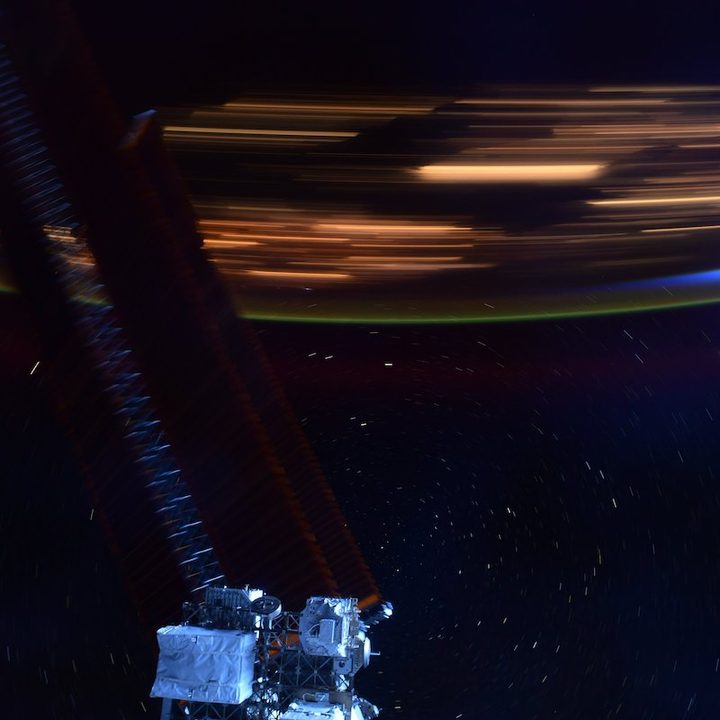
Pesquet recently posted the first photo (top and below) from his new project. It required a 30-second exposure and shows part of the space station as Earth and stars streak through the frame.
“A picture from some tryouts of a photo technique I’ve been experimenting with. It gives the impression of the speed we fly at (28 800 km/h!). This image is one 30-second exposure of Earth at night. The trails you see are stars, and city lights. More to come!”
A picture from some tryouts of a photo technique I’ve been experimenting with. It gives the impression of the speed we fly at (28 800 km/h!). This image is one 30-second exposure of Earth at night. The trails you see are stars, and city lights. More to come! 📷🤓 #MissionAlpha pic.twitter.com/h2GJScy6mk
— Thomas Pesquet (@Thom_astro) June 13, 2021
The ISS is about 400 km (250 miles) above the surface of Earth, and orbits our planet once every 90 minutes or so. This means the station orbits Earth around 16 times in a 24-hour period.
To get a clearer idea of how quickly the ISS moves through space, consider signing up to NASA’s notification system that lets you know when the space station is passing over your neighborhood. On a clear night or early morning, sunlight bouncing off the station’s solar arrays allows you to easily spot the ISS with the naked eye as it moves across the sky at great speed.
Despite the astonishing speed, astronauts on the space station don’t detect anything unusual while living and working there.
We look forward to seeing more of these speed photos from Pesquet in the coming months. Meanwhile, for more information about life on the space station, check out these short video presentations made by various astronauts from over the years showing everything from how to make coffee to how to use a space toilet.