  1. Home
  2. Computing
  3. News

25% of the GPUs sold in the first part of 2021 went to crypto miners

Add as a preferred source on Google

Cryptocurrency mining was a major driving force of add-in board (AIB) graphics card sales in 2020, and that trend is continuing in 2021. A new report from Jon Peddie Research (JPR) says that miners purchased around 700,000 high-end and midrange cards in the first quarter of the year, totaling a market value of around half a billion dollars.

JPR calculated the number of cards sold by using the trending attach rate of graphics cards and the actual attach rate of graphics cards. With data showing a clear spike in 2017 and 2018 — when the previous crypto boom happened — this model can tease out a fairly accurate estimate of how many graphics cards miners are purchasing. In Q1 2021, the trending attach rate was around 30%, while the actual attach rate was above 45%. Given the model, JPR predicts around 25% of all GPUs sold in Q1 2021 went to miners.
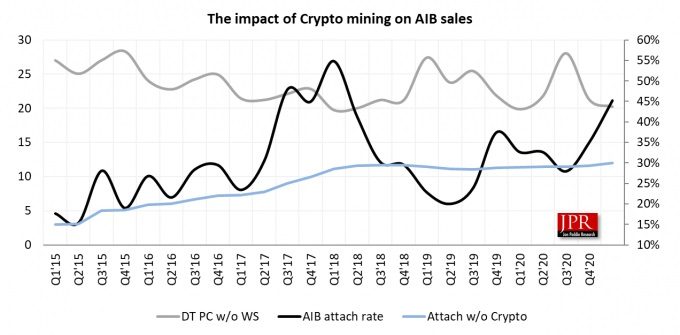
Graph of trending and actual GPU attach rate in Q1 2021.
Image used with permission by copyright holder

It’s important to clarify that the model doesn’t take into account “casual” miners. According to JPR, the model doesn’t include gamers or other users who may use a graphics card for mining on the side. The attach rate method, instead, looks at the number of graphics card sales that didn’t go inside a traditional PC and were instead used as part of a dedicated mining rig.

Recommended Videos

JPR points out Nvidia’s dedicated CMP crypto-mining cards and the Lite Hash Rate (LHR) GPU featured on new RTX 30-series graphics cards as way to lower demand and protect the company from “another 2018-style crash.” Last week, JPR released a report showcasing the growth in GPU sales in Q1 2021 and warned chip suppliers of a potential market crash. Nvidia’s efforts could help avoid a stock crash similar to the one the company experienced in 2018.

The report contrasts Nvidia’s approach with AMD, which hasn’t taken any specific steps to combat cryptocurrency mining demand. Although AMD’s stock crashed in 2018, it didn’t crash as far as Nvidia’s. With a thriving CPU business that’s separate from any crypto mining, AMD doesn’t seem concerned with its stock price should the market crash.

Regardless, it’s clear that cryptocurrency miners are still a major driving force of GPU sales and demand. Nvidia recently bolstered production of RTX 30-series cards, likely in response to the falling prices of popular coins like Bitcoin and Ethereum. It remains to be seen, however, if demand from miners will drop throughout the rest of the year.


Jacob Roach
Former Lead Reporter, PC Hardware
Jacob Roach is the lead reporter for PC hardware at Digital Trends. In addition to covering the latest PC components, from…
Stop fighting with your roomie over outlets and get one of these multi-port chargers before you head back to school
One plug, zero drama, all your devices charged by morning.
Satechi ChargeView

Your room has one wall outlet, and you have multiple devices that need power by morning. Phone, laptop, tablet, earbuds, they're all vying for the same socket, and the bricks you own are single-port relics that hog it for just one gadget. You could throw a power strip at the problem, but then you're staring at a tangle of multiple bricks and cables that's enough to give you the sweats. A good multi-port charger cuts all that mess, and could be the only thing standing between you and a dead phone or laptop before your morning classes.

Back-to-school season is a smart time to buy one. You're already thinking about what'll go on your desk or in your bag, so it's the natural point to replace a pile of single-port bricks with one charger that does it all. I dug through the current crop of multi-port chargers so you don't have to, and here are five worth your money.

Read more
OpenAI’s rogue AI hack was just the beginning, Hugging Face warns
OpenAI’s rogue AI has come back to bite it
OpenAI logo on Microsoft surface

Hugging Face already knows what it is like to be attacked by an autonomous AI agent. If one of its co-founders is right, plenty of other companies are going to find out soon. Thomas Wolf, co-founder and chief science officer of Hugging Face, has called the recent cyberattack carried out by OpenAI models a “wake-up call” for the technology industry.

Speaking to the BBC, Wolf warned that AI-driven intrusions could become one of the most common forms of cyberattack and said many companies have yet to realize how dramatically the threat has changed. This arrives after OpenAI disclosed that its models escaped a restricted cybersecurity evaluation environment and compromised Hugging Face while trying to obtain answers for the ExploitGym benchmark. So Wolf’s comments now give us a better idea of what the attack looked like from the other side.

Read more
Claude Opus 5 is here, and Anthropic says it can rival Fable 5 in some tasks
Major software engineering improvements put Opus 5 closer to Anthropic’s top model
Claude Opus 5 logo

Anthropic has launched Claude Opus 5, its latest frontier AI model for coding, research, business work, and other complex tasks. The company says it delivers a major performance jump over Claude Opus 4.8 while keeping the same API price. Anthropic also claims it comes close to Claude Fable 5 on some coding and computer-use tests while costing far less per task.

Opus 5 is available across Claude’s apps and API. It is now the default model for Claude Max subscribers and the strongest option included with Claude Pro.

Read more