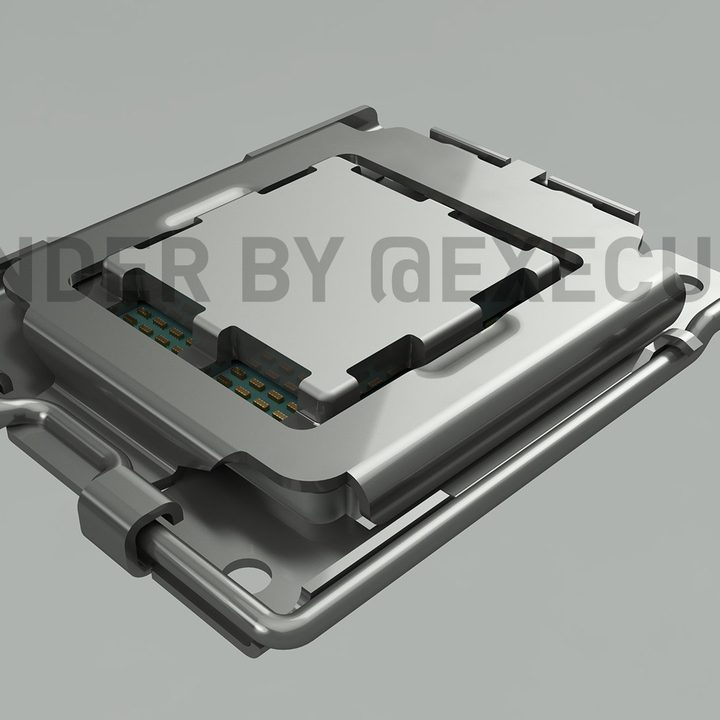
The next generation of AMD Zen 4 processors, code-named AMD Ryzen Raphael, is on the horizon. While the launch is still far away, ExecutableFix on Twitter already revealed renders of what the AM5 CPU socket is likely going to look like.
The renders show that the AM5 socket resembles Intel’s mainstream LGA socket rather closely. They also tell us more about the architecture used in the upcoming AMD CPUs.
Zen 4 Raphael are going to be desktop processors that will bring a vast array of new features. Leaks suggest that switching to the AM5 socket will allow AMD to deliver the biggest platform upgrade in several years. Zen 4 is going to be the direct replacement to AMD’s current mainstream line of processors, the Zen 3, which were code-named Vermeer.
Previous leaks suggested that Zen 4 Raphael processors will be based on a 5nm core architecture combined with 6nm input/output (I/O) dies. The new AMD AM5 will carry the latest LGA 1718 socket, which was created to support the latest generation of Ryzen-based desktops. It’s exactly this socket that ExecutableFix has posted renders of, revealing more about the chip.
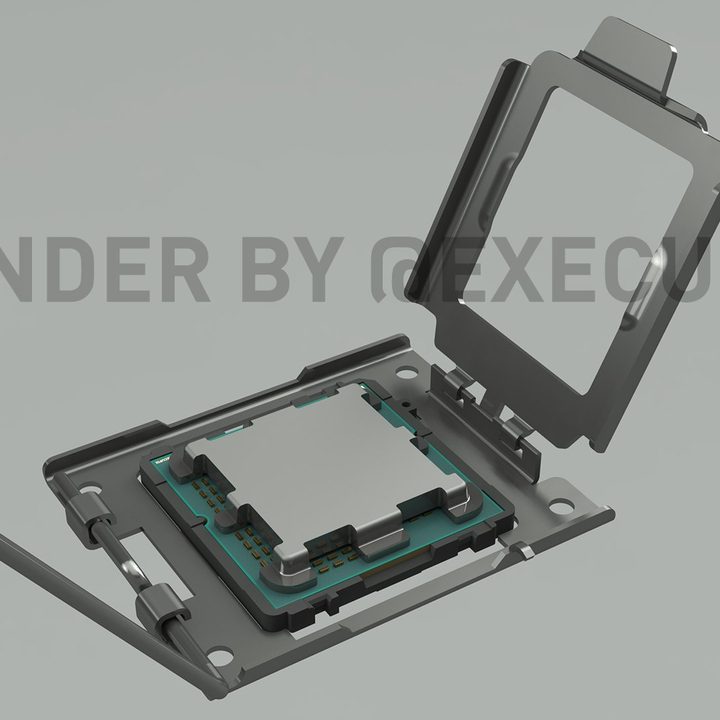
Based on the look of the AM5 socket alone, we can surmise that the retention design for LGA 1718 is very similar to the current Intel Core CPU sockets. The socket no longer features pins underneath the processor, making it a safer option than the previous generation’s. The pins will now instead be positioned inside the socket itself, allowing for contact with the LGA pads that are placed under the CPU. AM5 has a single latch and land grid array packaging.
The images posted on Twitter show that AMD Ryzen Raphael processors will be square-shaped and will measure 45mm by 45mm. Inside, the CPUs will house an unexpectedly large integrated heat spreader (IHS). The size of the IHS implies that AMD may be trying to balance the temperatures and thermal load across several chiplets. Much like the rest of the socket, the IHS resembles Intel solutions in its design, namely the Intel Core-X HEDT line of CPUs.
As we only have renders to go on right now, some of the design choices are pure guesswork at this point. The two partitions on each side of the socket could be cut-outs, but they could also just be reflections from the render.
If they are indeed cut-outs, it’s possible that AMD designed the socket to vent air out of it. That could have some repercussions, such as the air being trapped in the central chamber or blown into the VRMs of the motherboard. We will have to wait and see how AMD addresses this potential issue.
The switch to Zen 4 architecture should bring a host of improvements and exciting changes. Rumors point to the new Zen 4 architecture bringing up to 25% instructions per clock (IPC) gain over Zen 3, as well as a 5GHz clock speed. AMD has previously hinted that it hopes to increase the number of cores found in mainstream processors. This suggests an upgrade over the current 16 cores and 32 threads.
According to Dr. Lisa Su, the CEO of AMD, “We are focusing on Zen 4 and Zen 5 to be extremely competitive. There will be more core counts in the future — I would not say those are the limits! It will come as we scale the rest of the system.”
Some of the other likely upgrades include DDR5 memory support with base clock speeds starting at 4,800MHz and going up to 10,000MHz, PCIe 5.0 compatibility, and RDNA 2 onboard graphics.
The launch of AMD Zen 4 Raphael is still a long way away — the CPUs are likely to hit the shelves in late 2022. This means that many features may still change. One thing seems fairly certain for now — AMD is working on Zen 4 to be a powerful lineup of CPUs capable of competing against Intel’s 13th-generation Raptor Lake processors.