When AMD launched Radeon Pro W6800 workstation graphics card, we said it would make a perfect addition to Apple’s Mac Pro module lineup. And now, AMD and Apple are making our dreams come true. AMD is releasing three new modules for the Mac Pro, sporting two new high-powered graphics cards.
The two cards available are the AMD Radeon Pro 6800X and Radeon Pro 6900X. You can pick up either module individually, or you can pick up the W6800X Duo module, which features two W6800X GPUs. With the Mac Pro’s two MPX expansion slots, you can actually slot in two 6800X Duo modules, giving you a staggering 128GB of GDDR6 memory and up to 60 TFLOPs of computing power.
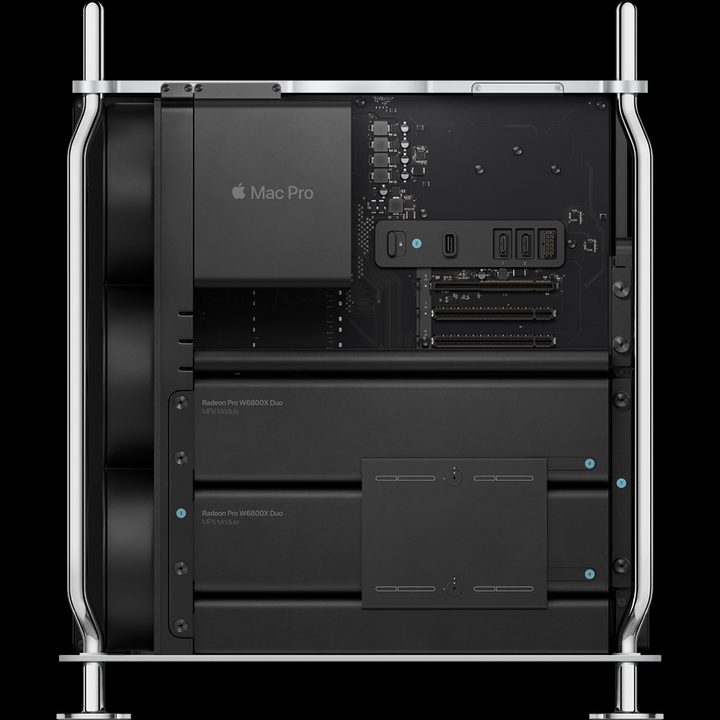
Both cards are built on AMD’s RDNA 2 architecture, which is featured in RX 6000 consumer graphics cards. They also feature AMD’s Infinity Cache and Infinity Fabric technologies, the former of which gives the card a pool of cache to reduce latency and power consumption, and the latter that provides a high-bandwidth connection between multiple GPUs, making things like two 6800X Duo MPX modules possible.
The Radeon Pro W6800X is identical to the W6800 in terms of specs. It features 60 RDNA 2 compute units (CUs), totaling 3,840 cores. It also comes with 32GB of GDDR6 memory on a 256-bit bus, 128MB of Infinity Cache, and a total graphics power of 300W. As mentioned, it’s available in a Duo MPX module, which doubles the specs across the board short of the power. The Duo module consumes 400W of power.
The W6900X is new, expanding AMD’s range of workstation cards. It bumps up to 80 CUs for a total of 5,120 cores. Otherwise, it matches the W6800X with 32GB of GDDR6 memory, 128MB of Infinity Cache, a 256-bit bus, and 300W of total power draw.
Although Apple and AMD just announced the modules, we’ve known about them for a while. Early samples of the Radeon Pro W6900X showed up in the Geekbench database in April, outpacing the Vega II Duo module by nearly 80%.
As for what these cards are capable of, we don’t know yet. AMD specifically calls out 8K video editing and GPU-focused applications like Octane X, DaVinci Resolve, Cinema 4D, and Final Cut Pro. The cards could perform anywhere from 23% to 84% faster in these applications compared to Apple’s previous lineup of MPX modules.
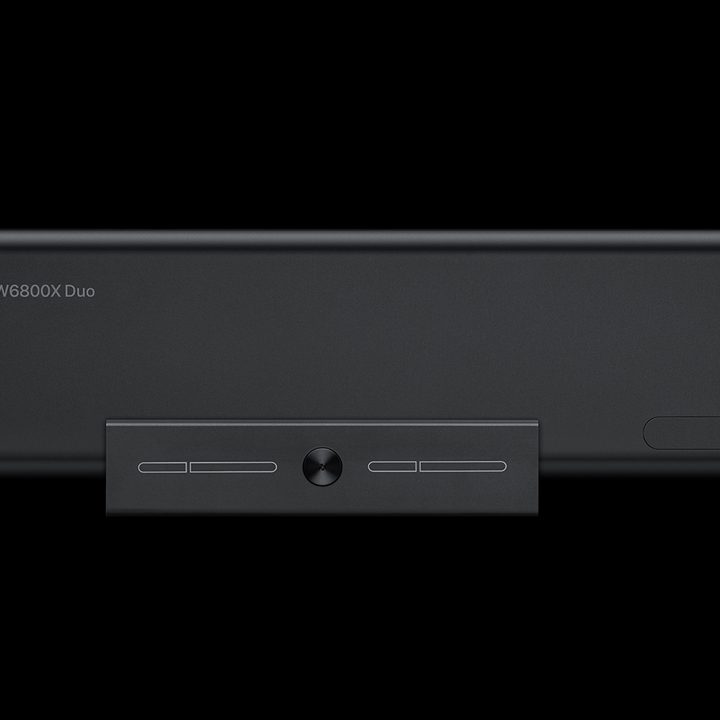
The Mac Pro was in dire need of updated modules. When the machine launched, Apple promised modularity unlike anything Apple fans had ever seen, but the company was slow to deliver new MPX modules to replace aging hardware. Now, creative professionals have access to the best and brightest from AMD, which should accelerate applications that lean heavily on the GPU.
All three modules are available now in Apple’s Mac Pro configurator or as standalone MPX units. They replace the Vega II and Vega Pro II Duo modules in the configurator, but those modules are still available as standalone purchases.
For pricing, the modules will cost you slightly different prices depending on how you buy them. The W6800X is available for $2,800 as a stand-alone module or $2,400 for the configurator. Meanwhile, the 6800X Duo module is cheaper as a stand-alone unit at $5,000, while the configurator runs $5,200. Finally, the W6900X is $6,000 as a standalone module and $5,600 through the configurator. Apple also has the option to purchase multiple modules through the configurator.