The International Space Station (ISS) is about as good as it gets when it comes to aerial photography.
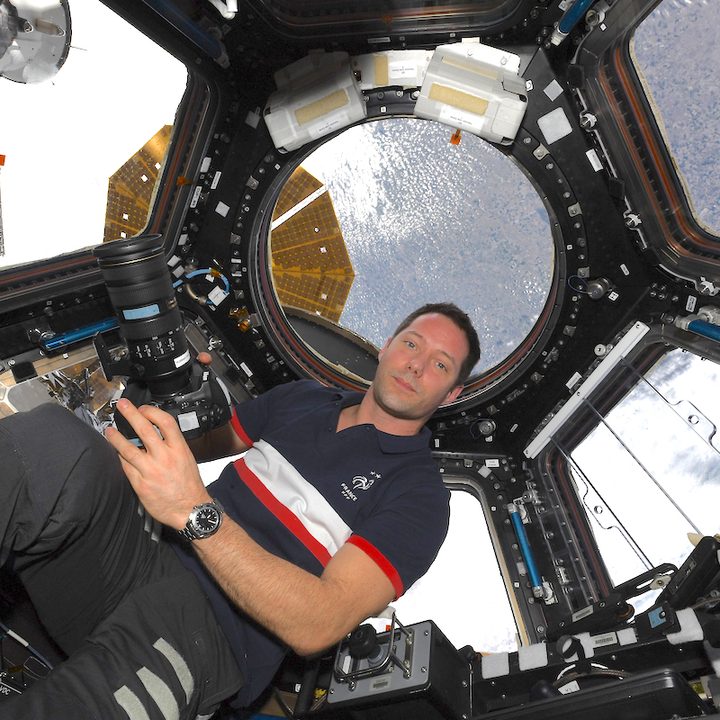
It’s no surprise, then, that many astronauts visiting the orbiting outpost quickly make a beeline for the Cupola, the space station’s seven-window observation module that offers mesmerizing views of Earth 250 miles below.
Current ISS inhabitant Thomas Pesquet has emerged as one of the most skillful shooters of the current crew, with the French astronaut regularly sharing breathtaking Earth images on his Instagram and Twitter accounts.
But getting those incredible images isn’t simply a matter of peering out of the Cupola and hoping for the best.
It has been a while, but the blues of the #Bahamas and #KeyWest just never disappoint, seem to change hue on every pass over the area and brighten up our day every time we see them. Bask in the blue tones, and if you want more, there is a mapping too: 💙https://t.co/d4Pw9S4WDq pic.twitter.com/ZmEg6ccXWJ
— Thomas Pesquet (@Thom_astro) September 21, 2021
Current astronauts usually use a Nikon D5 DSLR with a telephoto lens to photograph Earth, but as Pesquet pointed out in a recent online post, it actually takes a lot of preparation to increase the chances of capturing a great image.
“Good planning for a picture is half the job, and for us, it starts with our navigation software,” said the astronaut, who arrived at the ISS in April. “The software shows us where it is day and night and even cloud cover predictions, but most importantly it shows us the future orbits.”
It helps us anticipate passes over our targets, taking into account time of the day, lighting, weather… but even if the orbits and weather is in our favour and we have the time… we still need to spot the target from 400 km above and set up the camera settings correctly! pic.twitter.com/ouc9SgopxL
— Thomas Pesquet (@Thom_astro) September 23, 2021
Pesquet said he also plans many of his images before he leaves Earth, saving himself time once he reaches the space station.
According to the astronaut, whose current mission ends in October 2021, many people “think that we can take a picture of a specific place on Earth on command, but it is much harder than that. First of all, our orbits mean we only fly over specific areas periodically. Secondly, even if we do fly over an area of interest, it might be during nighttime so there will be nothing to see unless it is a city with bright streetlights.”
Depuis l'espace #LosAngeles brille autant que les stars qui parcourent ses rues ✨ https://t.co/HMepv8zaPW
✨
🎶City of stars, are you shining just for me?🎶 Los Angeles at night lights up like stars in the sky. https://t.co/HMepv8zaPW #MissionAlpha #BigPicture pic.twitter.com/CZ2t3Hcvar— Thomas Pesquet (@Thom_astro) September 18, 2021
The two biggest obstacles to capturing the desired shot are cloud cover and the work schedule, with ISS astronauts spending most of their time working on science experiments.
“Often we pass over areas when we are working,” Pesquet explained. “We cannot drop everything we are doing at 14:35 for example just because we really want to take a picture of a city or a mountain or other marvel of Earth. Even if the stars align and we have the time [and] the orbits and the weather [are] in our favor, we still need to spot the target from 400 kilometers above and set up the camera settings correctly!”
Spring has not taken over all of the northern hemisphere – three examples in Asia where snow can still be found. ❄ #MissionAlpha https://t.co/LongHxMHsf pic.twitter.com/iEGQloFCiu
— Thomas Pesquet (@Thom_astro) May 16, 2021
Just from the small number of images that we’ve posted on this page, it’s clear that Pesquet has an eye for a great photo, and that his careful preparation pays off.
Andes again. This area, between Peru, Chile, Bolivia, is an infinite source of magical shapes and striking colours. Do you prefer a burgundy red lake, or a neon blue amphitheatre? #MissionAlpha pic.twitter.com/VZhDr1id7q
— Thomas Pesquet (@Thom_astro) September 19, 2021
For more of Pesquet’s stunning space-based photography, check out this collection of images that we showcased earlier this year.