  1. Home
  2. Computing
  3. Emerging Tech
  4. Web
  5. Legacy Archives

U.S. to retake supercomputer throne from China

Add as a preferred source on Google
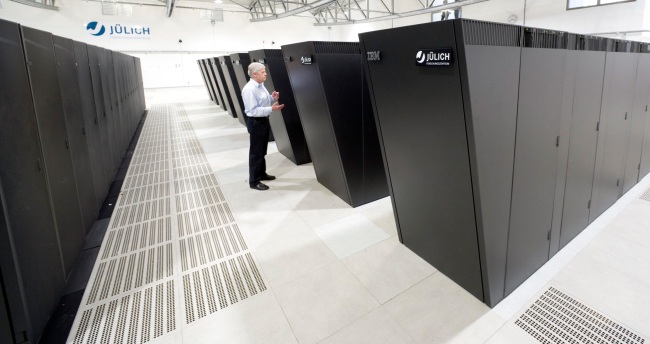
supercomputer-center-servers-ibm
Image used with permission by copyright holder

Is a digital cold war brewing? If so, it’s going to produce a lot of heat. China’s record-breaking 2.57 petaflop supercomputer, Tianhe-1A, officially broke the world record for computing speed Friday, and already the United States is working on something much larger. Two 20 petaflop supercomputers are in development in the States, reports Computerworld.

Oak Ridge National Laboratory is building one of the supercomputers. The lab’s Cray XT5 Jaguar supercomputer held the previous world record of 1.75 petaflops. The new computer will be eight times as fast as China’s Tianhe-1A when it debuts in 2012. IBM is building its own 20 petaflop system at the Lawrence Livermore National Laboratory. It should also be ready by 2012. Japan is also working on a 10 petaflop system.

Recommended Videos

Exoscale supercomputers, the next big thing

All current supercomputers may be left in the dust soon, however. New “exascale” supercomputers are already in the early planning stages and may make their debut in the next seven or eight years. Exascale computers would provide a 1000 fold increase in power compared to the petascale supercomputers being developed today. With computers that powerful, scientists speculate that they could do things like “simulate a whole living cell at atomic detail.”

Does this mean in 20 years we’ll be able to simulate an entire human body at atomic detail? That will be an interesting day.

Jeffrey Van Camp
As DT's Deputy Editor, Jeff helps oversee editorial operations at Digital Trends. Previously, he ran the site's…
Study says relying on AI can turn doubt into false confidence
AI is making it harder for people to say "I don't know."
AI Chatbot

You'd think getting wrong advice would make you more cautious. New research says the opposite happens when that advice comes from AI. A study led by Valerio Capraro, a psychology professor at the University of Milan-Bicocca, found that incorrect AI advice made people less accurate, yet noticeably more confident in their answers (via IBM Think).

The study also found that people who received incorrect AI advice became far less willing to admit they didn't know an answer, even when staying silent was an option, and they were rewarded for accuracy.

Read more
Back-to-school desk upgrade? Start with one of these monitor arms
Whether you're studying, coding, or gaming after class, these are the monitor arms I'd happily recommend.
The Best Monitor Arms for Back-to-School That I'd Actually Recommend - HUANUO FlowLift Dual Monitor Stand

Dorm rooms and study desks have one thing in common: they run out of space fast. Between textbooks, notebooks, keyboards, coffee mugs, and laptop chargers, a monitor's stock stand often ends up taking more room than it should. A good monitor arm instantly frees up valuable desk space while also putting the screen at a much more comfortable height, making long study sessions easier on the neck and shoulders. Whether it's a simple single-monitor setup or a dual-screen workstation, these are the monitor arms I'd actually recommend for Back-to-School.

Amazon Basics Single Computer Monitor Stand

Read more
WhatsApp Web finally lets your laptop handle calls instead of forcing you back to your phone
Other new features include Waiting Room, QuickHD, and background Noise Suppression.
Adult, Female, Person

I've lost count of how many times I've had to awkwardly grab my phone mid-task just to take a WhatsApp call my laptop couldn't handle on the web version. Today’s update changes that for good.

So what's actually rolling out today?

Read more