
If you’ve ever wanted to play a game with random strangers while standing in the middle of Times Square, well, your prayers were briefly answered on September 8 and 9.
Using the Mega Screen billboard located at 1500 Broadway and West 43 Street in Manhattan, bystanders could scan a QR code with their smartphones to participate as an “interactive spectator” in Streamline Studios’ 2020 co-op game Bake ‘n Switch. Those who did so were able to jump in and play part of the game without having to download or install it.
This was part of a public test of “Project Monarch,” a prototype that combines digital billboards with mobile games via 5G to create what its organizers call “mobile crowd gaming.” With Project Monarch’s technology, billboards could turn into interactive events. Imagine an advertisement you could pick up and play on your phone with three-quarters of a million people, and you get an idea of what this is going for. (Between this and that thing with the hoverboard, Times Square is becoming quite the random tech hub lately.)
With Project Monarch’s technology, billboards could turn into interactive events.
Project Monarch is a collaboration between multiple groups including the following: Streamline Media Group, a Metaverse-focused developer that released Bake ‘n Switch last year through its gaming imprint; Genvid, which produces a toolset to create interactive livestreams; Outfront Media, which owns the Times Square billboard; Intel, which contributed its Smart Edge technology to the project; and Sky Packets, which provided a 5G-connected hot spot that allowed users to connect to Project Monarch.
“Interactivity is dominating virtually every kind of media, and this experiment proves that even the most modern digital billboards can be reimagined,” said Jacob Navok, co-founder and CEO of Genvid Technologies, in a press release. “With our interactive livestream technology and Intel’s advanced 5G network platforms, advertisers and brand sponsors can easily and dynamically provide more engaging, entertaining content that consumers not only remember but even enjoy directly.”
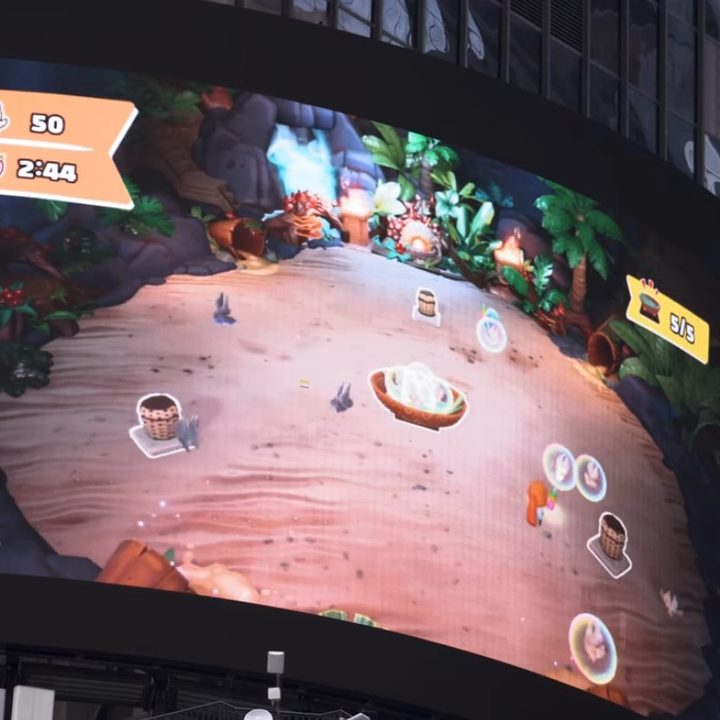
During the test of Project Monarch, up to six randomly chosen participants could be tagged in to help one of the two people playing Bake ‘n Switch, with three interactive spectators on each player’s side. Each round of the minigame being played lasted five minutes, and ended with both players and spectators being able to tap their screens to help drive up a score multiplier.
In theory, as argued by Genvid, Monarch’s technology could be used to turn just about any type of digital broadcast into an interactive event, with viewers being able to jump into the onscreen action and participate.
Genvid claims that a larger-scale deployment of Monarch could have 750,000 concurrent users. By way of comparison, that’s more people theoretically playing an interactive ad than are playing Counter-Strike: Global Offensive on Steam at time of writing.
Genvid claims that a larger-scale deployment of Monarch could have 750,000 concurrent users.
“Streamline is continuously working toward projects and partnerships that will advance the gaming industry,” said Alexander Fernandez, CEO of Streamline Media Group, in Genvid’s press release. “We believe the digital transformation of business and industry is accelerated best by leveraging video game technology and competencies. Streamline is always ready and able to innovate global consumer experiences with forward-thinking partners.”


