1. Home
  2. Computing
  3. News

How Nvidia is using A.I. to help Domino’s deliver pizzas faster

Add as a preferred source on Google

Nvidia announced a new tool that can help deliver your pizzas faster — yes, really — at its fall GTC 2021 event. It’s called ReOpt, and it’s a real-time logistics tool that Domino’s is already using to optimize delivery routes based on time and cost.

ReOpt is a set of logistics-planning algorithms that can find billions of routes to the same location. It utilizes heuristics powered by GPU computing to route vehicles in the most efficient way possible. It’s like Google Maps, just way more complex and designed specifically to meet the needs of last-mile delivery.
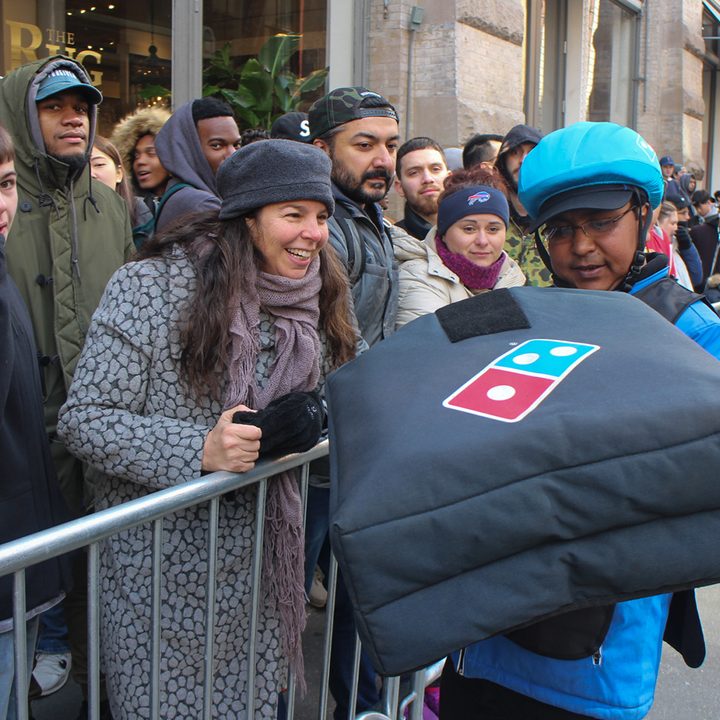
Domino's delivery in line.
Keith Nelson/Digital Trends

Domino’s hasn’t been shy about adopting new technology. The company has been saying for years that it’s a technology company that delivers pizzas, and has adopted everything from driverless cars to in-car delivery apps to help optimize ordering and delivery. ReOpt is the next evolution of that, it seems, and it’s an increasingly important tool for how the world operates today.

Recommended Videos

Last-mile delivery compromises the final leg of a package arriving to your door. It’s where an Amazon or FedEx driver drops off your package, and it represents the most significant pain point for e-commerce sales today. About 53% of delivery costs come just from last-mile delivery, as distant homes or traffic congestion create inefficiencies in delivery routes.

And with the pandemic boosting e-commerce sales to new highs, last-mile delivery has never been more important. ReOpt is the latest in a long line of Nvidia technologies that eyes GPUs as a solution. Nvidia says it can route 1,000 packages in three seconds on a GPU, work that would normally take a CPU five minutes.

Nvidia says that ReOpt can reduce delivery costs by 15%, which it says represents “billions” in savings. To illustrate this point, Nvidia pointed to Domino’s, which was able to quickly calculate 87 billion ways to visit 14 locations using ReOpt. ReOpt is also dynamic, helping last-mile delivery workers adapt to changing traffic conditions quickly.

Although Domino’s is the first company to adopt ReOpt, this type of tool applies across a wide variety of industries. From Amazon packages to DoorDash drivers, last-mile delivery has been a hurdle for several industries, and hopefully ReOpt will provide some solutions.

Jacob Roach
Former Lead Reporter, PC Hardware
Jacob Roach is the lead reporter for PC hardware at Digital Trends. In addition to covering the latest PC components, from…
Google’s new Magic Pointer Play Store listing reveals a Gemini shortcut built for Googlebooks
The unannounced app turns the cursor into a contextual AI tool for search, image creation, and shopping
Plant, Text, Business Card

Google has quietly published a new Play Store listing for Magic Pointer, an unannounced app built for Googlebooks. Updated on July 10, the app turns the cursor into a Gemini shortcut that can act on whatever a user selects on screen.

Magic Pointer can send an image to Lens, generate a related image, or surface a shopping action without forcing users to open a separate chatbot. Regular Android devices currently show as incompatible, so the listing offers an early preview rather than a broad release.

Read more
You can stop using AI, but this new report says you probably can’t escape it
A UK survey found that most people feel AI exposure is unavoidable, raising harder questions about consent, privacy, and whether opting out is still realistic
AI Chatbots

More people are trying to use less AI, but avoiding it altogether may already be impossible.

A survey of 2,055 UK adults found that 42% deliberately limit how much AI they use. Another 70% said avoiding AI exposure would be difficult or impossible, even when they actively wanted less of it.

Read more
The face on an AI interviewer may matter as much as the decision it makes
Researchers found that race and gender matching changed how fairly rejected applicants viewed an automated interview, even though everyone received the same outcome
File, Computer Hardware, Electronics

An AI hiring system can treat every applicant the same and still leave some people feeling targeted. Researchers found that rejected candidates judged an automated interview differently depending on the race and gender of the avatar delivering the result.

Around 220 participants completed a simulated interview for a fictional customer support role with one of four photorealistic AI avatars. Everyone was rejected, yet perceptions of fairness shifted with the interviewer’s appearance. An algorithm audit could miss that reaction because candidates don’t experience the system as raw code. They experience a face asking questions and judging their answers.

Read more