  1. Home
  2. Mobile
  3. Legacy Archives

Nielsen: Some minority groups quicker to adopt smartphones

Add as a preferred source on Google

Recent market data suggests that about three out of ten (31 percent ) of all U.S. mobile phone users now have a smartphone, but a new survey from Nielsen shows adoption rates are even higher amongst some minority groups. According to Nielsen, smartphone adoption amongst Hispanic and Asian/Pacific Islanders reached levels of 45 percent during the fourth quarter of 2010, which 33 percent of African Americans owning a smartphone during the same quarter. In comparison, only 27 percent of white Americans had a smartphone during the fourth quarter of 2010.
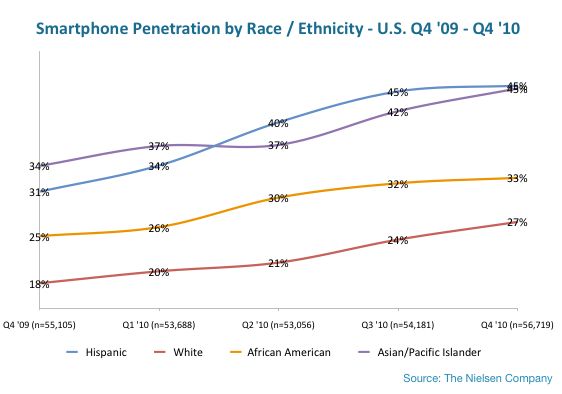
Image used with permission by copyright holder

The figures for new handsets acquired during the last six months show a similar trend. Some 60 percent of Asians/Pacific Islanders who got a phone in the last six months got a smartphone, compared with 56 percent of Hispanics, 44 percent of African Americans, and 42 percent whites.

Recommended Videos

Nielsen didn’t offer much in the way of explanation for the figures, save to now that the Asian/Pacific Islander, Hispanic, and African-American populations in the U.S. “tend to skew younger.” Younger Americans have been the backbone of the mobile phone market for years.

Overall, Nielsen’s survey finds the three major smartphone platforms—Apple’s iOS, RIM’s BlackBerry, and Google’s Android—in a virtual dead heat for market share, with iOS having 28 percent of the market and RIM and Android each having 27 percent—although Android’s share has been climbing very quickly. (The figures echo recent findings from Canalys that found Android has claimed the top spot in phone shipmnents.) However, Nielsen did find that Apple’s iOS is leading amongst smartphone owners who are Asian/Pacific Islanders, with 36 percent reporting they have iPhones. Conversely, BlackBerries were favored by African-American smartphone owners, with 31 percent saying they owned a BlackBerry device.
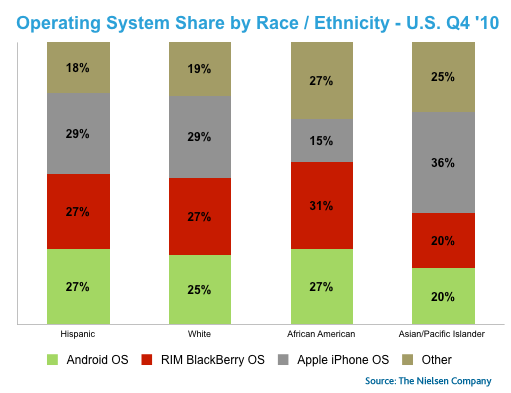
Image used with permission by copyright holder

Nielsen’s survey covered some 56,719 people, with 13,258 responding to questions about phone purchases in the last six months.

Geoff Duncan
Former Contributor
Geoff Duncan writes, programs, edits, plays music, and delights in making software misbehave. He's probably the only member…
The best phones in 2026: our 14 favorite smartphones right now
We tested phones across all price brackets so that you can make the best pick based on your needs and budget.
Google Pixel 10 Pro Fold vs Galaxy Z Fold 7 cameras

Choosing the right smartphone in 2026 is no easy task. Apple and Android manufacturers now have strong options at almost every price, while better cameras, longer battery life, improved software support, new AI features, and more refined foldable designs have made the market more competitive than ever. But picking one is not easy, especially if your budget is tight, or you are just legitimately concerned about getting the best value for your money and need a reliable daily driver for long-term usage.

We have tested and compared the leading smartphones available today, looking beyond the spec sheet to see how they actually perform in daily use. Camera quality, battery life, performance, display quality, software, design, and long-term value all play a part in our recommendations. Whether you are looking for a powerful flagship, a dependable budget phone, a compact device, or a foldable, this guide should help narrow down your choices.

Read more
Snapchat Planets Meaning: Order, Rankings, and How Friend Solar System Works
Snapchat Planets turns your best friends list into a solar system, and yes, your orbit says a lot
Snapchat Planets being shown on the Snapchat app on iPhone.

Snapchat+ includes several exclusive features, but few have generated as much curiosity as Snapchat Planets. Part of the app's Friend Solar System, it transforms your Best Friends list into a planetary ranking, assigning each of your top eight friends a planet based on how often you interact.

From Mercury, which represents your closest friend, to Neptune, which represents your eighth closest, the system offers a quick visual snapshot of your interactions. But what do the different planets actually mean, and how does Snapchat decide who gets which one?

Read more
How to use WhatsApp Web
We'll show you how to use WhatsApp on your desktop or laptop
WhatsApp Web

As one of the most popular messaging services, you’ve already heard of WhatsApp. From its humble beginnings in 2009—two years before Apple introduced iMessage—to its acquisition by Facebook (now Meta) in 2014, WhatsApp has become the dominant messaging platform around the globe.

In recent years, it's grown even more potent with new features like video messages, self-destructing voice messages, the ability to edit sent messages, and more. We even finally got an WhatsApp iPad app in May 2025.

Read more