  1. Home
  2. Gaming
  3. Legacy Archives

Video game pioneer Jerry Lawson dead at 70

Add as a preferred source on Google
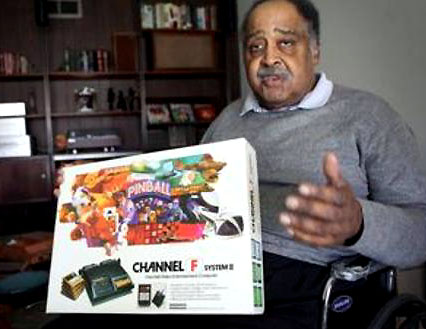
Gerald "Jerry" Lawson
Image used with permission by copyright holder

In these days of portable game systems with Wi-Fi and consoles with motion sensors, Internet connectivity, and integrated Blu-ray drives, it can be hard to remember that the industry had to get its start somewhere. Jerry Lawson, a key figure in the development of home video game systems was one of a handful of people who jump-started the industry. He died this week at age 70 in Santa Clara, California, from complications from diabetes.

Lawson was the key engineer behind the Fairchild Channel F console game system. The Channel F wasn’t a tremendous commercial success—it was quickly eclipsed by Atari systems that hit the market the next year—but it was the first system to use interchangeable ROM cartridges to load games, paving the way not only for Atari but for innumerable console systems and game developers that followed, including the likes of Nintendo and Sega. The same basic technology was used as recently as the Nintendo Game Boy Advance. Interchangeable cartridges enables a single game system to play multiple titles rather than a single game embedded into a system’s ROM or controllers. At the time of the Channel F, few people thought it would be practical to design a home video game console on a general microprocessors rather than a dedicated chip—but that’s exactly what Lawson did. The Channel F marked the first commercial use of the Fairchild F8 CPU. Lawson also had to come up with ways to shield cartridges from static electricity, and come up with a design that would stand up to home use and be simple enough for consumers to use. Before Lawson, nobody had tackled those problems.

Recommended Videos

Lawson was also an earliy pioneer in video arcade games, developing a Demolition Derby arcade console game that hit the market shortly after the seminal Pong.

Lawson’s story and contribution went largely unrecognized by the video game industry until his later years. Lawson grew up in public housing in Queens, New York, and was one of only a handful of black students at an almost all-white school. He built his own ham radio transmitter by age 12, and his skill and determination eventually landed him engineering work in the nearly all-white Silicon Valley. Lawson was the sole black member of the Homebrew Computer Club, a group of early computer aficionados that included future Apple founders Steve Jobs and Steve Wozniak. After the Fairchild, Lawson founded and ran Videosoft, a game development company that created titles for the Atari 2600, and did various consulting work, including a gig with musician Stevie Wonder.

In February of this year, Lawson was honored by the International Game Developers Association for his outstanding achievement in the industry.

[Image of Jerry Lawson: Maria J. Avila Lopez/Mercury News]

Geoff Duncan
Former Contributor
Geoff Duncan writes, programs, edits, plays music, and delights in making software misbehave. He's probably the only member…
Ayaneo’s new handheld revives the Game Boy Advance. Nintendo probably wishes it had done it first
If you missed the Game Boy Advance, this handheld is built for you
KONKR Pocket Advance

The Game Boy Advance is celebrating its 25th anniversary in the US, and while Nintendo has largely chosen to honor the handheld through its Switch Online library, another company has decided to recreate the hardware itself. Chinese handheld maker Ayaneo has unveiled the Konkr Pocket Advance, a modern reinterpretation of the iconic Game Boy Advance that updates almost every part of the original while preserving the horizontal design that made Nintendo's console so beloved.

Rather than building a nostalgia piece that simply looks like the original, Ayaneo is targeting the growing retro gaming market with modern hardware. The Konkr Pocket Advance features a higher-resolution display, additional controls, USB-C connectivity and wireless support, making it less of a replica and more of a contemporary handheld inspired by one of gaming's most influential consoles.

Read more
Sony’s 720Hz tandem WOLED gaming monitor is finally available worldwide
The INZONE monitor runs at 540Hz in QHD and 720Hz at 720p
Sony OLED high refresh-rate gaming monitor.

Sony’s ultra-fast OLED gaming monitor has finally made its way to store shelves. A few months after announcing the INZONE M10S II, the company has started shipping the esports-focused monitor across major global markets. Buyers in the US can purchase the monitor for $1,099.99. It costs £1,199 in the UK, while customers in supported Eurozone markets will have to fork out €1,349.

It uses a QHD Tandem WOLED panel that runs at a native 540Hz refresh rate. The monitor also has a 0.02ms response time and Sony’s Motion Blur Reduction technology. Sony worked with esports organization Fnatic on a separate competitive mode that trades resolution and usable screen size for an even higher refresh rate. (via Notebookcheck)

Read more
LG’s bonkers 1,000Hz gaming monitor is now available for $1,000
The UltraGear 25G590B reaches 1,000Hz without dropping below Full HD
LG UltraGear 1000Hz monitor featured.

LG’s insanely fast UltraGear 25G590B finally has a price and a US release date. The 24.5-inch esports monitor is now available to preorder exclusively from LG for $999.99, with free expedited shipping scheduled to begin on September 1.

The headline feature is a native 1,000Hz refresh rate at 1920 x 1080, making it the first Full HD gaming monitor to reach that speed without dropping to a lower resolution. The screen can update up to 1,000 times per second, or once every millisecond. LG also lets users overclock it to 1,100Hz.

Read more