1. Home
  2. Space
  3. News

Exoplanet with eccentric orbit discovered in the habitable zone of a red dwarf

Add as a preferred source on Google

Astronomers have found a planet in the habitable zone of a red dwarf star, but its orbit is so elongated that it would have wildly variable temperatures and likely couldn’t support life.

The planet, named TOI-2257 b, was first spotted using data from NASA’s planet-hunting telescope TESS (Transiting Exoplanet Survey Satellite) and then observed in more detail using the Las Cumbres Observatory Global Telescope and the SAINT-EX telescope in Mexico. Using the SAINT-EX observations, the researchers were able to confirm that a planet was orbiting the red dwarf star every 35 days.
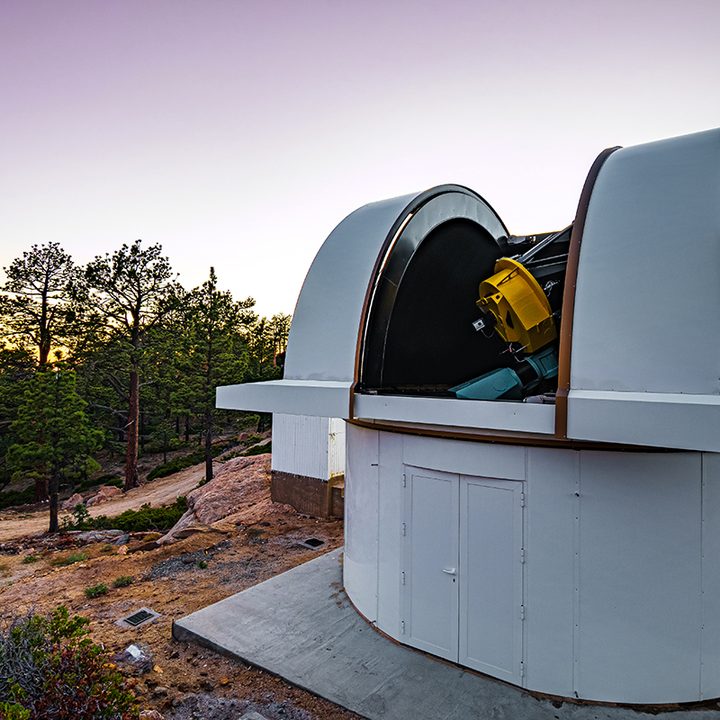
The SAINT-EX telescope.
The SAINT-EX telescope Institute of Astronomy, UNAM / E. Cadena

As red dwarf stars are smaller and cooler than our sun, the habitable zone around them, or the area in which liquid water could exist on the surface of an orbiting planet, is also different. Planets orbiting red dwarf stars could have liquid water even if they orbit much closer than the Earth orbits the sun. And having the planet close to the star also makes it easier to detect.

Recommended Videos

However, even though TOI-2257 b is in the habitable zone, don’t make any plans to move there just yet. The first issue with habitability is that the planet has a radius 2.2 times that of Earth, meaning it is large and likely gaseous with high atmospheric pressure. The second and most intriguing fact about this planet is that it has a highly eccentric orbit, meaning that its orbit traces an elliptical or oval shape rather than a circle. Sometimes the planet is close to its star, and other times it is further away.

In fact, it has the most eccentric orbit of a planet around a cool star discovered to date. And that has a big effect on surface temperatures there.

“We found that TOI-2257 b does not have a circular, concentric orbit,” lead researcher Nicole Schanche explained in a statement. “In terms of potential habitability, this is bad news. While the planet’s average temperature is comfortable, it varies from -80°C to about 100°C depending on where in its orbit the planet is, far from or close to the star.”

The researchers are curious as to why the planet’s orbit is so eccentric, which could be due to a giant planet in the same system affecting this planet’s orbit. To learn more, the researchers hope that the planet could be studied further using the James Webb Space Telescope.

Georgina Torbet
Georgina has been the space writer at Digital Trends space writer for six years, covering human space exploration, planetary…
China’s answer to SpaceX’s reusable rockets literally catches boosters in a net
SpaceX catches boosters on legs. China just used a net.
Ammunition, Missile, Weapon

SpaceX's playbook for recovering a rocket booster generally involves legs, a precisely controlled vertical landing, and either a concrete pad or a drone ship. 

China just managed to pull off something similar, but in a slightly different way, and on July 10, it tested the method as well.

Read more
Dimming the sun sounds unhinged, but this new study on El Niño makes a surprisingly good case for it
A natural test case, Australia's worst-ever wildfire season, suggests the idea deserves serious consideration.
Nature, Outdoors, Sky

When I first saw "scientists propose dimming the sun," I rolled my eyes. It sounds like a science fiction movie cooked up after watching many climate documentaries. But a new study, published on July 8, 2026, in the journal Science Advances, seems to have a genuinely compelling argument.

A Super El Niño is currently forming in the Pacific, feared to be the most intense in decades. It could escalate floods, wildfires, and extreme heat events worldwide. However, Researchers at UC San Diego's Scripps Institution of Oceanography, led by climate scientists Kate Ricke and Jessica Wan, are now proposing one of the most interesting solutions I’ve come across.

Read more
You can now walk through space and gaze into a black hole at this VR exhibit
Smithsonian Starstruck lets you drift past dying stars and see the origin point of the universe for as little as $18 a person.
Smithsonian Starstruck featured

Most planetarium shows ask you to sit still and look up. The Smithsonian's new VR exhibit takes a different approach, letting visitors walk through the vast expanse of the universe, drifting past stars, planets, and a black hole to get a physical sense of its true scale.

A $29 ticket to the edge of the galaxy

Read more