  1. Home
  2. Space
  3. Emerging Tech
  4. Legacy Archives

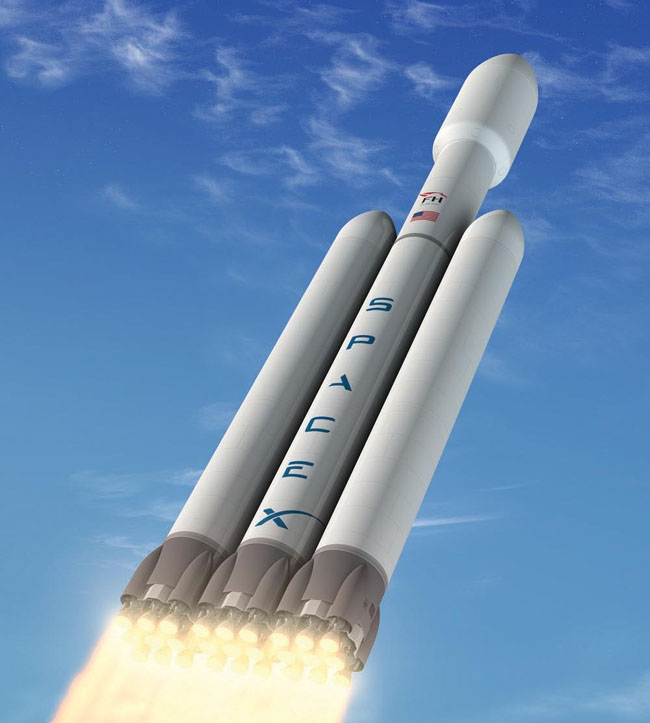
SpaceX breaks ground for Falcon Heavy launch facility

Add as a preferred source on Google
Image used with permission by copyright holder

The NASA Space Shuttle Atlantis is nearing the end of the shuttle program’s final flight, and the United States is betting the next generation of American space flight will come from private commercial enterprises. Although efforts are already underway for private sub-orbital passenger service via Virgin Galactic, Elon Musks’ SpaceX is going in an entirely different direction: the firm has just broken ground at Vandenberg Air Force Base for a launch facility for its Falcon Heavy rocket.

When it’s completed, the Falcon Heavy will be the world’s most powerful rocket since the Saturn V vehicles that took Apollo astronauts to the moon, generating some 3.8 million pounds of thrust from 27 engines. The Falcon Heavy should also be the first vehicle to break the $1,000-per-pound pricing barrier for getting material to orbit—that’s about a tenth the cost of hoisting materials into orbit with the Space Shuttle—and the vehicle itself costs just a third of the price of the Boeing/Lockheed Delta IV Heavy, currently the workhorse of the commercial satellite and Department of Defense launches.

Recommended Videos

SpaceX hopes the Falcon Heavy—alongside the medium-lift Falcon 9—will be the go-to next-generation launch vehicles for everyone from the U.S. Air Force to NASA to the Department of Defense to commercial satellite operations.

“These are difficult fiscal times for our federal government and the Falcon vehicles can save the Department of Defense almost $2 billion per year in launch costs, while increasing reliability and capability,” said SpaceX CEO Elon Musk, in a statement. “This presents a great opportunity for the DoD to avoid canceling other programs and minimize reductions in personnel as budgets contract.”

The first Falcon Heavy is expected to get to Vandenberg by the end of 2012, with its inaugural flight to follow shortly thereafter.

Geoff Duncan
Former Contributor
Geoff Duncan writes, programs, edits, plays music, and delights in making software misbehave. He's probably the only member…
China’s answer to SpaceX’s reusable rockets literally catches boosters in a net
SpaceX catches boosters on legs. China just used a net.
Ammunition, Missile, Weapon

SpaceX's playbook for recovering a rocket booster generally involves legs, a precisely controlled vertical landing, and either a concrete pad or a drone ship. 

China just managed to pull off something similar, but in a slightly different way, and on July 10, it tested the method as well.

Read more
Dimming the sun sounds unhinged, but this new study on El Niño makes a surprisingly good case for it
A natural test case, Australia's worst-ever wildfire season, suggests the idea deserves serious consideration.
Nature, Outdoors, Sky

When I first saw "scientists propose dimming the sun," I rolled my eyes. It sounds like a science fiction movie cooked up after watching many climate documentaries. But a new study, published on July 8, 2026, in the journal Science Advances, seems to have a genuinely compelling argument.

A Super El Niño is currently forming in the Pacific, feared to be the most intense in decades. It could escalate floods, wildfires, and extreme heat events worldwide. However, Researchers at UC San Diego's Scripps Institution of Oceanography, led by climate scientists Kate Ricke and Jessica Wan, are now proposing one of the most interesting solutions I’ve come across.

Read more
You can now walk through space and gaze into a black hole at this VR exhibit
Smithsonian Starstruck lets you drift past dying stars and see the origin point of the universe for as little as $18 a person.
Smithsonian Starstruck featured

Most planetarium shows ask you to sit still and look up. The Smithsonian's new VR exhibit takes a different approach, letting visitors walk through the vast expanse of the universe, drifting past stars, planets, and a black hole to get a physical sense of its true scale.

A $29 ticket to the edge of the galaxy

Read more